Loading author…

author · editor
Ryan Shugars
Collector & Market Data Builder
Ryan Shugars is an avid Pokémon card collector who builds the market-data tooling behind Cardboard Alpha. He collects across multiple eras, tracks population reports and price movement as a matter of habit, and started building Cardboard Alpha to get a straight answer to questions the existing price guides couldn't: what's actually trading, what's just an asking price, and what a grade is really worth on a given card right now. He writes from that same collector's vantage point, close to the data, skeptical of hype, and always checking a claim against the ledger before it goes in an article.
Credentials
- Collecting Pokémon cards for over a decade, across multiple eras and sets
- Builds and maintains the Cardboard Alpha pricing and population dataset
- Reviews every article's market claims against Cardboard Alpha's own live data before publish
Ryan Shugars is a collector and the builder of Cardboard Alpha's data systems, not a licensed financial advisor. Articles he writes or edits describe market history and mechanics; they are informational and are not personalized investment advice.
Articles by Ryan Shugars

Collecting Guides
Japanese vs English Pokemon Cards: Value and Collecting Differences
Japanese cards release weeks or months earlier, come in five-card standard packs and use different rarity names, but they are not reliably cheaper. In eight matched pairs with identical art, three Japanese copies sold for more than their English twins and three sold for less than a third as much. Here is the pair-by-pair read.
7 min read
Grading
Common Pokemon Card Counterfeits and How to Catch Them
CGC has published three separate, dated counterfeit alerts for Pokemon cards in 2026, each naming the specific checkable tells that gave a fake away: card weight, UV-light reaction, holofoil pattern, security stamps, set symbols, and font accuracy. Each alert lists several red flags rather than one. This guide walks through all three cases, the checks each one turned up, and where CGC's own Authentic and Authentic Altered designations do, and don't, apply.
6 min read
Grading
Fake Slabs: How to Spot a Counterfeit PSA or CGC Case
A fake slab is a counterfeit or altered grading-company holder, not a fake raw card. PSA reported intercepting $200 million in projected market value of fraudulent collectibles in 2025, and a federal case shows exactly how a forged-label scheme deceived buyers.
6 min read
Price Guides
Most Valuable Charizard Pokemon Cards: A Price Guide
Charizard's price range runs from a press-reported $1.7 million Japanese Base Set PSA 10, and a $550,000 English 1st Edition on Heritage's own record, down to a $10 modern GX. This guide prices the graded sales, three raw vintage prints, and seven modern chase cards from 2019 through 2025.
6 min read
Grading
How to Spot Fake Pokemon Cards: A Complete Guide
Spotting a fake Pokemon card starts with the light test and knowing what official products look like, both straight from Pokemon Support's own guidance, not a hobbyist trick. This guide adds what CGC's Authentic and Authentic Altered designations actually mean, a documented 2023 Japan arrest that shows which cards counterfeiters target, and the enforcement record behind it.
6 min read
Price Guides
Most Valuable Eevee Pokemon Cards: A Price Guide
By recorded sale, the most valuable Eevee card is a PSA 10 Legendary Collection 74/110 Reverse Holo at $29,999.00 (eBay, March 1, 2026). Raw, Team Up's Eevee & Snorlax GX Secret Rare leads at $496.49 delivered. This guide ranks both and shows where the order flips.
6 min read
Grading
Is PSA Grading Worth It? The Break-Even Math
PSA's orderable per-card grading fees run from $59.99 to $999 for cards declared up to $25,000, as reported in mid-September 2026. A $348 chase card needs about a 17 percent price gain to clear the cheapest tier; a $2.91 Hyper Rare needs a graded sale above 21 times its raw price just to cover that same fee. Here is the math, tier by tier.
6 min read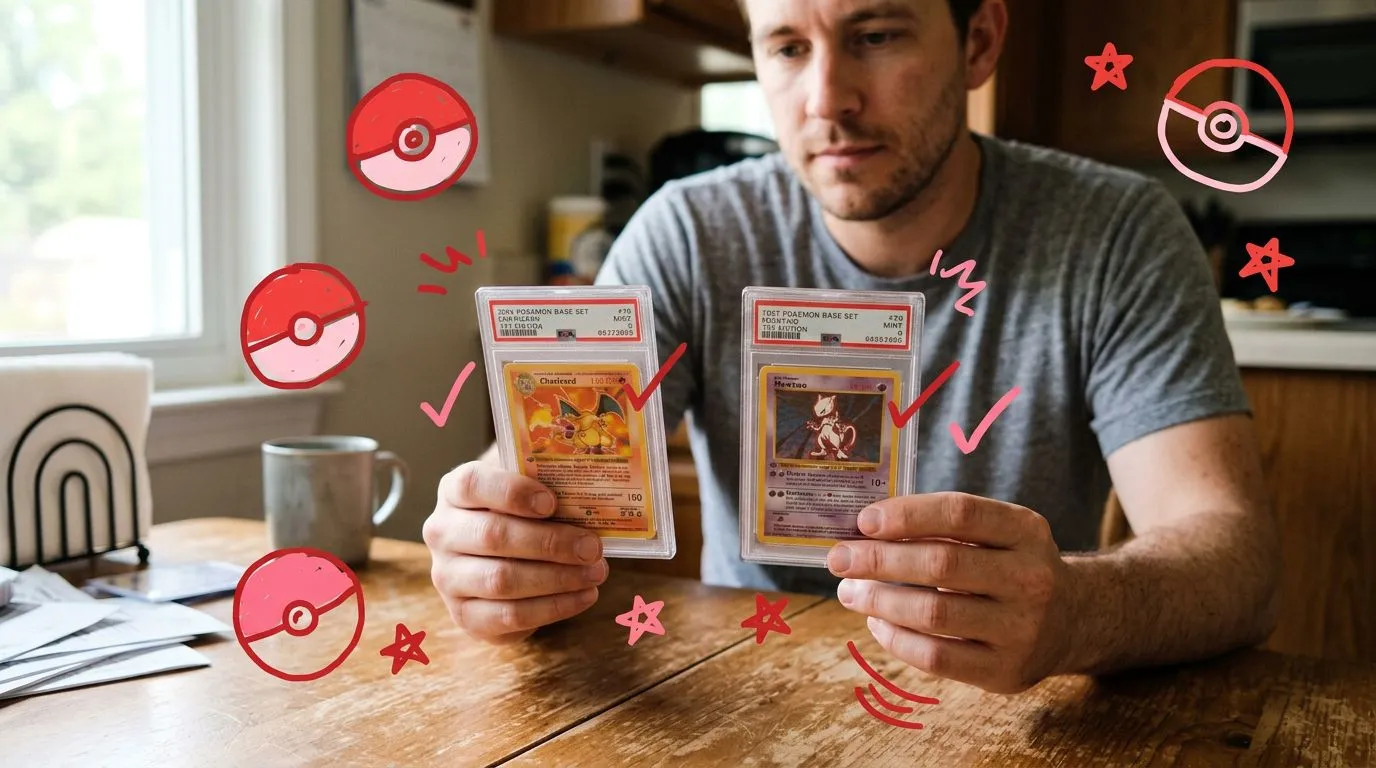
Grading
Pokemon Card Grading Scale Explained: What Each Grade Means
A Pokemon card's grade is a number from 1 to 10 assigned after inspecting centering, corners, edges and surface, but PSA, CGC, BGS and TAG do not all use that number the same way. This guide lines up all four companies' scales side by side, explains what actually separates a 9 from a 10 at each one, and covers the authentication step that has to happen before any number gets assigned.
6 min read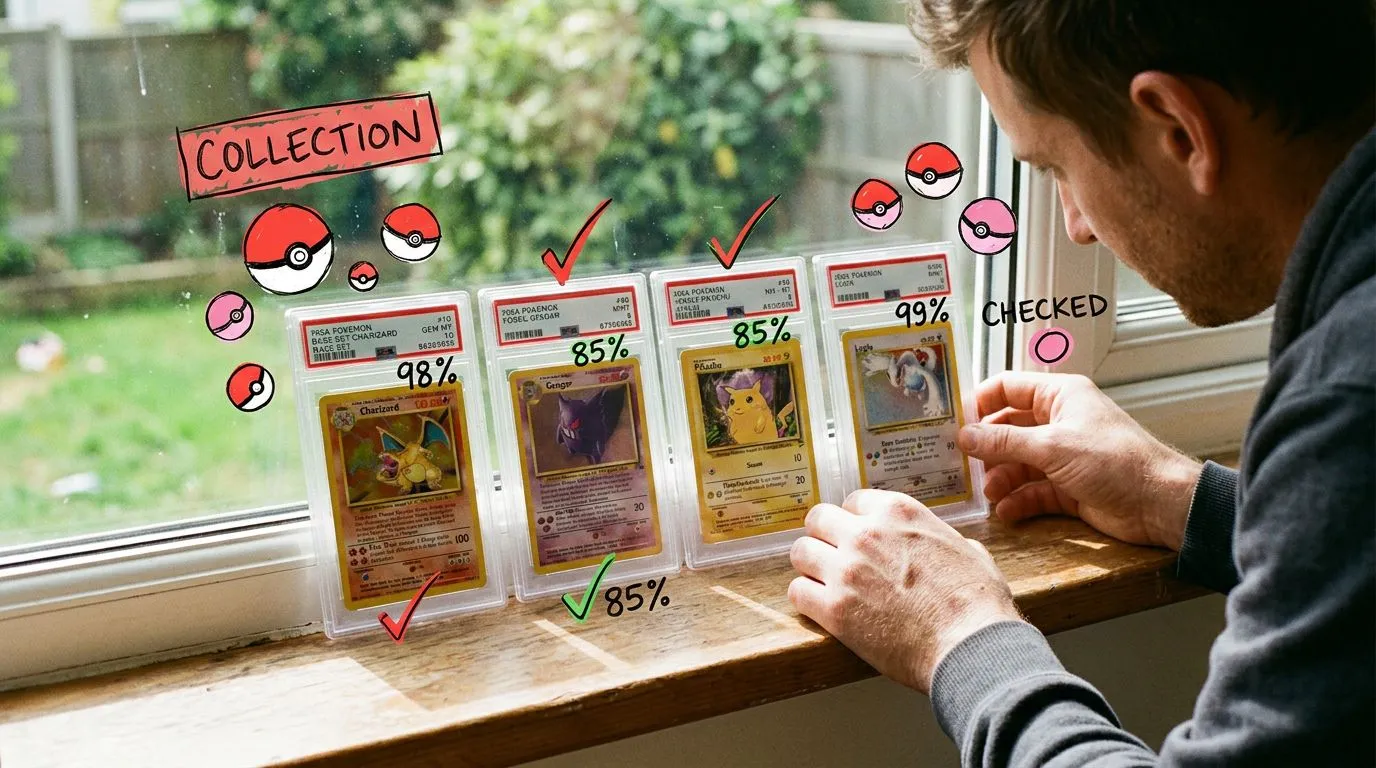
Grading
PSA vs CGC vs BGS vs TAG: Full Grading Company Comparison
PSA, CGC, BGS and TAG do not define a top grade the same way. CGC issues two labels inside one numeric 10, BGS prints separate centering, corners, edges and surface grades on its label, and TAG grades with a multi-patented system on a 1000-point scale with a per-attribute digital report. On September 26, 2026, CGC was running a full six-tier service; on October 24, Express was Beckett's only open tier.
8 min read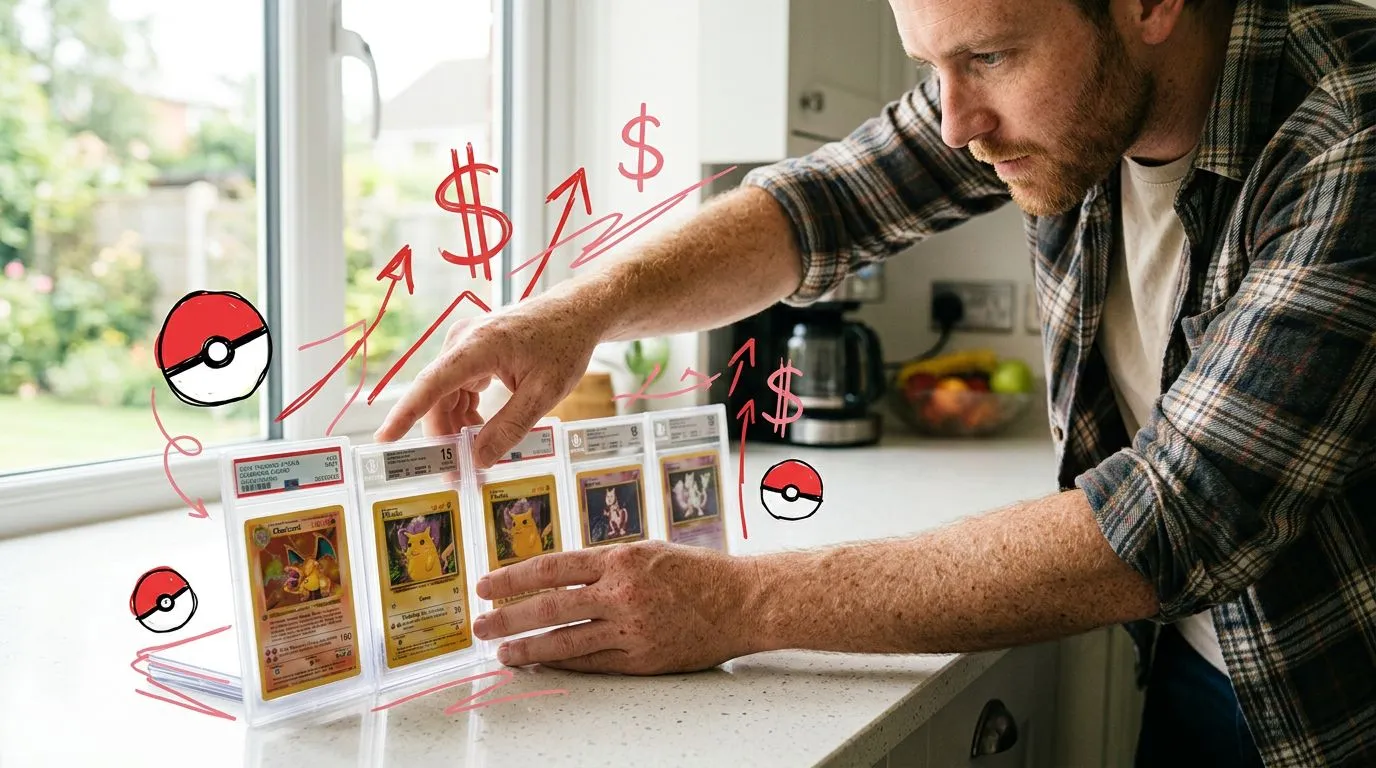
Price Guides
Most Valuable Pikachu Pokemon Cards: A Price Guide
Pikachu Illustrator's PSA 10 sold for $16,492,000 at Goldin Auctions on February 16, 2026. Among English printings, Gold Star Pikachu leads Cardboard Alpha's ledger, ahead of Legend Maker's Pikachu δ, the XY124 Pikachu-EX promo and Generations RC29, each ranked by median PSA 10 sale.
7 min read
Price Guides
Most Valuable Rayquaza Pokemon Cards: A Price Guide
Rayquaza VMAX 218/203, the Evolving Skies alternate art, is the most valuable Rayquaza card on TCGplayer's market, at $1,255.44 as of September 26, 2026. This guide ranks the seven Rayquaza cards priced at $750 or more, shows how much the reverse holo finish moves two 2005 prints, and discloses what it does not price.
4 min read
Sealed & Investing
Booster Box EV Compared: Evolving Skies, 151, and Prismatic Evolutions
Using TCGplayer's own measured pull rates against Cardboard Alpha's live raw-card price ledger (read September 26, 2026), this guide prices the expected raw-card return of a single pack for Evolving Skies, 151 and Prismatic Evolutions, then applies it to the boxed products that carry a publisher pack count in Cardboard Alpha's catalog, since only Evolving Skies has a traditional booster box in that catalog.
8 min read
Selling & Trading
How Marketplace Fees Eat Into Your Pokemon Card Sale
TCGplayer charges a 10.75% commission plus a 2.5% + $0.30 transaction fee. eBay's Trading Cards final value fee runs 13.25% plus a per-order fee. A PayPal goods-and-services payment costs the seller 2.99%. Applied to a $7.89 card and a $347.58 card from the 151 set, the flat components dominate the cheap card and the percentage fees dominate the expensive one.
8 min read
Sealed & Investing
How to Calculate Sealed Booster Box Expected Value
A booster box's expected raw-card value comes from two sourced numbers per rarity tier, its pull rate and its average raw price, divided and summed. Worked on Pokemon TCG: Scarlet & Violet-Surging Sparks using TCGplayer's own measured pull rates and Cardboard Alpha's live price ledger, one pack returns about $2.07 in expected raw-card value and a 36-pack box returns about $74.39, against a live box price of $303.23 as of September 27, 2026.
6 min read
Collecting Guides
How to Start Collecting Pokemon Cards: A Beginner's Guide
A practical starting point for new Pokemon card collectors: how rarity tiers separate a set's everyday cards from its chase cards, which marketplace protections matter above $200, the counterfeit checks worth doing before you pay, and the storage basics to set up on day one.
7 min read
Sealed & Investing
Is Opening Sealed Product Worth It? The EV Math
Pitch Black's distributor trade sheet lists MSRP and pack counts for every configuration but no per-card pull odds; Pitch Black's odds come instead from TCGplayer's July 2026 count of more than 4,000 opened packs. What is sourceable, current market price against pack count and chase-tier value, is read here across two Mega Evolution era sets: Pitch Black against its MSRP, and 30th Celebration's launch-week sales against its market guide.
7 min read
Selling & Trading
TCGplayer vs eBay vs Local Card Shops: Where to Sell Pokemon Cards
TCGplayer's 10.75 percent commission plus its 2.5 percent and $0.30 transaction fee, and eBay's 13.25 percent final value fee for sellers without an eBay Store plus its per-order fee, net almost the same amount on a hypothetical $50 card, per each platform's own fee schedule accessed September 26, 2026. A local shop's buylist trades a lower price, TCGplayer's own guidance to shop owners uses 50 percent of value as a worked example, for instant cash, and eBay adds a PSA authentication step on single cards sold for $200 or more to US buyers.
7 min read
Price Guides
Most Valuable Blastoise Pokemon Cards: A Price Guide
The highest Blastoise sale this guide could document is a $360,000 presentation test print, not a retail card. Among English retail prints, a PSA 10 1st Edition Base Set copy holds the record at $138,880. Raw, a 1st Edition Base Set tops this guide's TCGplayer ranking at $1,300.00, and this guide ranks 21 English prints, every figure dated.
7 min read
Price Guides
Alternate Art and Full Art Pokemon Cards: What Drives Their Premium
Alternate-art and full-art Pokemon card premiums come from three things: the official rarity tier, how scarce that tier is inside the set, and demand for the character. TCGplayer prices read September 26, 2026 show Umbreon's alternate-art printings carrying a larger multiple over their standard versions than Charizard ex's Special Illustration Rare, despite an identical rarity tier.
6 min read
Price Guides
Most Valuable Clefairy Pokemon Cards: A Price Guide
Clefairy's most valuable card is the 1999 Base Set Holo Rare in 1st Edition Shadowless PSA 10, with an $8,000 median across five reported sales. This guide ranks the ten Clefairy printings with the highest PSA 10 medians, with sale counts, ranges and dates.
7 min read
Market Analysis
Is Investing in Pokemon Cards a Good Idea? Risk and Return Basics
Cardboard Alpha's own broad index, POKE150, was down over one day, seven days, 30 days and since its July 2026 base at its last finalized close, while a record-setting single-card sale more than tripled between 2021 and 2026. This guide separates the return side of that from the five risk factors, thin liquidity, no yield, grading uncertainty, auction-versus-fixed-price markets, and fraud, that a price chart alone never shows.
8 min read
Market Analysis
Liquidity Risk in Pokemon Cards: Why Rare Doesn't Mean Easy to Sell
A thin PSA population and a high sticker price both describe scarcity. Neither one tells you how many buyers are actually waiting to pay it, and that gap is where liquidity risk lives.
6 min read
Price Guides
Scarlet & Violet Era Pokemon Cards: A Value Guide
The Scarlet & Violet era ran 16 mainline expansions from March 2023 to July 2025. This guide prices each set's own flagship chase card from TCGplayer market data on a single read, September 26, 2026, ranks them side by side, and shows where the era's value actually sits.
6 min read
Market Analysis
Sealed vs Graded vs Raw: Comparing Investment Vehicles
Raw, graded and sealed Pokemon cards behave like three different investment vehicles, not three prices on one card. Cardboard Alpha's Graded Index, as of September 14, 2026, shows the grading premium over raw compressed in every era group since October 2024, from a 5 percent slide in Classic to a 48 percent slide in Modern. The Sealed Index shows the Modern basket up 52 percent over the past 52 weeks even as its 30-day reading slipped, and the in-print basket down 22 percent since January despite a recent bounce.
7 min read
Market Analysis
Vintage vs Modern Pokemon Cards: Which Outperforms Long Term
Vintage Pokemon cards have outperformed modern Pokemon cards on every multi-year window Cardboard Alpha's own market-series data covers. This guide breaks the return gap down by era bucket through September 17, 2026, grounds the vintage side in dated Heritage Auctions results for the 1st Edition Base Set Charizard, and names what the data does not explain.
6 min read
Market Analysis
Auction vs Buy It Now: How Pokemon Card Market Structure Works
Buy It Now and TCGplayer listings sell at a posted price the moment a buyer accepts it. Auctions resolve only when bidding ends, and a live auction house then adds a buyer's premium on top of the hammer price. Heritage Auctions' $550,000 PSA 10 1st Edition Base Set Charizard, sold December 2025, is a realized price with the buyer's premium already included, not the winning bid itself.
6 min read
Market Analysis
How to Read an Order Book for Pokemon Card Liquidity
A Pokemon card's market shows only one side of a real order book: active, delivered-price listings from cheapest to most expensive. Reading a real 119-seller book from Cardboard Alpha's live ledger on September 26, 2026 shows how to count depth, score concentration with the Herfindahl-Hirschman Index, and see what the ladder can never show: the bid side.
6 min read
Sealed & Investing
Sealed Pokemon Products and Long-Term Value, 2022-2023
Published TCGplayer market data, as reported by ICv2, covers seven sealed products between December 2022 and December 2023. Boxes from Evolving Skies and XY Evolutions rose. Boxes from Obsidian Flames and Paradox Rift fell in the month tracked, and two further products fell during presale months before their release dates. This is a review of what the data shows, grouped by documented release date, not a buying recommendation.
6 min read
Grading
Centering, Surface, Corners, Edges: Four Grading Criteria
PSA, CGC, and BGS each describe a Pokemon card's centering, corners, edges, and surface in their published grade definitions. Here is what each company actually publishes, where their numbers agree, and where they do not.
7 min read
Market Analysis
Why Auction Prices and BIN Floors Tell Different Stories
An auction's winning bid and a TCGplayer or eBay Buy It Now floor are not interchangeable. Auction houses add a buyer's premium on top of the hammer price, a TCGplayer or eBay fixed-price ask carries none, and a vanished listing is never automatically a sale. This piece walks through the mechanics that make the two numbers diverge.
6 min readReviewed by Ryan Shugars
- Bear Markets in Pokemon Cards: What History Shows
- Delta Reign Preview: Illustration Rare Binder Watchlist
- Ascended Heroes Card Values: The Complete Guide
- How to Store Pokemon Cards to Protect Their Value
- 30th Celebration Artwork: Visual Threads and Binder Gems
- How to Build a Master Set: Strategy and Cost
- Should You Insure Pokemon Cards? What Policies Pay
- Delta Reign Artwork: Connected Scenes and Hidden Details
- Shipping Pokemon Cards Safely: Materials and Insurance
- How PSA Grading Works: Submission Tiers, Fees and Turnaround
- 30th Celebration Card Values: The October 2026 Chase Ladder
- How to Tell a Reprint From an Original Vintage Pokemon Card
- Most Valuable Pokemon Cards by Decade: 1990s Through 2020s
- Bulk Pokemon Cards Worth Money: What to Look For
- Affordable 30th Celebration Illustration Rares: Ten Picks
- Holo vs Reverse Holo vs Non-Holo: Value and Condition
- Delta Reign Chase Cards: An English Release Watchlist
- When to Sell: Timing the Pokemon Card Market
- Miscut and Error Pokemon Cards: Are They Worth More
- Grading Japanese Pokemon Cards: What's Different
- Pull Rates Explained: How Pokemon TCG Odds Actually Work
- Prismatic Evolutions Card Values: The Complete Guide
- Near Mint vs Lightly Played: A Raw Card Condition Guide
- What to Do With an Inherited Pokemon Card Collection
- Elite Trainer Box vs Booster Box: Which Has Better EV
- Pokemon Card Rarity Symbols Explained: From Common to Hyper Rare
- Base Set Card Values: The Complete Guide
- How Population Reports Shape Pokemon Card Grading Value
- Most Valuable Mewtwo Pokemon Cards: A Price Guide
- PSA 10 vs PSA 9: How Much Is the Grade Jump Worth
- The Most Expensive Pokemon Cards Ever Sold: A Running Ranking
- 1st Edition vs Unlimited Pokemon Cards: What's the Price Gap
- Expedition Base Set Card Values: The Complete Guide
- Most Valuable Umbreon Pokemon Cards: A Price Guide
- Most Valuable Arceus Pokemon Cards: A Price Guide
- How to Sell Pokemon Cards: Fees, Timing, and Platform Comparison
- Most Valuable Articuno Pokemon Cards: A Price Guide
- Team Magma vs Team Aqua Card Values: The Complete Guide
- Team Rocket Returns Card Values: The Complete Guide
- Most Valuable Celebi Pokemon Cards: A Price Guide
- Base Set Charizard Price Guide by Print Run
- Base Set Shadowless vs Unlimited: Value Differences Explained
- Most Valuable Crobat Pokemon Cards: A Price Guide
- Mega Evolution Era Pokemon Cards: A Value Guide
- Most Valuable Dialga Pokemon Cards: A Price Guide
- Most Valuable Pokemon EX and GX Cards: A Price Guide
- Most Valuable Dragonite Pokemon Cards: A Price Guide
- Sword & Shield Era Pokemon Cards: A Value Guide
- Most Valuable Entei Pokemon Cards: A Price Guide
- WOTC Era Pokemon Cards: A Complete Value Guide
- How Floor Price Is Calculated and Why It Moves
- Delivered Price Explained: Why Shipping Cost Changes the Real Floor
- What Counts as an Inferred Sale vs an Actual Sale
- 151 Card Values: The Complete Guide
- Absorption and Depth: What Happens When You Sell Into a Thin Market
- Gem Mint 10 Odds by Set: Which Sets Grade the Hardest