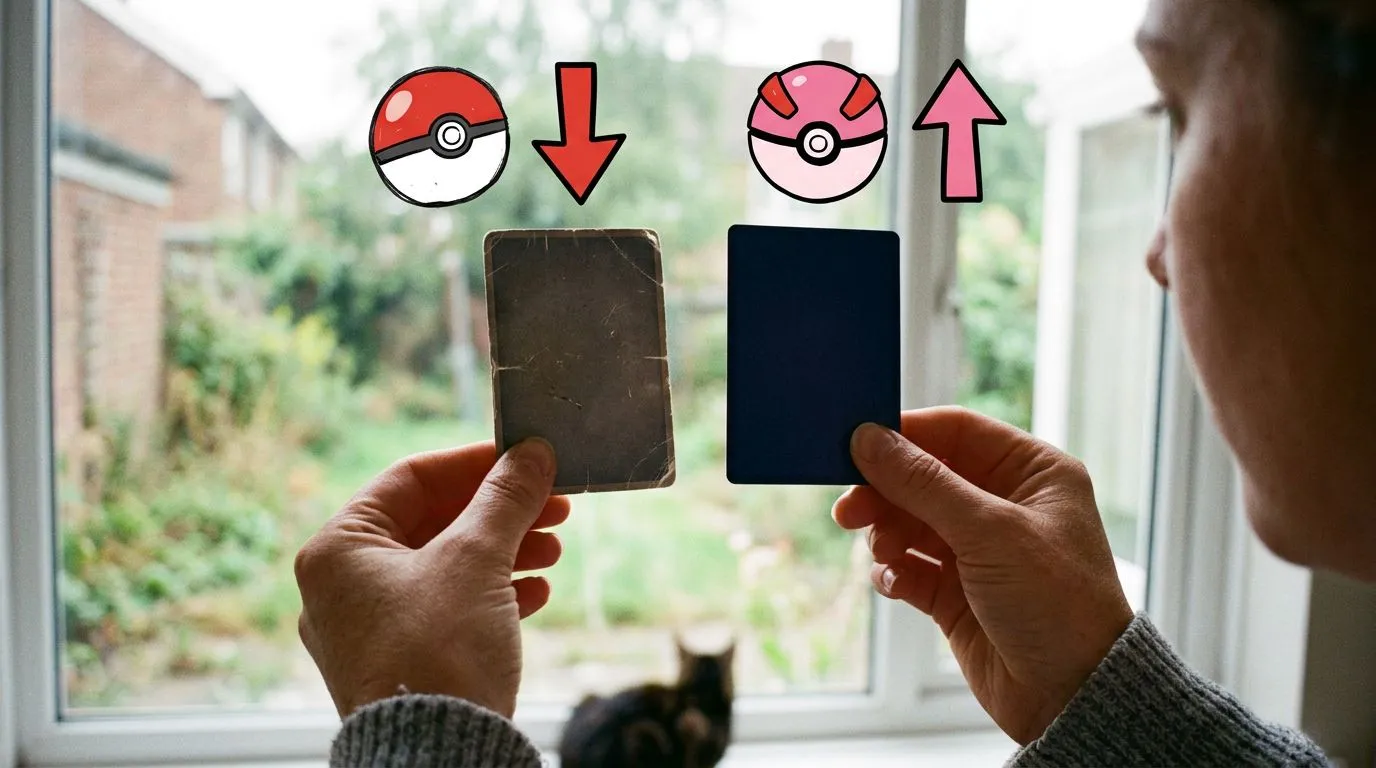
Holo vs Reverse Holo vs Non-Holo: Value and Condition
On October 10, 2026, a Scarlet & Violet reverse holo Common or Uncommon priced a median $0.24 against $0.15 for its non-holo twin, a gap that widens to 14.6 times in the EX era and 91.9 times in Legendary Collection.
A holo card has foil on its art frame only and a reverse holo has foil on every part of the card except the art frame, per TCGplayer; a non-holo card has no foil. The price gap depends on era: on October 10, 2026, Cardboard Alpha's evaluated raw Near Mint price for a Common or Uncommon reverse holo was a median 1.7 times its non-holo twin in Scarlet & Violet, 2.1 times in Sword & Shield and 14.6 times in the EX era.
In Scarlet & Violet the gap is small in dollars, a median $0.24 against $0.15, and it fades where prices rest on recorded sales. On condition, the standards cited here judge every finish by one set of rules, while CGC, Beckett and TCGplayer each name foil-linked flaws such as holo roller lines and metallic print lines.
The three finishes
Finish
Where the foil sits
Where it comes from in a pack
Non-holo
None
Commons, Uncommons and, before Scarlet & Violet, non-holo Rares
Holo
The art frame only
The Rare slot, always foil since Scarlet & Violet
Reverse holo
Everything except the art frame
The reverse holo slot: one per pack since Legendary Collection, two since Scarlet & Violet
TCGplayer's breakdown shows how supply changed. From Sun & Moon through Sword & Shield, a pack held five Commons, three Uncommons, one Reverse Holo (or better), one Rare (or better), a Basic Energy and a code card. Scarlet & Violet cut Commons to four, added a second reverse holo slot and made every Rare foil.
Per Bulbapedia, Legendary Collection (2002) was the first set with reverse holos, and a counterpart usually exists for every card in a set except Ultra Rares, Secret Rares and full arts. Two sibling guides cover which rarity symbol marks which slot and the odds per slot.
Reverse holo vs non-holo by era
Cardboard Alpha's evaluated raw Near Mint prices for October 10, 2026 cover 8,865 English Commons and Uncommons that have both a non-holo and a standard reverse holo print, across 115 sets. Promo sets, subsets, stamped, jumbo and pattern-foil prints are left out, as are carried-forward prices.
Era
Cards
Non-holo
Reverse holo
Median ratio
Legendary Collection
66
$1.49
$120.08
91.9x
e-Card sets
279
$12.04
$53.36
4.1x
EX
948
$1.30
$23.40
14.6x
Diamond & Pearl
830
$0.60
$4.86
6.0x
HeartGold & SoulSilver
288
$0.70
$7.13
7.7x
Black & White
589
$0.39
$1.50
3.6x
XY
910
$0.27
$0.70
2.7x
Sun & Moon
1,238
$0.26
$0.49
2.2x
Sword & Shield
1,422
$0.14
$0.28
2.1x
Scarlet & Violet
1,875
$0.15
$0.24
1.7x
Mega Evolution
420
$0.13
$0.25
1.9x
Price columns are medians; the ratio is the median of each card's own reverse holo price divided by its non-holo price. The e-Card sets are Expedition Base Set, Aquapolis and Skyridge.
In every era the reverse holo is the higher-priced print for at least 90 percent of cards; in Scarlet & Violet that is 1,755 of 1,875. The multiple narrows from 14.6 in the EX era to 1.7 in Scarlet & Violet, the first era with two reverse holo slots, but these prices cannot separate pack design from the age of a set.
Reverse holo price as a multiple of the non-holo price, by era
e-Card sets4.1x
EX14.6x
Diamond & Pearl6x
HeartGold & SoulSilver7.7x
Black & White3.6x
XY2.7x
Sun & Moon2.2x
Sword & Shield2.1x
Scarlet & Violet1.7x
Mega Evolution1.9x
Median ratio, Commons and Uncommons, raw Near Mint. Legendary Collection (91.9x) is off the scale. Cardboard Alpha evaluated prices, October 10, 2026.
How solid these prices are
Most of the numbers behind that table are quotes, not trades. Of its 17,730 prices, 93.3 percent are guide-only values (a quoted market-guide price rather than a recorded sale), 4.4 percent are anchored on active asking prices and 2.3 percent draw on at least one recorded sale.
Where both prices in a pair rest on recorded sales, which only the newest eras allow in any number, the premium shrinks or reverses:
Scarlet & Violet: 51 pairs, median ratio 0.94, with the reverse holo higher in 23, lower in 27 and tied in one.
Mega Evolution: 30 pairs, median ratio 0.62, with the reverse holo higher in 8.
Sword & Shield: 11 pairs, median ratio 1.25, with the reverse holo higher in 9.
Cards that trade often enough to be priced from sales are a different slice from the bulk majority, so these cuts qualify the table rather than replace it.
Reverse holo vs holo by era
Holo Rares come in both finishes, and there the order depends on era. On October 10, 2026, 1,537 cards had both a holo and a standard reverse holo price; 80.0 percent of those prices are guide-only and 15.1 percent are anchored on active asks.
Era
Cards
Holo
Reverse holo
Median ratio
Reverse higher
Legendary Collection
17
$78.24
$419.50
4.94x
16
e-Card sets
33
$159.44
$90.00
0.63x
4
EX
181
$43.12
$49.98
1.22x
108
Diamond & Pearl
164
$23.64
$18.11
0.73x
43
HeartGold & SoulSilver
69
$22.75
$23.02
0.88x
21
Black & White
104
$4.39
$5.57
1.22x
71
XY
142
$2.19
$2.30
1.16x
98
Sun & Moon
225
$1.31
$1.45
1.12x
150
Sword & Shield
261
$0.33
$0.42
1.25x
221
Scarlet & Violet
283
$0.20
$0.27
1.35x
199
Mega Evolution
58
$0.20
$0.26
1.31x
45
By the median ratio, the holo is the pricier print only in the e-Card sets, Diamond & Pearl and HeartGold & SoulSilver. In Scarlet & Violet the reverse holo is higher in 199 of 283 cases, with 60 tied, and the 25 pairs priced from recorded sales agree at a median 1.41.
The Legendary Collection exception
Per Bulbapedia, Legendary Collection made a reverse holo of every card in the set and put one in each pack, with a few exceptions. On October 10, 2026, 17 of its 19 Holo Rares had fresh prices for both prints, at a median $78.24 as holos and $419.50 as reverse holos, and the reverse holo was higher for 16.
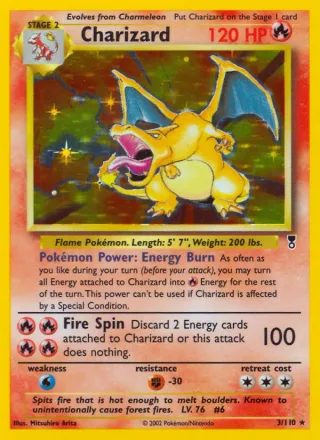
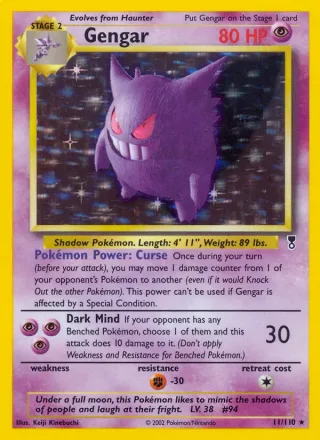
Charizard 3/110 priced $899.99 as a holo and $1,399.31 as a reverse holo, 1.55 times as much. Gengar 11/110 priced $289.99 and $2,224.99, 7.7 times as much.
Holo $289.99, reverse holo $2,224.99 (7.7 times), raw Near Mint, Cardboard Alpha, October 10, 2026. Both guide-only.
Even its Commons and Uncommons show it, at a median $1.49 non-holo against $120.08 reverse holo across 66 cards. Every Legendary Collection price here is guide-only or ask-anchored, and the sources cited give no reason for the gap.
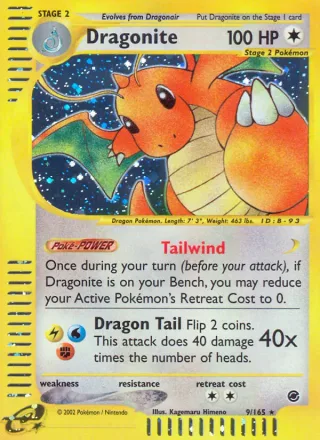
Expedition Base Set, released in September 2002, runs the other way: the holo was higher in 29 of the 33 e-Card pairs, all on guide-only or ask-anchored prices, as with Dragonite 9/165 at $949.79 against $599.75 for the reverse holo, 0.63 times. Bulbapedia records one quirk of that set: it printed identical reverse holo counterparts for its holo and non-holo rares, which Wizards of the Coast changed in Aquapolis and Skyridge. Expedition's card-by-card values price its Holo Rares in both finishes.
Holo $949.79, reverse holo $599.75 (0.63 times), raw Near Mint, Cardboard Alpha, October 10, 2026. Both guide-only.
Modern examples and patterned foils
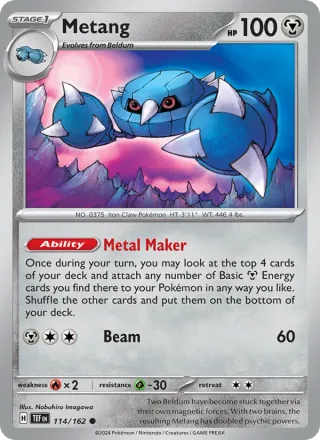
Two cards priced from same-day sales on October 10, 2026 show both directions. In 151, Gengar 094/165's holo priced $2.74 from 14 sales and its reverse holo $9.04 from five, 3.3 times as much. In Temporal Forces, Metang 114/162's non-holo priced $5.14 from five sales against $4.37 for its reverse holo from seven.
Non-holo $5.14 (5 same-day sales), reverse holo $4.37 (7), raw Near Mint, Cardboard Alpha, October 10, 2026.
Newer sets add patterned reverse holos, which Cardboard Alpha's catalog lists as separate prints and the tables above leave out. Prismatic Evolutions, Black Bolt and White Flare carry both Poké Ball and Master Ball foils. In Prismatic Evolutions, the Master Ball print of a card priced at a median 27.9 times its standard reverse holo (67 cards), and the Poké Ball print at 1.7 times (100 cards).
Foil and condition standards
The standards cited here judge a card's surface by one set of rules, whatever its finish. Because the foil sits in different places, it follows, though none of these standards says so, that any foil-linked flaw does too: the art frame on a holo, the rest of the face on a reverse holo, and nowhere on a non-holo.
TCGplayer (raw conditions): a scratch is a hairline mark that does not reveal material beneath the surface; one up to 20mm is allowable in every condition, while one over 40mm caps a card at Moderately Played. Roller lines, speckled foil and gloss errors are production defects judged by size: up to 2.5mm² is allowed at Near Mint, and anything larger, up to 5mm², caps a card at Lightly Played. TCGplayer says roller lines can fall outside its measurements and be evaluated differently.
CGC (graded): in a July 2020 explainer, CGC said it grades with "the severity and prevalence of a production defect" in mind, and named holo roller lines on earlier Pokemon cards as a defect judged by severity.
Beckett (graded): its Pristine 10 surface must be "devoid of scratches and metallic print lines".
PSA (graded): a Gem Mint 10 needs "full original gloss", yet "an allowance may be made for a slight printing imperfection". PSA lists scratch removal and enhanced gloss as altered stock, one reason it returns a card without a numeric grade.
Side by side, the graders word printing flaws differently, from PSA's allowance at a 10 to Beckett's exclusion of metallic print lines at Pristine. How points add up is in the Near Mint vs Lightly Played guide, and the four grading criteria cover surface.
Cardboard Alpha cannot yet say whether foil widens the Near Mint to Lightly Played discount: at most 84 cards in any era have fresh prices at both conditions in both finishes.
What these figures cover
Every figure here is a single dated read of raw, English cards, not a graded price or a forecast. Cardboard Alpha's card screener tracks fair value, liquidity and supply going forward.
Frequently asked questions
Is a reverse holo worth more than a regular Pokemon card?
Usually, but by an amount that depends on the era. On October 10, 2026, Cardboard Alpha's evaluated raw Near Mint prices put the reverse holo above the non-holo for 1,755 of 1,875 Scarlet & Violet Commons and Uncommons, at a median $0.24 against $0.15. In the EX era the medians were $23.40 against $1.30, though 93.3 percent of the prices behind the all-era comparison are guide-only quotes rather than recorded sales.
Is a reverse holo worth more than a holo?
It depends on the era. On October 10, 2026, a card's reverse holo priced at a median 1.35 times its holo across 283 Scarlet & Violet cards with both prints, but at 0.73 times across 164 Diamond & Pearl cards and 0.63 times across 33 e-Card pairs. Legendary Collection is the outlier at 4.94 times across 17 Holo Rares with fresh prices on both prints, all guide-only or ask-anchored.
How many reverse holos are in a Pokemon booster pack?
Bulbapedia records one reverse holo per pack since Legendary Collection in 2002, raised to two in Scarlet & Violet. TCGplayer's breakdown of a Scarlet & Violet pack lists one reverse holo, a second slot that holds a reverse holo or a higher rarity, and a Rare that is always foil. From Sun & Moon through Sword & Shield it lists a single Reverse Holo (or better) slot.
Do reverse holos grade differently from holos?
The PSA and Beckett pages cited here set one grading scale for every card, with no separate scale for foil finishes. Their wording on printing flaws differs: PSA's Gem Mint 10 allows 'a slight printing imperfection', while Beckett's Pristine 10 surface must be 'devoid of scratches and metallic print lines'. CGC said in July 2020 that it weighs the severity and prevalence of production defects, naming holo roller lines on earlier Pokemon cards.
Why are Legendary Collection reverse holos worth so much more than the holos?
The sources cited here give no reason. Bulbapedia records that Legendary Collection was the first set with reverse holos and made one for every card, with one in each pack. Cardboard Alpha's October 10, 2026 prices put the median reverse holo of 17 of its Holo Rares at $419.50 against $78.24 for the holo, all on guide-only or ask-anchored prices.
Are Master Ball reverse holos worth more than a normal reverse holo?
In Prismatic Evolutions on October 10, 2026, Cardboard Alpha's raw Near Mint prices put the Master Ball print of a card at a median 27.9 times its standard reverse holo across 67 cards, and the Poké Ball print at 1.7 times across 100 cards. Black Bolt and White Flare list the same two patterns in the catalog. The Master Ball prices mix guide quotes, asking prices and recorded sales.
Sources
How Pokémon Booster Packs Are Changing in Scarlet & Violet, TCGplayer Official / primary source · accessed October 23, 2026
Holofoil, Bulbapedia Industry press · accessed October 23, 2026
Jay Montalbo writes about grading and selling for Cardboard Alpha. His background is in information technology, with nearly six years as an IT systems administrator and later work as an IT support analyst, and he brings the same troubleshooting habit to cards: break the problem into steps, check each one, and trust the answer only when every step holds. His articles work through when a grading submission pays for itself, how condition and grading-company standards move a card's value, and what a sale actually nets after marketplace fees and shipping, using published population reports, fee schedules, and completed-sale data. Every source is cited inline, and each piece is fact-checked against those sources before it is published.
Jay Montalbo's articles describe grading and selling mechanics using published population, fee, and pricing data. They are informational and are not personalized investment advice.
Market Analysis
Vintage vs Modern Pokemon Cards: Which Outperforms Long Term
Vintage Pokemon cards have outperformed modern Pokemon cards on every multi-year window Cardboard Alpha's own market-series data covers. This guide breaks the return gap down by era bucket through September 17, 2026, grounds the vintage side in dated Heritage Auctions results for the 1st Edition Base Set Charizard, and names what the data does not explain.