Should You Insure Pokemon Cards? What Policies Pay
The Texas Department of Insurance says a standard policy may leave collectibles out, cap what it pays on items such as coins, or pay only to replace a card with a similar one, so the check is the policy's limits against a dated inventory. On October 19, 2026, the 10 highest-priced cards held a median of about 63 percent of a set's one-of-each value across 38 English sets.
Whether a Pokemon card collection needs its own insurance comes down to one gap: what the cards would cost to replace against what a homeowners or renters policy would pay. The Texas Department of Insurance (TDI) says a standard policy may leave collectibles out, cap what it pays on items such as coins, or pay only to replace a card with a similar one, so the check is the policy's limits and valuation wording against a dated inventory.
Value also sits in a few cards. Across 38 English sets on October 19, 2026, Cardboard Alpha's evaluated prices put a median of about 63 percent of a set's one-of-each value, one raw Near Mint copy of every card, in its 10 highest-priced cards.
This is general information, not advice on which policy to buy.
What a standard policy covers
The National Association of Insurance Commissioners (NAIC) says personal property coverage reimburses the value of possessions even away from home, such as in a storage locker, but only for losses from a covered cause. It gives 50 percent of the dwelling limit as the typical contents limit and says to check the policy, because percentages can differ.
Causes of loss: the NAIC describes the popular special form as covering all perils except those it names, with flood and earthquake commonly excluded, and the renters' tenants form as covering personal property against the broad-form perils. It adds that homeowners policies do not cover flood.
Deductible: the NAIC says it is paid out of pocket on each claim before the policy pays, and its examples are $500 and $1,000.
Special limits: a 2013 consumer guide from the New York State Department of Financial Services (NYDFS) lists typical examples of $200 for money, $1,500 for securities and for theft of jewelry, and $2,500 for theft of silverware or guns, each typically the most paid for that category in one loss.
Where collectibles fall short
None of the regulators cited here gives a dollar limit for trading cards, but they single out collections.
Caps and exclusions: TDI says some home and renters policies do not cover collectibles at all, or cap what they pay for certain items. Its example is a $500 coin limit that pays at most $500 on a $5,000 coin, with the deductible still owed.
Replacement wording: TDI says a policy pays to replace a damaged or stolen item with a similar one, so it might pay $1 for a Pokemon card rather than the value of a rare card worth $2,000.
Separate cover: NYDFS lists coin, stamp and sports card collections among property to consider insuring separately, by endorsement or a floater policy.
Cards named: State Farm's Maine homeowners form HW-2119 (a 2017 form; the Maine Bureau of Insurance's copy carries a May 2023 data-call stamp) sets a $2,500 special limit on stamps, trading cards and comic books, collections included, as the total for each loss. Its renters form, H4-2119, carries the same limit.
Cards held for sale: property used for a business typically gets its own limit. NYDFS's examples are $2,500 on the premises and $500 away, and State Farm's form lists $1,500 and $750 and names merchandise held for sale, though its definition of business excludes incidental and infrequent activity such as a hobby.
The State Farm form is one insurer's wording in one state, and forms differ: NYDFS's jewelry-theft example is $1,500, while the same State Farm form lists $1,000.
Actual cash, replacement and agreed value
How a loss is valued can matter as much as the limit. The sources describe four bases.
Actual cash value: replacement cost minus depreciation. NYDFS says contents are usually insured this way unless an endorsement is bought, and that insurers may use different depreciation formulas.
Replacement cost: an endorsement that pays to replace contents without a deduction for depreciation, which NYDFS says generally costs more.
Market value: for articles whose age or history add substantially to their value, State Farm's form pays what a willing buyer and seller would agree on an open market at the time of loss, capped at the smallest of replacement cost, repair cost, the special limit or the contents limit. The clause names memorabilia, souvenirs and collectors items, not trading cards.
Agreed value: American Collectors Insurance (ACI) says its collectibles coverage insures a collection for collector value, not depreciated replacement cost, so the insured amount is known at the time of loss.
Actual cash value turns on age and wear, and none of these sources says how an adjuster would apply it to a trading card. That is a question for the insurer, in writing.
Riders and collector policies
A scheduled personal property endorsement, which the NAIC also calls a personal article floater, covers items such as jewelry, furs, stamps, coins, guns, computers and antiques whose value might exceed the normal limits. TDI says to look for a company that specializes in collectibles if your own insurer does not sell the coverage.
TDI adds that extra coverage might pay for damage a typical policy will not, such as breakage, and that its deductibles are usually lower. Two collector insurers describe their own Pokemon products differently.
Topic
ACI
Collectibles Insurance Services (CIS)
Valuation
Agreed value
Market value, for losses over $50
Proof asked
Detailed inventory with estimated values; an adjuster may assess it
Your own inventory; no schedule or appraisal for most items, but items or sets of $25,000 or more are scheduled
Mysterious disappearance
Covered for items worth $2,000 and scheduled on the policy
Listed as an exclusion
Away from home
Not described on its page
Transit coverage, subject to a sublimit, and coverage at scheduled shows
Each insurer's own Pokemon page: product descriptions, not policy forms, and neither gives a premium for a card collection. CIS words its scheduling threshold as over $25,000 in one place and $25,000 or more in another. Naming an insurer is not a recommendation; terms vary by state and policy.
Records to keep for a claim
An inventory: the NAIC says to go room by room, write down and photograph or video everything including collectibles, keep a copy at another location, update it yearly and keep receipts. Photographing and listing an inherited collection starts the same way, with dated photographs.
Proof after a loss: State Farm's form asks for an inventory of damaged or stolen property showing quantity, description, age, replacement cost and amount of loss, with bills and receipts, and a sworn proof of loss within 60 days.
Appraisals: TDI says to use receipts or a professional appraisal to size coverage, to repeat appraisals to see whether values rose or fell, and to keep appraisals, receipts and pictures somewhere safe.
Disputes: the NAIC says that if you and the insurer disagree on a claim's value, check the policy for an appraisal clause.
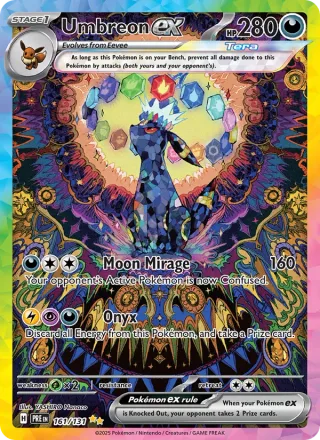
For a card, a line that can be priced later names the set, number, finish and condition or grade, because a price belongs to one printing and one condition or grade. On October 19, 2026, Cardboard Alpha's evaluated prices for Umbreon ex 161/131 in Prismatic Evolutions were $1,149.99 raw Near Mint, $1,300.00 for PSA 9 and $5,300.00 for PSA 10, the PSA 10 figure being 4.6 times the raw one.
The two graded figures are 90-day medians of recorded sale prices, before shipping, last refreshed October 15 and 16 and carried to October 19. The raw figure blends the best asking price with the prior evaluation, because no sale was recorded that day.
161 · Prismatic Evolutions · Special illustration rare
Raw Near Mint $1,149.99, PSA 9 $1,300.00, PSA 10 $5,300.00, Cardboard Alpha evaluated prices, October 19, 2026.
Where a set's value sits
Cardboard Alpha's evaluated price is a once-a-day estimate built from completed sales, asking prices and published market-guide prices, not an appraisal, and an insurer values a claim under its own wording. The table sums one raw Near Mint copy of each card in a set for the five largest totals on October 19, 2026, plus the range across 38 English sets released from February 2020 to July 2026.
Cardboard Alpha evaluated prices, policy evp-1.0.0, FINAL, October 19, 2026: raw Near Mint, English, standard size, with stamped, jumbo and pattern-foil (Poke Ball, Master Ball) versions excluded, each card number counted once at its highest-priced finish, and galleries and vaults counted with their set. Top 10 share is the 10 highest prices as a share of the total, and cards for half is how many of the highest-priced cards it takes to reach half of it.
Promo, energy, McDonald's, My First Battle, Celebrations and 30th Celebration sets are not included. In Evolving Skies, none of the 10 highest-priced cards had a recorded sale that day, and each blends the best asking price with the prior evaluation.
Half of a set's value sat in 5 or fewer cards in 19 of the 38 sets, and in 10 or fewer in 31. Cards under $1.00 made up a median 68 percent of a set's cards and held a median 3.7 percent of its value, and most of those were priced from a published market guide, not a sale. Of 7,706 cards, 90 were priced at $100 or more, 11 at $500 or more and 3 at $1,000 or more.
A set is a proxy, not a typical collection: the figures describe catalog prices, not what any collector owns. For scale, one copy of every card in 16 of the 38 sets totaled under $1,000, a deductible size the NAIC uses as an example.
A category total can bind quickly when a collection holds a few top cards. On that date the two highest-priced Evolving Skies cards, Umbreon VMAX 215/203 at $2,044.00 and Rayquaza VMAX 218/203 at $1,138.43, totaled $3,182.43 raw Near Mint, more than a $2,500 category total such as State Farm's, and one PSA 10 Umbreon ex 161/131 at $5,300.00 was more than twice that $2,500 total.
Does homeowners or renters insurance cover Pokemon cards?
Generally as personal property, for losses from a cause the policy covers, but with limits. The NAIC says coverage follows possessions away from home, TDI says some policies do not cover collectibles at all or cap what they pay on certain items, and State Farm's Maine homeowners form sets a $2,500 total for stamps, trading cards and comic books in one loss. The policy's own limits and valuation wording decide.
What is a scheduled personal property endorsement?
The NAIC describes it, or a personal article floater, as coverage for jewelry, furs, stamps, coins, guns, computers, antiques and other items whose value might exceed a homeowners policy's normal limits. NYDFS names coin, stamp and sports card collections among property to consider insuring this way or with a separate policy. TDI says to use receipts or a professional appraisal to decide how much coverage to buy.
What is the difference between actual cash value and agreed value?
Actual cash value is replacement cost minus depreciation, and NYDFS says contents are usually insured that way, with no set formula for depreciation. Replacement cost pays to replace an item without that deduction. American Collectors Insurance says its agreed value coverage insures a collection for collector value rather than depreciated replacement cost, so the insured amount is known at the time of loss.
What records do insurers ask for on a card collection?
State Farm's Maine form asks for an inventory of damaged or stolen property with quantity, description, age, replacement cost and amount of loss, plus bills and receipts. The NAIC advises photos or video, receipts, a copy stored away from home and a yearly update. Collectibles Insurance Services says it needs no appraisal for most items but expects you to keep your own inventory, and American Collectors Insurance says you will typically provide a detailed inventory with estimated values.
Are cards covered in the mail or at a grader?
It depends on the policy and the carrier. The NAIC says personal property is covered away from home, such as in a storage locker, and Collectibles Insurance Services describes transit coverage that is subject to a sublimit. Carrier insurance and a grader's insured-value caps follow their own terms, covered in the shipping and PSA guides.
How much is a typical Pokemon card collection worth?
No source cited here measures what collectors own. As a scale, one raw Near Mint copy of every card in a set ranged from $288.61 to $7,371.25 across 38 English sets on October 19, 2026, and 16 of the 38 totaled under $1,000. Cards under $1.00 held a median 3.7 percent of a set's value, so a few chase cards or graded copies can outweigh the rest.
Janelle Sazon writes collecting guides and best-card roundups for Cardboard Alpha, with an eye on what makes a Pokémon card worth chasing: the artwork, the rarity tier, the condition it survives in, and what it really costs to own once the hype is set aside. Articles under this byline are written for collectors at every level, lean on published pricing and population data rather than speculation, cite every source inline, and are fact-checked against those sources before they are published.
Janelle Sazon's articles describe the collecting market using published pricing and population data. They are informational and are not personalized investment advice.