What to Do With an Inherited Pokemon Card Collection
Change nothing first, then record, protect, sort and price the cards from sold listings: on October 1, 2026, 51.6 percent of 33,644 standard English Pokemon prints were under $1, while the 4.0 percent at $100 or more made up 63.7 percent of combined value.
With an inherited Pokémon card collection, do nothing irreversible first. Leave the cards uncleaned, untaped and unsold while you record what is there, protect it, sort it into bulk, maybes, and graded or sealed, and price the maybes from recent sold listings. Grading, selling or keeping comes last.
The sorting is worth the effort because value is lopsided. On October 1, 2026, Cardboard Alpha had a raw Near Mint price for 33,644 standard English Pokémon prints: 51.6 percent were under $1, while the 4.0 percent priced at $100 or more made up 63.7 percent of what one copy of each would cost.
The nine steps in order
Pause. Clean, press, tape, mark or sell nothing yet.
Record. Photograph everything and list what you find, with the date.
Protect. Sleeve loose cards and keep them cool, dry and out of attics.
Sort. Make three piles: bulk, maybes, and graded or sealed.
Identify. Note each maybe's set, number, finish, edition and language.
Price. Use recent sold prices for the card's actual condition.
Decide. Grade, sell or keep, but only after pricing.
Sell. Match each pile to a channel and compare fees.
Keep records. Save dated values for the tax basis question.
Where the value sits
The table covers every standard English Pokémon print with a raw Near Mint price in Cardboard Alpha's evaluated prices on October 1, 2026. A print is one card in one finish, so a common printed in regular and reverse holo counts twice.
Combined value adds up one copy of every print; shares are rounded. Left out: jumbo, stamped, 1st Edition, Shadowless and other named-variant prints, pattern-foil prints, and 72 Wizards-era prints priced identically to their 1st Edition twins.
The median print was 87 cents. Each print counts once here, so the table describes the catalog, not any particular box: TCGplayer notes that packs hold many lower-rarity cards and few higher ones, so a pile of opened packs would skew cheaper.
Most of these prices are not sales. Of the 33,644 prices, 73.7 percent are quoted guide values, 11.8 percent blend an active asking price with the previous price, 10.8 percent draw on at least one recorded sale and 3.6 percent are carried forward; under $1, 93.4 percent are guide values. Among the 3,646 sale-backed prices the shape holds: the $100 and up slice was 3.3 percent of prints and 46.7 percent of combined value.
Steps 1 to 3: Pause, record, protect
Three steps come before any sorting, and each guards value that cannot be put back.
Do not clean, press or repair. PSA's grading standards return a card with no numeric grade, and still charge the fee, for evidence of cleaning (a whitener on borders, a solution on stains, a spray or wax on the surface), altered stock such as pressed creases and removed scratches, or restored paper stock.
Do not write or stamp. PSA marks writing, ink or pencil, and even the impression left by writing, with an MK qualifier, and TCGplayer lists cards altered with stamps, signatures, paint or marker as Damaged.
Avoid tape, rubber bands and clips. NARA's list of materials to avoid when storing family papers includes pressure-sensitive tape, non-stainless steel staples and paper clips, and it pictures a rubber band stuck to a photograph. That guidance covers papers and photographs, not cards, so treat it as a precaution.
Record before anything moves. Photograph the lot where it was found, then log each maybe with a date. If the estate is not settled, ask the executor before selling anything.
Store it cool and dry. Put loose cards in sleeves and the sleeves in a box. NARA's family-papers guidance calls for temperatures below 75°F and relative humidity below 65 percent, and says to keep items out of damp basements, garages and hot attics. It also asks for containers big enough that items lie flat or upright without bending, and not overstuffed.
Step 4: Sort into three piles
Sorting takes three reads per card: the rarity symbol, the number and the age of the set. TCGplayer's rarity guide says a circle marks a Common, a diamond an Uncommon and a star a Rare or better, with the symbol at the bottom left or right beside the collector number; what each rarity symbol and number tells you goes tier by tier.
The same guide warns that rarity alone does not set value, since an old common such as Base Set Pikachu can outprice a recent Ultra Rare, but calls it the first step when sorting. The October 1, 2026 prices show how the cues line up.
What the card shows
Prints
Median
Under $1
$20 or more
A number with letters, such as SWSH001 or TG05
1,600
$10.93
4.3%
36.8%
A number above the set total, such as 107/105
1,979
$9.99
2.0%
31.4%
Rare or higher, numbered within the total
9,645
$2.76
34.1%
23.7%
Circle or diamond, set released before April 2011
5,827
$4.13
23.9%
22.3%
Circle or diamond, set released April 2011 or later
13,763
$0.26
89.2%
0.4%
Raw Near Mint prices for the same prints, minus 127 prints from two sets with no printed total in the catalog and 703 promo or no-rarity prints numbered within a total.
Only 1.5 percent of the older circle and diamond prices rest on a recorded sale, so that row says where to look, not what a card sells for.
Bulk: circles and diamonds from sets released since April 2011, and repeats of cheap cards. Count them instead of pricing them.
Maybes: any star or foil art box, any number with letters or above the set total, any black star marked PROMO, any 1st Edition stamp, and anything from an older set or one you cannot date yet.
A card's name says little; its exact print sets the price. Record five details for every maybe.
Set: match the symbol against Cardboard Alpha's set symbol reference, which lists tracked sets by name or release year. If a card prints no symbol, search it by name and number over total.
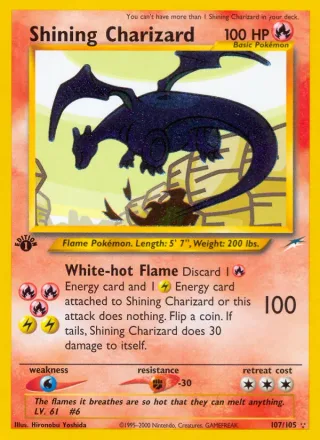
Number: the collector number reads number over total, and a number above the total marks a secret rare, as with Neo Destiny's Shining Charizard at 107/105.
Finish: on black-star cards printed before 2023, foil on the art box alone marks a Holo Rare, while foil on everything except the art box marks a reverse holo.
Edition: look for a 1st Edition stamp on early cards. Cardboard Alpha's catalog prices 1st Edition and Shadowless prints separately from regular ones, and how to tell 1st Edition from Unlimited shows the difference.
Language: TCGplayer says language is not part of condition but changes how a card can be listed. Every price in this guide is for an English card.
Price what cards sold for, not what sellers ask. TCGplayer's Market Price is compiled from recent sales completed on TCGplayer.com, while its Listed Median covers asking prices only and, TCGplayer warns, can differ widely from what buyers pay.
The gap is especially wide on older cards with few copies listed, because copies priced near the market sell and leave the dearer listings behind.
Then price the condition you actually hold. TCGplayer sorts raw cards into five conditions and counts wear from play, handling and storage: Near Mint can show a nearly unmarked surface, crisp corners and unblemished edges outside a few slight flaws, while Heavily Played shows a major amount of wear, with creasing, whitening and other faults.
Base Set Zapdos shows the spread, and like every catalog card it has its own Cardboard Alpha page. On October 1, 2026, Cardboard Alpha's evaluated prices for the Unlimited holo print were $44.51 in Near Mint, $34.78 in Lightly Played, $16.11 in Moderately Played and $13.60 in Heavily Played, each blending two or three recorded sales from that day with recent sales and the best ask.
Unlimited holo print. Raw Near Mint $44.51 and Heavily Played $13.60 (Cardboard Alpha, October 1, 2026).
That Heavily Played copy priced at about 31 percent of Near Mint, so treat every Near Mint figure above as a ceiling for a worn card, not an estimate of it.
Steps 7 and 8: Grade, sell or keep
Grading comes after pricing, one card at a time. The fee has to be covered by the graded price, which the break-even math on a grading fee works through, and PSA will not give a cleaned or pressed card a numeric grade.
Selling splits by pile. What each channel adds to the timeline covers singles, bulk stacks, graded slabs and sealed product, with each channel's fees and extra steps.
A single offer for a whole box is one number for cards nobody has priced one by one, so a list of your priced maybes gives you something to compare it with. Keeping some or all of the collection is an equally valid ending.
Step 9: The tax basis note
IRS Publication 551, Basis of Assets (December 2025), states: "Generally, the basis of property inherited from a decedent is one of the following." The first two items are "The FMV of the property at the date of the individual's death" and "The FMV on the alternate valuation date if the personal representative for the estate chooses to use alternate valuation." The list continues, and the publication sets out exceptions.
FMV is fair market value, which the publication defines as "the price at which property would change hands between a buyer and a seller, neither having to buy or sell, and both having reasonable knowledge of all necessary facts." It adds: "Sales of similar property on or about the same date may be helpful in figuring the property's FMV."
Basis is what you use "to figure gain or loss on the sale or other disposition of property," and the publication says: "You must keep accurate records of all items that affect the basis of property so you can make these computations." The dated photographs and list from step 2 are a starting point for that record.
This describes a published rule and is not tax advice. Which value applies to a given estate, and what is owed on a sale, is a question for the executor and a tax professional; the tax guide to buying and selling Pokémon cards covers gains, holding periods and the collectibles rate.
Every price here is one dated read from October 1, 2026. Cardboard Alpha's screener tracks fair value, liquidity and supply across the covered catalog.
Frequently asked questions
Are my old Pokémon cards worth anything?
Some are, but most individual cards are worth little. On October 1, 2026, 51.6 percent of 33,644 standard English prints were priced under $1 and 4.0 percent at $100 or more, though most of those prices are quoted guide values rather than sales. Sort by rarity symbol, number and set age, then check sold prices for the cards in the maybes pile.
Should I clean old Pokémon cards before selling them?
No. PSA's grading standards return a card without a numeric grade for evidence of cleaning, such as a whitener on borders or a solution used on stains, and TCGplayer treats marker, paint, stamps and signatures as Damaged. Photograph the card as it is and describe its condition honestly.
Do I owe tax on inherited Pokémon cards?
That depends on the estate and on whether and when you sell, so ask a tax professional. IRS Publication 551 (December 2025) says the basis of property inherited from a decedent is generally its fair market value at the date of death, or on the alternate valuation date if the estate's personal representative chooses it, and basis is what a later gain or loss is measured from. People often call this a stepped-up basis, a phrase the publication does not use.
Should I sell an inherited collection to one buyer?
A buyer who takes the whole lot is pricing cards that nobody has valued one by one. Build your own list of the maybes with sold prices first, so you have a number to compare the offer with. How each selling channel trades fees against speed is covered in Cardboard Alpha's selling guides.
How should I store inherited Pokémon cards until I decide?
Keep them in sleeves, inside a box that is not overstuffed, somewhere cool and dry. The National Archives' guidance for family papers calls for temperatures below 75°F and relative humidity below 65 percent and says to keep items out of damp basements, garages and hot attics. Its list of materials to avoid includes pressure-sensitive tape, non-stainless steel staples and paper clips, and it pictures a rubber band stuck to a photograph.
Janelle Sazon writes collecting guides and best-card roundups for Cardboard Alpha, with an eye on what makes a Pokémon card worth chasing: the artwork, the rarity tier, the condition it survives in, and what it really costs to own once the hype is set aside. Articles under this byline are written for collectors at every level, lean on published pricing and population data rather than speculation, cite every source inline, and are fact-checked against those sources before they are published.
Janelle Sazon's articles describe the collecting market using published pricing and population data. They are informational and are not personalized investment advice.
Collecting Guides
Miscut and Error Pokemon Cards: Are They Worth More
Most miscut and error Pokemon cards are not worth more than a clean copy, because graders treat slight miscuts and print flaws as condition, which mostly lowers the grade. A small set of documented errors and variants is the exception: a Near Mint Shadowless Red Cheeks Pikachu was $109.95 on TCGplayer on October 7, 2026, against $45.66 for the yellow-cheek print.