Pull Rates Explained: How Pokemon TCG Odds Actually Work
The Pokemon Company does not publish pull rates for English booster packs, so every rate comes from opened samples. TCGplayer's 8,500-pack Chaos Rising study puts the set's Mega Hyper Rare at 1 in 956, which, modeling packs as independent draws, is about a 3.7 percent chance per 36-pack box.
The Pokemon Company International does not publish pull rates for English Pokemon TCG booster packs. Its official product pages describe what is in the box, not the odds: the Chaos Rising expansion page lists pack counts and cards per pack, then notes that "Cards vary by pack." Every pull rate in circulation is measured from opened packs, not declared.
TCGplayer's Authentication Center counted more than 8,500 Chaos Rising packs (published June 4, 2026) and measured the set's single Mega Hyper Rare at 1 in 956. That is an average, not a promise: if packs are independent draws, a 36-pack booster box carries about a 3.7 percent chance at the card, and even 956 packs reach only about 63 percent.
Where pull-rate numbers come from
That Chaos Rising page specifies the pack (10 cards, 1 Basic Energy and 1 Pokemon TCG Live code card) and the products (36 packs in the Booster Display, 9 in the Elite Trainer Box), but gives no odds.
Prismatic Evolutions' page goes only as far as adjectives: its Poké Ball and Master Ball foils "might be difficult to find, as the Poké Ball is rare, and the Master Ball is even rarer."
The numbers come from opened samples. TCGplayer's Authentication Center opens packs around new releases and publishes per-pack rates with 95 percent confidence intervals, including these four:
Ascended Heroes: 2,000-plus packs, published February 24, 2026.
Chaos Rising: 8,500-plus packs, published June 4, 2026.
TCGplayer's specific-card odds assume an equal population of every card at a rarity; every specific-card figure below inherits that. Without a counted sample there is no rate at all, and sealed EV math stalls without one.
Reading a pull-rate table
A pull-rate table answers two questions: how often a pack holds any card of a rarity, and how often one specific card. The second is the first divided by the number of cards at that rarity.
Rarity
Cards
Any card, per pack (95% CI)
Any card
One specific card
Double Rare
10
20.30% ± 0.85%
1 in 5
1 in 49
Illustration Rare
11
10.66% ± 0.65%
1 in 9
1 in 103
Ultra Rare
18
8.29% ± 0.58%
1 in 12
1 in 217
Special Illustration Rare
6
1.21% ± 0.23%
1 in 83
1 in 496
Mega Hyper Rare
1
0.10% ± 0.07%
1 in 956
1 in 956
TCGplayer Authentication Center, 8,500-plus Chaos Rising packs, June 4, 2026. Per-pack rates.
Six Special Illustration Rares share a 1.21 percent rate, so any one, such as the Mega Greninja ex SIR, comes out near 0.20 percent, or 1 in 496. The lone Mega Hyper Rare's rarity rate and card rate are the same.
Sample size and confidence intervals
Every measured rate carries a margin. Chaos Rising's 1.21% ± 0.23% means the true Special Illustration Rare rate plausibly sits between 0.98 and 1.44 percent, roughly 1 in 69 to 1 in 102 packs. That margin narrows as the sample grows:
Set
Packs opened
SIR rate (95% CI)
Plausible range
Prismatic Evolutions
1,200+
2.22% ± 0.81%
1 in 33 to 1 in 71
Ascended Heroes
2,000+
1.44% ± 0.50%
1 in 52 to 1 in 106
Phantasmal Flames
5,000+
1.25% ± 0.31%
1 in 64 to 1 in 106
Chaos Rising
8,500+
1.21% ± 0.23%
1 in 69 to 1 in 102
TCGplayer intervals; ranges are 1 divided by each end of the interval.
The rarest tiers matter most: at 1 in 956, about 8,500 packs would hold only about nine Mega Hyper Rares, so Chaos Rising's 0.10% ± 0.07% spans roughly 1 in 588 to 1 in 3,333 packs. Phantasmal Flames' Mega Hyper Rare measured 0.08% ± 0.08%, an interval that reaches zero.
TCGplayer agrees: Chaos Rising's Mega Hyper Rare looked easier to find than those in Phantasmal Flames and Perfect Order, a gap it called "not statistically significant." A top-tier "1 in X" is a best estimate with wide error bars.
Per-pack odds versus a booster box
Every TCGplayer rate is per pack; the studies say they represent "your odds per pack (not e.g. 'per box')." The official pages promise no box-level distribution either.
If every pack were an independent draw at 1 in 83, a 36-pack Chaos Rising booster box would average about 0.43 Special Illustration Rares, and about 65 percent of boxes would contain none. A 9-pack Elite Trainer Box would come up empty about 90 percent of the time.
No source here measures whether real boxes are packed that way or collated to spread hits, so box-level figures are a model, not a description of real boxes.
The odds of one specific chase card
If packs are independent, the chance of at least one copy in n packs is 1 − (1 − p)^n, where p is the card's per-pack rate: the chance of missing every pack, subtracted from 1. For the Mega Charizard X ex Special Illustration Rare, put at 1 in 400 Phantasmal Flames packs, over one box:
Per-pack rate: p = 1 ÷ 400 = 0.0025.
Miss one pack: 1 − 0.0025 = 0.9975.
Miss all 36 packs: 0.9975^36 = 0.9138.
Hit at least once: 1 − 0.9138 = 0.0862, about 8.6 percent.
On that model the last column holds for every card: opening exactly X packs gives about a 63 percent chance, not 100. "1 in X" is a long-run average, not a countdown.
The Mega Greninja ex Mega Hyper Rare shows the spread. On the same model, half of collectors chasing it would have one within about 662 packs, but a 90 percent chance takes about 2,200 packs, roughly 61 booster boxes. The 956 average sits between the two because a minority of very long droughts pull it up.
Mega Hyper Rare, 1 in 956 packs (TCGplayer, June 4, 2026). Cardboard Alpha evaluated raw NM price $132.03 as of October 5, 2026.
Packs also have no memory on that model: a pack opened after 500 misses has the same 1 in 956 chance as the first, so a dry streak never makes the next one "due."
God packs and special slots
Some sets break the pattern the formula assumes. In Prismatic Evolutions, TCGplayer found a Poké Ball foil in 33.10% ± 2.60% of packs and a Master Ball foil in 4.92% ± 1.19%; with 67 Master Ball cards sharing that rate, any specific one came out near 1 in 1,362.
The set also has multi-hit packs. Citing collectors' posted pulls, TCGplayer reports "demigod packs" holding three Special Illustration Rares and "god packs" holding a Master Ball Eevee, the Eevee ex SIR and one of each Eeveelution SIR. It opened no god packs and suspects, but cannot confirm, two demigod packs in its sample.
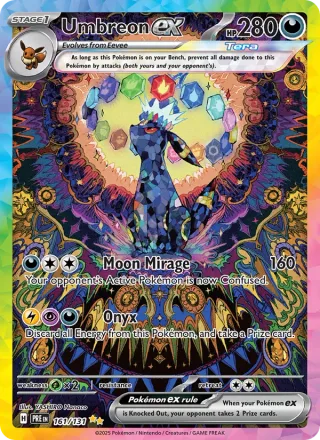
That changes what the 1 in 45 SIR rate means: TCGplayer calls it a ratio of SIRs to packs and says the share of packs holding at least one is likely lower. The Umbreon ex Special Illustration Rare, put at 1 in 1,440, carries the same caveat.
161 · Prismatic Evolutions · Special illustration rare
SIR, 1 in 1,440 packs (TCGplayer, January 17, 2025), a rate demigod and god packs can skew. Cardboard Alpha evaluated raw NM price $1,252.81 as of October 5, 2026.
Ascended Heroes added the Mega Attack Rare (1 in 29), which takes an Ultra Rare's place rather than adding a hit. TCGplayer reports god packs there holding three Mega Attack Rares and seven Special Illustration Rares, found none in 2,000-plus packs, and says its rates do not reflect them. A specific SIR such as Mega Gengar ex works out to 1 in 1,533.
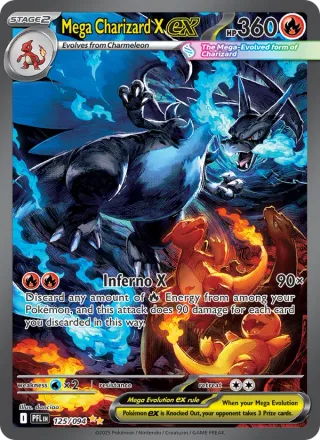
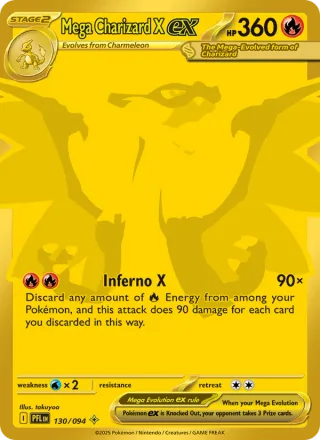
In Phantasmal Flames, the Mega Charizard X ex Special Illustration Rare, at 1 in 400 and $654.97, adds about $1.64 to every pack, roughly 14 percent of a Phantasmal Flames booster pack's $11.96 market guide value on October 5, 2026. The rarer Mega Hyper Rare version, at 1 in 1,260 and $210.97, adds about $0.17.
Mega Hyper Rare, 1 in 1,260 packs (TCGplayer, November 15, 2025). Cardboard Alpha evaluated raw NM price $210.97 as of October 5, 2026.
Chaos Rising isolates the rarity effect. Its two Mega Greninja ex chase cards price almost identically, $134.74 for the Special Illustration Rare and $132.03 for the Mega Hyper Rare, but at 1 in 496 and 1 in 956 they add about $0.27 and $0.14 per pack.
SIR, 1 in 496 packs (TCGplayer, June 4, 2026). Cardboard Alpha evaluated raw NM price $134.74 as of October 5, 2026.
The error bars carry through too: across the Mega Hyper Rare's 0.03 to 0.17 percent interval, its contribution runs from about $0.04 to $0.22.
Chasing one card is also a different purchase from buying it. At an average of 956 packs per copy, the Mega Hyper Rare implies about $5,650 of packs at the $5.91 Chaos Rising booster pack market guide value, against $132.03 for the single.
A pull rate measures what comes out of packs, not the market, and nothing here forecasts a price. Pulling a card is also only the first probability: how often a pulled card actually grades a 10 varies widely by set.
Does The Pokemon Company publish official pull rates?
Not for English booster packs. Its official expansion pages list pack contents and how many packs each product holds; the Chaos Rising page says only that "Cards vary by pack," and the Prismatic Evolutions page calls the Master Ball foil "even rarer" than the Poké Ball foil without giving a number. Published rates come from measured samples such as TCGplayer's Authentication Center studies.
What does 1 in 83 packs actually mean?
It is a long-run average from a measured sample, not a guarantee. TCGplayer put Chaos Rising's Special Illustration Rares at 1 in 83 packs; if packs are independent draws, a 36-pack box gives about a 35 percent chance of at least one, and opening 83 packs gives about 63 percent.
How many packs does it take to pull one specific card?
Use 1 − (1 − p)^n, where p is the card's per-pack rate. For the Mega Charizard X ex Special Illustration Rare from Phantasmal Flames, at 1 in 400, that is about 8.6 percent per 36-pack box, about an even chance by roughly 277 packs, and a 90 percent chance only after about 920 packs, assuming independent packs.
Are god packs counted in published pull rates?
Not in the two studies this article uses. TCGplayer opened no god packs in its Prismatic Evolutions or Ascended Heroes samples and says its Ascended Heroes rates do not reflect them. For Prismatic Evolutions, it says suspected demigod packs make its 1 in 45 Special Illustration Rare figure a ratio of cards to packs, so the share of packs with at least one is likely lower.
Does a booster box guarantee a Special Illustration Rare?
Nothing The Pokemon Company publishes promises one, and TCGplayer reports odds per pack, not per box. If every pack were an independent draw at TCGplayer's 1 in 83 rate, about 65 percent of 36-pack Chaos Rising boxes would hold no Special Illustration Rare. Whether real boxes are collated to spread hits differently has not been measured by any source cited here.
Brandon Valdez writes market analysis and sealed-product coverage for Cardboard Alpha, and comes to the Pokémon TCG market from a decade in financial planning and analysis. Brandon spent those years building budgets, forecasts, and financial models for Las Vegas hospitality and nightlife groups, rising from senior financial analyst to FP&A manager before moving into premium and VIP services leadership, and reads the card market the same way: what actually sold, what it cost delivered, and whether a sealed product's expected value survives the math. Market narrative stays separate from the numbers behind it, every source is cited inline, and each piece is fact-checked against those sources before it is published.
Brandon Valdez is a finance professional, not a licensed financial advisor. Articles under this byline describe market history and mechanics using published pricing and population data; they are informational and are not personalized investment advice.
Sealed & Investing
Booster Box EV Compared: Evolving Skies, 151, and Prismatic Evolutions
Using TCGplayer's own measured pull rates against Cardboard Alpha's live raw-card price ledger (read September 26, 2026), this guide prices the expected raw-card return of a single pack for Evolving Skies, 151 and Prismatic Evolutions, then applies it to the boxed products that carry a publisher pack count in Cardboard Alpha's catalog, since only Evolving Skies has a traditional booster box in that catalog.