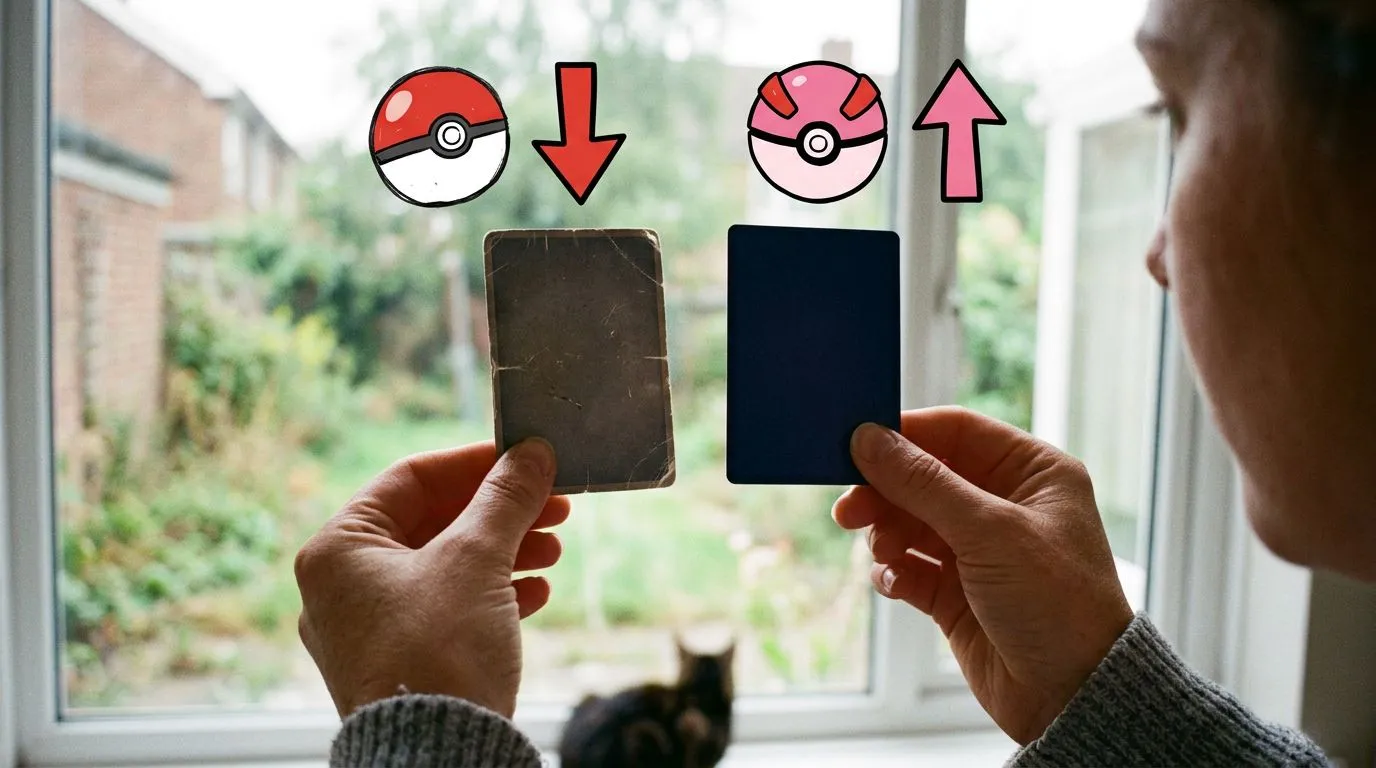
Vintage vs Modern Pokemon Cards: Which Outperforms Long Term
Cardboard Alpha's own composite data puts raw WOTC-era vintage cards up 97.30% from a January 2021 base while raw Sword & Shield, Scarlet & Violet and Mega Evolution era modern cards are down 33.75% from a February 2021 base, both through September 17, 2026.
Vintage Pokemon cards have outperformed modern Pokemon cards on every multi-year window Cardboard Alpha's own market data covers. Through September 17, 2026, the VINTAGE composite of raw, near-mint WOTC-era singles gained 97.30% from its January 1, 2021 inception, while the MODERN composite of raw, near-mint Sword & Shield, Scarlet & Violet and Mega Evolution era singles lost 33.75% from its own February 1, 2021 base, per Cardboard Alpha's own equal-weighted market-series data. Measured from that same February 1, 2021 start, VINTAGE was up 117.28%.
The gap holds at every checkpoint sampled here. Across every window of one year or longer in the series, the VINTAGE composite finished ahead of MODERN. Modern did turn positive on the shorter reads, up 16.70% over roughly three years and 19.60% over the trailing year, but vintage led both.
The card most collectors already picture is a fair anchor for the vintage side of that gap.
Cardboard Alpha groups every priced raw, near-mint, English single into one of four era buckets, plus an era-agnostic ALL composite, then builds an equal-weighted composite for each. Each day's move is the geometric mean of every qualifying card's own daily price move, with each card's daily log return clamped at plus or minus 0.5 (roughly a 39% fall or a 65% rise in price terms) before it enters the average. No card is weighted by price or trading volume.
VINTAGE covers the WOTC era, base date January 1, 2021. CLASSIC covers the EX, Diamond & Pearl and HeartGold & SoulSilver eras. MID covers Black & White, XY and Sun & Moon. MODERN covers Sword & Shield, Scarlet & Violet and the new Mega Evolution era. ALL is every priced raw single, era-agnostic. ALL shares VINTAGE's January 1, 2021 base date; CLASSIC, MID and MODERN share a February 1, 2021 base date, one month later.
The pricing basis itself changes partway through the window. Every reading before February 8, 2024 comes from a monthly ungraded guide price. Every reading from that date forward comes from daily TCGplayer market-guide data. No single day's move is chained across that seam, but it does mean the 2021 and 2023 checkpoints below are monthly reads, not daily closes, while the 2025 and 2026 checkpoints are daily.
WOTC ran from Base Set's January 9, 1999 release through Skyridge's release in May 2003. The three eras that make up MODERN begin with SWSH Black Star Promos dated November 15, 2019 and the Sword & Shield set's February 7, 2020 release, and run through the Mega Evolution era, which opened with the Mega Evolution set on September 26, 2025.
One more distinction matters before the numbers: these are broad, equal-weighted raw-card composites built for this comparison. They are not Cardboard Alpha's published POKE50, POKE150 or POKE250 benchmark indices, and they carry no graded-population data of any kind.
The full return scoreboard by era
Figures below are total returns to 2026-09-17, per Cardboard Alpha's own composite data. Since-inception returns run from each bucket's own base date: January 1, 2021 for VINTAGE and ALL, February 1, 2021 for the other three.
Era bucket
Since inception
About 5 years (from 2021-09-01)
About 3 years (from 2023-09-01)
Trailing 1 year (from 2025-09-17)
VINTAGE (WOTC)
+97.30%
+178.95%
+172.46%
+75.92%
CLASSIC (EX / DP / HGSS)
+160.60%
+210.40%
+172.42%
+90.11%
MID (BW / XY / SM)
+123.77%
+138.78%
+124.97%
+49.91%
MODERN (SWSH / SV / MEGA)
-33.75%
-16.25%
+16.70%
+19.60%
ALL (every priced raw single)
+60.71%
+93.19%
+89.04%
+46.67%
Total return since inception by era bucket, through 2026-09-17
The framing in this guide's title is really a two-bucket slice of a wider pattern. CLASSIC and MID both beat VINTAGE on the since-inception read, and MODERN is the only one of the five buckets sitting in negative territory over that full window.
The trailing-year column tells a different story. Every bucket was positive over the most recent twelve months, MODERN included, though MODERN's 19.60% gain was the smallest of the five. The depth and length of past declines are covered for the same composites.
Vintage at the top: Charizard auction records
Dated auction results for one specific card show what sits at the top of the vintage market, and why headlines about it can run far ahead of the composite above.
January 2021: Heritage Auctions sold a PSA GEM-MT 10 1st Edition Base Set Charizard for $300,000, then Heritage's own record for the card, per Antique Trader's report on Heritage's results.
March 4-5, 2022: The same grade and print sold for $336,000 at a Heritage Trading Card Games Signature Auction, on 69 bids against a pre-auction estimate of $200,000-plus.
December 12-13, 2025: Heritage sold another PSA 10 1st Edition Charizard for $550,000, one of 125 copies of the card certified PSA 10 at the time, inside a $5,279,820 Trading Card Games auction that Heritage described as the all-time high total for a trading card games auction, per Intelligent Collector, Heritage's own trade-press outlet.
Each of those is a single top-graded copy changing hands at auction, not a market-wide price. Heritage put the PSA 10 population for this card at 125 at the time of the December 2025 sale. Cardboard Alpha's VINTAGE composite tracks raw, ungraded cards, so none of these three graded sales are inputs to the 97.30% figure above; they explain collector attention on vintage, not the composite's math.
Modern chase cards vs the basket
A falling MODERN composite does not mean every modern card is losing value. On September 17, 2026 the MODERN composite averaged 13,706 priced singles, each weighted equally, so a chase card counts for no more than a bulk common and can move very differently from the basket average.
A Special Illustration Rare from the SV era, inside Cardboard Alpha's MODERN composite bucket. Current price and depth are visible on its own card page.
That mirrors the vintage side: a small number of cards can draw outsized demand, and a broad equal-weighted average does not show it.
What the data doesn't explain
Nothing in Cardboard Alpha's source pack for this comparison explains why MODERN specifically lagged while CLASSIC and MID, both of which sit between vintage and modern in age, rallied harder than VINTAGE itself on the since-inception read. That could plausibly connect to reprint volume, print-run size, or grading population, but no Tier-1 source in this research cycle measures any of those factors for these specific buckets, and no PSA population figure was obtained for this comparison. Rather than guess, this gap is stated here and left open.
Limits of this comparison
It is history, not a forecast. A multi-year composite return describes what already happened. It is not a projection, and no era bucket, card or grade is being rated as a good or bad holding.
It is not one card's performance. Composite moves reflect the whole basket in that era bucket. An individual card, including either Charizard shown above, can move very differently from its bucket.
Graded and raw are different markets. The composites above are raw-card only. The Heritage auction prices are PSA 10 graded results. Neither substitutes for the other.
Part of the window is monthly, not daily. The 2021 and 2023 checkpoints in the table come from a monthly pricing basis; only the 2025 and 2026 checkpoints are daily reads.
Have vintage Pokemon cards outperformed modern Pokemon cards?
Yes, on every multi-year window Cardboard Alpha's own composite data covers. Raw, near-mint WOTC-era cards (VINTAGE) gained 97.30% from inception through September 17, 2026, while raw Sword & Shield, Scarlet & Violet and Mega Evolution era cards (MODERN) lost 33.75% from its own February 2021 base. The gap held on roughly five-year and roughly three-year reads too.
Does the falling MODERN composite mean modern Pokemon cards are a bad investment?
Not necessarily, and this is history, not a forecast. The MODERN composite actually rose 19.60% in the most recent twelve months, alongside every other era bucket. A multi-year composite decline describes a broad raw-card basket's past behavior; it does not rate any single card or grade, and it is not a guarantee about what happens next.
What counts as vintage, classic, mid and modern in this comparison?
VINTAGE is the WOTC era (1999 to 2003). CLASSIC covers the EX, Diamond & Pearl and HeartGold & SoulSilver eras. MID covers Black & White, XY and Sun & Moon. MODERN covers Sword & Shield, Scarlet & Violet and the new Mega Evolution era. All four are Cardboard Alpha's own equal-weighted composite buckets of raw, near-mint, English singles, not official Pokemon TCG terminology.
Are the big Charizard auction prices typical of vintage card values?
No. The $300,000 (January 2021), $336,000 (March 2022) and $550,000 (December 2025) Heritage Auctions results are each a single top-graded PSA 10 1st Edition copy changing hands, not a market-wide price. Heritage put that card's PSA 10 population at 125 at the time of the December 2025 sale. Cardboard Alpha's VINTAGE composite tracks raw, ungraded cards and does not include any of these graded auction sales.
Why isn't PSA population data included in this comparison?
No Tier-1 PSA population figure was obtained for this comparison, and the composites it rests on are raw-card only. Rather than substitute an unverified number, this comparison omits grading-population data entirely and states that gap here.
Ryan Shugars is an avid Pokémon card collector who builds the market-data tooling behind Cardboard Alpha. He collects across multiple eras, tracks population reports and price movement as a matter of habit, and started building Cardboard Alpha to get a straight answer to questions the existing price guides couldn't: what's actually trading, what's just an asking price, and what a grade is really worth on a given card right now. He writes from that same collector's vantage point, close to the data, skeptical of hype, and always checking a claim against the ledger before it goes in an article.
Ryan Shugars is a collector and the builder of Cardboard Alpha's data systems, not a licensed financial advisor. Articles he writes or edits describe market history and mechanics; they are informational and are not personalized investment advice.
Price Guides
Celebrations Card Values: The Complete Guide
Celebrations' value sits in its Classic Collection reprints. This guide prices all 50 cards on Cardboard Alpha's evaluated prices for October 11, 2026, compares 14 reprints with their original printings, and sets the 2021 Charizard beside the 2026 30th Celebration one.