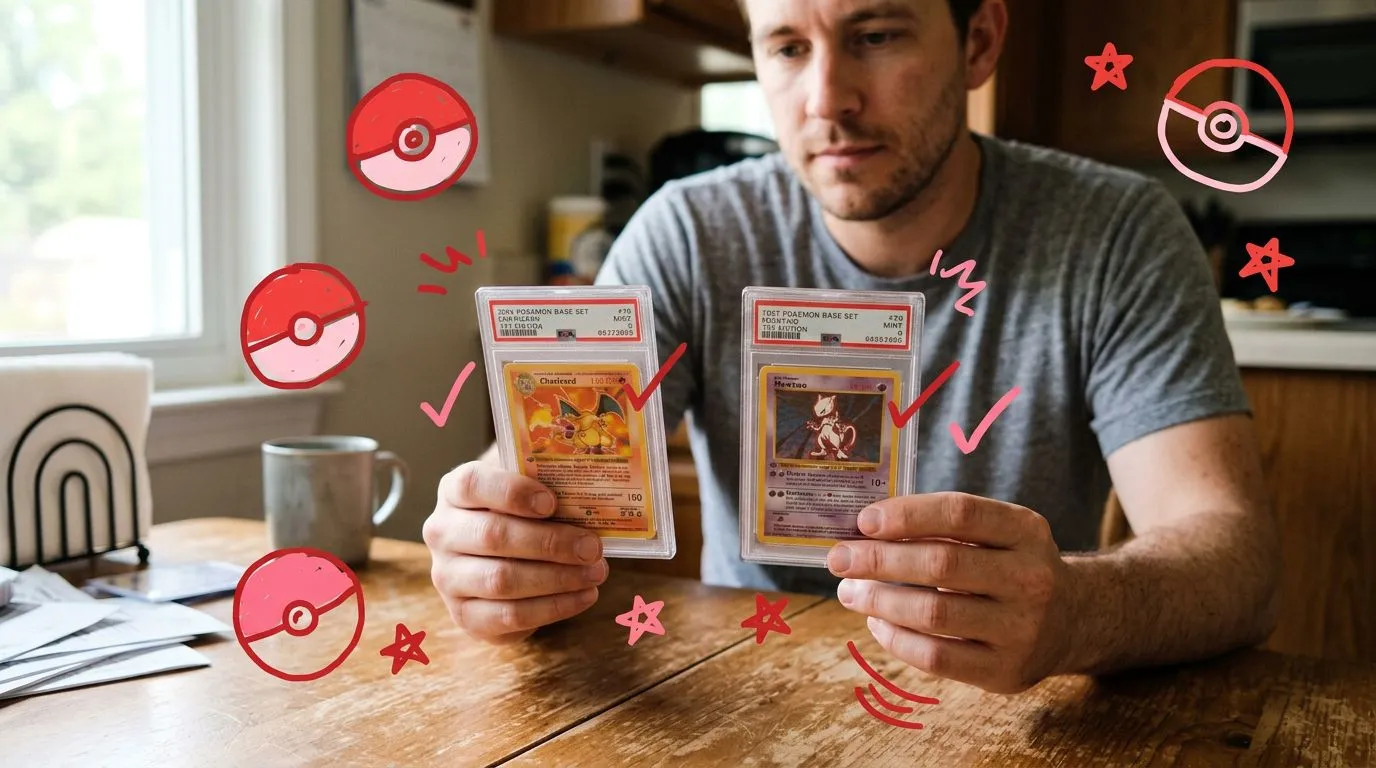
A Pokemon card's grade is a single number, almost always somewhere from 1 to 10, that a third-party company assigns after inspecting its centering, corners, edges and surface against that company's own published scale. PSA's top grade is Gem Mint 10, and CGC's numeric 10 comes in two labels: Gem Mint 10 and a stricter Pristine 10.
Beckett's (BGS) top grade is instead called Pristine 10, with Gem Mint sitting one half-point below it at 9.5. TAG scores a card on a 1000-point system that still lands on the same familiar 1-to-10 ladder collectors already know.
None of that is universal across companies. The same raw card can carry a different-sounding label depending on who graded it, and a "10" on one company's slab does not always describe the same physical bar as a "10" on another's.
What follows lines up all four companies' scales side by side, explains what actually separates a 9 from a 10 at each one, and covers the one thing that has to happen before any of it: authentication.
The grading scale, side by side
Every major grading company uses the same rough shape: a low single-digit floor and a 10 at the top. The names attached to each whole number differ company to company.
Grade
PSA
CGC
BGS
TAG (score)
10
Gem Mint 10
Gem Mint 10 (Pristine 10 is a stricter label inside the same 10)
Pristine 10
Gem Mint or Pristine, 950 to 1000
9
Mint 9
Mint 9
Mint 9
Mint, 900 to 949
8
NM-MT 8
NM/Mint 8
Near Mint / Mint 8
NM MT, 800 to 849
7
NM 7
Near Mint 7
Near Mint 7
NM, 700 to 749
6
EX-MT 6
Ex/NM 6
Excellent / Mint 6
EX MT, 600 to 649
5
EX 5
Excellent 5
Excellent 5
EX, 500 to 549
4
VG-EX 4
VG/Ex 4
Very Good / Excellent 4
VG EX, 400 to 449
3
VG 3
Very Good 3
Very Good 3
VG, 300 to 349
2
Good 2
Good 2
Good 2
Good, 200 to 249
1
Poor 1
Poor 1
Poor 1
Poor, 100 to 149
Source: PSA Grading Standards, CGC Cards Grading Scale, the Beckett Grading Scale on Beckett's card grading page and TAG Grading's published scale, all read October 24, 2026.
All four companies also publish half grades between most of these whole numbers, and that is where they actually diverge the most.
What actually separates a 9 from a 10
PSA has no 9.5 at all. Its published definitions offer half-point grades only between PSA 2 and PSA 9, plus a Fair 1.5 below Good 2. The jump from a 9 to a 10 is a single step with nothing between them.
CGC has a 9.5, called Mint+. It sits below Gem Mint 10 on CGC's current scale. CGC's legacy-grade key is a separate fact worth keeping straight: older CGC Trading Cards and CSG "Gem Mint 9.5" grades now map to the current Gem Mint 10, and the old Perfect 10 grade is retired, though slabs already graded keep their Perfect 10 status.
BGS also has a 9.5, called Gem Mint. On BGS's scale, Gem Mint names 9.5 specifically, one step below Pristine 10, whereas PSA and CGC use "Gem Mint" for a 10, and PSA has no Pristine grade.
TAG has no separate 9.5 tier. Its 1000-point system maps scores 950 through 1000 entirely into a single numeric grade 10, then splits that band into Gem Mint (950 to 989) and Pristine (990 to 1000, which TAG says exceeds the industry standard for a Gem Mint 10).
PSA's own published Gem Mint 10 standard requires centering no worse than approximately 55/45 on the front of the card and 75/25 on the back, four sharp corners, full original gloss, and freedom from staining, with only a slight printing imperfection tolerated. PSA also says its graders can make a judgment call, based on eye appeal, on a card that falls just within or just outside its printed centering standards.
BGS subgrades and the Black Label
Beckett's card grading page says each card is assessed on four subgrades, centering, corners, edges and surface, and that all four are displayed directly on the label. Overall grades come in half-point steps from 1 to 10.
That subgrade system is also what separates BGS's two kinds of Pristine 10. Beckett's page lists a Black label for perfect Pristine 10s. It says the only difference from a Gold label Pristine 10 is that the gold label allows one small imperfection under magnification, which works out to one 9.5 and three 10s across the four subgrades.
Below the top, label colors follow the overall number: Gold also covers Gem Mint 9.5, and Silver covers every other grade, per the same page.
The ladder loosens fast below the top
BGS's public scale spells out a full numeric centering ladder, which shows how much room opens up between a 10 and a 1.
BGS front-centering ceiling by grade
Pristine 1050
Mint 955
Near Mint / Mint 860
Near Mint 765
Excellent / Mint 670
Excellent 575
Very Good / Excellent 480
Very Good 385
Good 290
The Beckett Grading Scale on Beckett's card grading page, read live October 24, 2026. Value is the larger number in each grade's front-centering limit (55 means 55/45). Poor 1 has no numeric ceiling (100/0 or offcut) so is not charted.
A Pristine 10 needs 50/50 front centering, and Gem Mint 9.5 shares Mint 9's 55/45. From there the front limit widens by five points per whole grade: 55/45 at Mint 9, 60/40 at 8, 65/35 at 7, 70/30 at 6, 75/25 at 5, 80/20 at 4 and 85/15 at 3. By Good 2, BGS will accept centering as lopsided as 90/10.
Corner, edge and surface wording also loosens grade by grade. BGS's Pristine 10 asks for corners "perfect to the naked eye and virtually flawless under intense scrutiny," while its Poor 1 definition allows "heavily rounded" corners and "destructive chipping" on the edges.
None of the numbers above apply to a card the grading company decides is not genuine or has been altered. PSA's published standards say it will not grade a card of questionable authenticity, and a card that appears counterfeit never qualifies for encapsulation.
PSA (Authentic and Altered Authentic) and CGC both publish designations for a genuine card that cannot take a number. At CGC, Authentic covers a card that is authentic and unaltered but cannot receive a numeric grade, and Authentic Altered is printed when a card is real but has been altered, with recoloring and trimming as CGC's examples.
Counterfeit Pokemon cards are common enough that both the company and enforcement agencies have acted directly. Creatures Inc. announced in September 2023 that it would work with Japanese auction platforms to suspend counterfeit listings and pursue legal action against sellers.
Earlier, in November 2021, Chinese customs intercepted roughly 7.6 tons of counterfeit Pokemon booster packs, about 400,000 packs, bound for the Netherlands.
Collectors checking a raw card before submission often rely on a handful of physical tests. One counterfeit-detection guide describes holding the card to a bright light: a genuine English card has an opaque dark layer that blocks most light, while cheap fakes tend to glow through.
The same guide points to the back-print pattern as its single most reliable tell. The guide itself warns that newer high-quality fakes add a dark middle layer to pass the light test. Those are collector tips from a single hobby guide, not a grading company's own published standard, worth treating as a starting point rather than a verdict.
A card that clears authentication only then gets measured against the scales above. Card pages in the Pokemon catalog carry PSA and CGC population counts by grade where Cardboard Alpha holds them, and the screener ranks cards on fair value, liquidity and supply.
Frequently asked questions
Why is there such a big jump from a PSA 9 to a PSA 10?
PSA's published scale has no 9.5 step: its half-point grades sit only between PSA 2 and PSA 9, so the jump from a 9 to a 10 is a single grade with nothing between them. CGC and BGS both keep a numbered 9.5 (Mint+ at CGC, Gem Mint at BGS), and TAG has no half grade between 9 and 10 either.
Is a BGS Black Label the same as a BGS Pristine 10?
Not quite. Beckett's card grading page lists a Black label for perfect Pristine 10s and a Gold label for other Pristine 10s and for Gem Mint 9.5. It says the only difference between the two Pristine 10s is that the gold label allows one small imperfection under magnification, giving one 9.5 and three 10s across the four subgrades.
What is the difference between CGC's Pristine 10 and Gem Mint 10?
Both are the number 10 on CGC's scale, but they are two different published labels. Pristine 10 is a stricter, virtually flawless designation with flawless color and registration. Gem Mint 10 covers a 10 where one grading criterion falls just short of that Pristine standard, per CGC's own published scale.
How does TAG's 1000-point score work?
TAG assigns a numeric score, roughly 100 to 1,000, and maps that score onto the traditional 1-to-10 grade collectors already know. A score of 990 to 1,000 is TAG's Pristine 10, 950 to 989 is Gem Mint 10, and 900 to 949 is a 9, stepping down from there on TAG's published scale.
What happens if a submitted card turns out to be counterfeit or altered?
A card that appears counterfeit does not receive a numeric grade at all; PSA's published standards say such a card never qualifies for encapsulation. For a genuine card that cannot take a number, PSA publishes Authentic and Altered Authentic designations, and CGC publishes Authentic and Authentic Altered. CGC's examples of an alteration include recoloring and trimming.
Can a light test or back-print check catch a fake before I submit it?
Those are useful collector habits, not a grading company's own published standard. One hobby counterfeit-detection guide describes a light test and a back-print pattern check as early screens, but treat that as a starting point. The grading company's own authentication process is the actual determination.
Sources
PSA Grading Standards, PSA (Professional Sports Authenticator) Official / primary source · accessed October 24, 2026
Grading Scale - CGC Cards, CGC Cards (Certified Guaranty Company) Official / primary source · accessed October 24, 2026
Pokemon Announces Legal Action Against Counterfeit Cards on Auction Platforms, PokeBeach Industry press · accessed September 27, 2026
Nearly 7000kg of Counterfeit Pokemon Cards Headed to the Netherlands Have Been Intercepted by Chinese Customs, PokeGuardian Industry press · accessed September 27, 2026
Ryan Shugars is an avid Pokémon card collector who builds the market-data tooling behind Cardboard Alpha. He collects across multiple eras, tracks population reports and price movement as a matter of habit, and started building Cardboard Alpha to get a straight answer to questions the existing price guides couldn't: what's actually trading, what's just an asking price, and what a grade is really worth on a given card right now. He writes from that same collector's vantage point, close to the data, skeptical of hype, and always checking a claim against the ledger before it goes in an article.
Ryan Shugars is a collector and the builder of Cardboard Alpha's data systems, not a licensed financial advisor. Articles he writes or edits describe market history and mechanics; they are informational and are not personalized investment advice.
Revision history
— Ryan Shugars: Beckett's scale moved to beckett.com/grading and reads differently from the archived /grading/scale, /grading/about and BGS Black announcement copies first cited: label colours are now Black, Gold and Silver (no White), the gold Pristine 10 is defined on Beckett's own page as one 9.5 and three 10 subgrades, Pristine corners wording changed, and BGS grade names follow the live page. The third-party BGS guide is replaced by Beckett's own page; its 'not a simple average' line, which no official page supports, is removed. PSA's centering-discretion line re-quoted from its live eye-appeal note. All grader pages re-read live.