Alternate Art and Full Art Pokemon Cards: What Drives Their Premium
TCGplayer market data shows an Umbreon Special Illustration Rare can carry a far larger multiple over its standard printing than a Charizard one, even though both cards share the exact same rarity tier.
Three things set an alternate-art or full-art Pokemon card's premium: its official rarity tier (Illustration Rare, Special Illustration Rare, or Hyper Rare, each marked by a gold-star count The Pokemon Company introduced with Scarlet & Violet), how scarce that tier is inside the set, and collector demand for the character itself. In the three comparisons below, that third factor separates prices far more than the rarity label does.
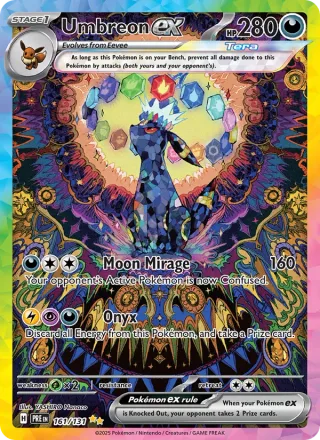
On TCGplayer's market as of September 26, 2026, an Umbreon ex Special Illustration Rare from Prismatic Evolutions trades at roughly 165 times its plain Double Rare counterpart from the same set. A Charizard ex Special Illustration Rare from 151, a nominally identical rarity tier, trades at only about 45 times its own Double Rare counterpart. Same mechanic, same tier, and one multiple is roughly 3.6 times the other.
That gap is the whole story this piece measures. Two cards can share every mechanical label the print run assigns them, drawn from the same generation of sets and the same gold-star category, and still land on very different sides of the market once collectors decide which artwork and which Pokemon they actually want.
What alternate art and full art actually mean
"Full art" and "alternate art" get used loosely, but they describe a specific print treatment, not a marketing label. A Full Art card shows the Pokemon's artwork across the entire card face instead of confining it to a boxed art window, and the card is fully holographic, a format CGC traces back to the Black & White expansion (CGC Cards, accessed September 26, 2026).
Starting with the Scarlet & Violet expansion, The Pokemon Company added (CGC Cards, accessed September 26, 2026):
Double Rare: two black stars. Both standard printings compared below, Charizard ex 006/165 and Umbreon ex 060/131, are Double Rares.
Ultra Rare: two silver stars.
Illustration Rare: one gold star. CGC notes these cards are also known as alt art cards.
Special Illustration Rare (SIR): two gold stars.
Hyper Rare: three gold stars.
CGC groups Illustration Rares and Special Illustration Rares with the secret rares, the cards numbered above a set's official card count. That tiering tells you where a card sits in the print hierarchy. It does not, by itself, tell you what the card is worth, a point CGC makes directly: a card's value cannot be determined just by checking its rarity symbol.
Knowing the exact tier still matters for a buyer, because it tells you what you are comparing against. A Special Illustration Rare should be measured against that same set's Double Rare or Ultra Rare printing of the identical Pokemon, not against an unrelated card from a different tier entirely. The next section does exactly that, one Pokemon and one set at a time.
The premium, measured across three sets
Comparing a set's plain printing of a Pokemon against its alternate-art or Special Illustration Rare sibling isolates the art-and-rarity premium from everything else, since the character, set, and release window all stay fixed.
TCGplayer market price $348.31 as of September 26, 2026, the Special Illustration Rare printing.
The multiple runs from about 45x to about 165x. Nothing about the rarity tier alone explains that range, since two of these three cards carry the exact same Special Illustration Rare label.
All three comparisons hold the print mechanic constant and let the price float, which is deliberate. A ranking of the most expensive alternate-art cards in the hobby would mostly just re-rank whichever Pokemon are already popular. Holding the mechanic fixed and comparing a card against its own set's standard printing isolates how much of the price is coming from the alternate-art treatment itself.
Character demand beats the rarity label
Both Umbreon comparisons post a larger multiple than the Charizard one. Umbreon's Evolving Skies Alternate Art Secret Rare, illustrated by KEIICHIRO ITO, comes from a set TCGplayer lists as released August 27, 2021. Its Prismatic Evolutions Special Illustration Rare, illustrated by YASHIRO Nanaco, repeats that same pattern for the same Pokemon in a set released January 17, 2025, roughly three and a half years later.
161 · Prismatic Evolutions · Special illustration rare
TCGplayer market price $1,384.05 as of September 26, 2026, the Special Illustration Rare printing.
The rarity tier sets a print mechanic. It does not set a fixed price relationship to the set's standard printing. A Special Illustration Rare of one character can trade at more than three times the multiple of a Special Illustration Rare of another, even from the very same generation of sets.
Read the other way, the price a market assigns to an alternate-art card is itself evidence about collector demand for that specific Pokemon, separate from whatever a set's overall checklist looks like. Two Special Illustration Rares of two different Pokemon, released about 16 months apart (151 in September 2023, Prismatic Evolutions in January 2025), carry the same two-gold-star label, and the market prices Umbreon's premium over its standard printing far above Charizard's.
Trainer Gallery: a second alt-art system
Before the Scarlet & Violet symbols existed, four late Sword & Shield sets carried a separate alternate-art subset: the Trainer Gallery, a numbered subset using a "TG" prefix instead of the set's regular numbering. TCGplayer's set catalog lists Trainer Gallery subsets for Brilliant Stars, Astral Radiance, Lost Origin and Silver Tempest.
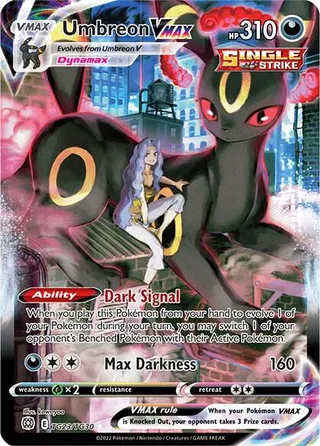
TCGplayer market price $105.87 as of September 26, 2026, the Brilliant Stars Trainer Gallery printing, illustrated by kawayoo.
Umbreon VMAX's Brilliant Stars Trainer Gallery printing (TG23/TG30), illustrated by kawayoo, carried a TCGplayer market price of $105.87 as of September 26, 2026. That sits well below the Evolving Skies Alternate Art Secret Rare ($2,214.79) and above both of Evolving Skies' other Umbreon VMAX printings: the standard 095/203 ($27.25) and the Secret Rare 214/203 ($83.73), all read the same day. The Trainer Gallery card comes from a different set, so it is not a same-set Secret Rare and should not be treated as interchangeable with one.
Brilliant Stars released roughly six months after Evolving Skies (February 25, 2022 versus August 27, 2021, per TCGplayer's set catalog) and added a third distinct piece of Umbreon VMAX artwork: the Evolving Skies 095/203 and 214/203 printings share AKIRA EGAWA's illustration, the Alternate Art Secret Rare is KEIICHIRO ITO's, and the Trainer Gallery card is kawayoo's. That is a print decision, not a price one, but it is why one Pokemon in one card type carries four separately tracked market prices across the two sets.
What the gap does and does not tell a buyer
These are dated snapshots of TCGplayer market prices, not a forecast. A large multiple today describes past and current demand, not a guarantee that any specific card's premium holds, grows, or reverses going forward.
One gap is worth stating plainly rather than papering over: neither PokeBeach nor Pokemon.com's own pull-rate coverage was reachable for this piece (both returned blocked or interstitial responses on every access attempt on September 26, 2026), so this article compares market prices only. It does not state, and should not be read as implying, a specific print-run or pack-pull-odds figure for any set, because none was verified.
What the price data does show is consistent across three different sets and three different years: rarity tier sets the print mechanic for a full-art or gold-star treatment, but the size of the premium above a set's standard printing depends on the character, the artwork, and the moment, not on the tier label by itself. Cardboard Alpha's screener covers the supply and liquidity side of that same question across the full tracked card universe, and 151's complete per-tier price breakdown shows how far that same Special Illustration Rare premium extends across an entire set rather than one card.
What is the difference between alternate art and full art Pokemon cards?
Full art describes a card whose artwork spans the entire card face instead of a boxed art window, a completely holographic format introduced in the Black & White expansion (CGC Cards, accessed September 26, 2026). Alternate art describes a printing that swaps a card's standard artwork for a different illustration; CGC notes that Illustration Rare cards are also known as alt art cards. Each alternate-art card in this piece carries a different credited illustrator from its standard printing, for example KEIICHIRO ITO on Evolving Skies' Umbreon VMAX 215/203 versus AKIRA EGAWA on the standard 095/203.
Why do Special Illustration Rares of different Pokemon sell for such different prices?
The rarity tier is identical, so the tier label cannot be what separates them. On TCGplayer as of September 26, 2026, Umbreon ex's Special Illustration Rare from Prismatic Evolutions traded at about 165 times its Double Rare counterpart, while Charizard ex's Special Illustration Rare from 151, the same tier, traded at about 45 times its own Double Rare counterpart. What differs is the character and the artwork collectors are paying for, which is why CGC Cards warns that a card's value cannot be read from its rarity symbol alone.
What is a Trainer Gallery card?
Trainer Gallery is a numbered subset, using a "TG" prefix instead of a set's normal numbering, that TCGplayer's set catalog lists for four late Sword & Shield expansions: Brilliant Stars, Astral Radiance, Lost Origin and Silver Tempest. Umbreon VMAX's Trainer Gallery printing from Brilliant Stars (TG23/TG30) carried a TCGplayer market price of $105.87 as of September 26, 2026, a separate price point from that same Pokemon's Evolving Skies printings.
Do the gold stars on a modern Pokemon card tell you its price?
They tell you the print tier, not the price. Starting with Scarlet & Violet, one gold star marks Illustration Rare, two gold stars mark Special Illustration Rare, and three gold stars mark Hyper Rare (CGC Cards, accessed September 26, 2026), but two cards carrying the same star count can trade at multiples that differ by more than three times, as the Umbreon-versus-Charizard comparison shows.
Is an Alternate Art Secret Rare the same as a Special Illustration Rare?
They are related but not identical. Evolving Skies' Umbreon VMAX Alternate Art Secret Rare predates the Scarlet & Violet rarity symbols and is numbered 215/203, above the set's official card count, which is what makes a card a secret rare. Special Illustration Rare is the two-gold-star rarity symbol added starting with Scarlet & Violet. Both give a card a different illustration from its standard printing; only the naming and numbering convention differs by era.
Ryan Shugars is an avid Pokémon card collector who builds the market-data tooling behind Cardboard Alpha. He collects across multiple eras, tracks population reports and price movement as a matter of habit, and started building Cardboard Alpha to get a straight answer to questions the existing price guides couldn't: what's actually trading, what's just an asking price, and what a grade is really worth on a given card right now. He writes from that same collector's vantage point, close to the data, skeptical of hype, and always checking a claim against the ledger before it goes in an article.
Ryan Shugars is a collector and the builder of Cardboard Alpha's data systems, not a licensed financial advisor. Articles he writes or edits describe market history and mechanics; they are informational and are not personalized investment advice.