No calendar date reliably wins. Four Mega Evolution chase cards took four different paths in their first 180 days, while the queue of competing sellers and the fee were numbers a seller could read on the day.
No calendar date reliably beats the others for selling a Pokemon card. In Cardboard Alpha's own price history, the most expensive card from each of the first four Mega Evolution expansions took a different path over its first 180 days. Two finished that window at 39 and 55 percent of their release-week price, one at 150 percent, and one at 128 percent after climbing higher first.
What a seller can check on the day is narrower: how many other sellers list the same card, where the cheapest sit, and what the marketplace fee takes. For a card past its launch weeks, the fee alone can outweigh the price drift, as the Perfect Order example below shows.
For each set, the table takes the highest-priced card in Cardboard Alpha's catalog during release week, then reads its evaluated raw, Near Mint price on the first Monday after the set's Friday release, and again 30, 90 and 180 days later.
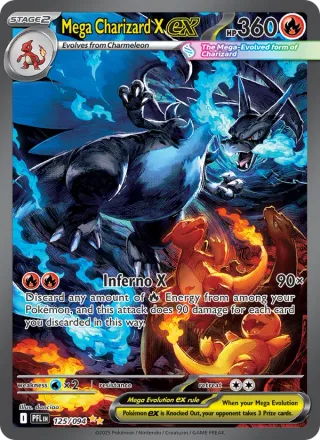
Mega Charizard X ex 125/94, Special Illustration Rare
$578.87
$455.06
$613.63
$867.42
$652.42
Ascended Heroes (Jan 30, 2026)
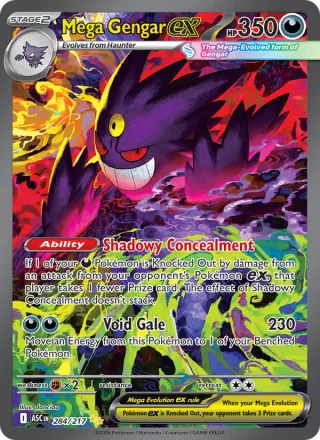
Mega Gengar ex 284/217, Special Illustration Rare
$873.72
$993.28
$1,262.65
$1,119.99
$798.24
Perfect Order (Mar 27, 2026)
Mega Zygarde ex 124/88, Mega Hyper Rare
$184.41
$157.25
$152.50
$102.20
$100.29
Cardboard Alpha evaluated price, raw Near Mint, on exact dates counted from the first Monday after release. Release dates per Pokemon.com.
A caveat: every release-week and day-30 figure, three of the four day-90 figures, and the Lucario and Charizard X day-180 figures are published market-guide values, or such values carried forward, not prices built from sales.
Cardboard Alpha scores those at low confidence. The rest, including every October 7 figure, are sale-based.
Day-180 price as a share of release-week price
Mega Lucario ex (Mega Evolution)39%
Mega Charizard X ex (Phantasmal Flames)150%
Mega Gengar ex (Ascended Heroes)128%
Mega Zygarde ex (Perfect Order)55%
Cardboard Alpha evaluated price, raw Near Mint, day 180 divided by the first Monday after release. Release-week and the Lucario and Charizard X day-180 values are low-confidence market-guide values. Price data effective October 7, 2026.
Four cards, four paths
Launch high, then a long slide: Mega Lucario ex stood at 79 percent of its release-week price on day 30, 49 percent on day 90, 39 percent on day 180 and 33 percent by October 7, 2026.
Early dip, then a climb: Mega Charizard X ex fell to 79 percent by day 30, then reached 106 percent on day 90 and 150 percent on day 180, before easing to 113 percent.
Climb, then give-back: Mega Gengar ex rose to 114 percent on day 30 and 145 percent on day 90, then slipped to 128 percent on day 180 and 91 percent.
A slow drift: Mega Zygarde ex moved from 85 percent on day 30 to 83 percent on day 90 and 55 percent on day 180.
125 · Phantasmal Flames · Special illustration rare
Evaluated price $578.87 (raw, Near Mint) on November 17, 2025 and $867.42 on day 180, both market-guide values; $652.42 (sale-based) on October 7, 2026.
Four cards from one era cannot set a rule for the hobby. They do show that "prices drop after release" described two of the four at day 180, not all of them.
Same set, opposite paths
The clearest case against a calendar rule comes from inside one set. Phantasmal Flames' two highest-priced cards in release week were both Mega Charizard X ex.
The Special Illustration Rare finished day 180 at 150 percent of its release-week price. The Mega Hyper Rare, 130/94, went from $501.20 in release week to $353.86 on day 180 (both market-guide values), or 71 percent, and stood at $209.20 on October 7, 2026.
Same Pokemon, same set, same release date. A fixed rule such as "sell in release week" or "wait six months" would have described one of those two cards and missed the other.
Evaluated price $873.72 (raw, Near Mint) on February 2, 2026 and $1,262.65 on day 90, both market-guide values; $798.24 (sale-based) on October 7, 2026.
The launch window on a new set
Release dates are typically public in advance. Pokemon.com announced on November 20, 2025 that Ascended Heroes "arrives on January 30, 2026," so the date was public at least 71 days before release.
The newest example in our data, the anniversary set 30th Celebration, released September 16, 2026, per The Pokemon Company International's launch announcement, and its first evaluated prices arrived six days later, built from recorded sales.
Mew ex 152/128, Special Illustration Rare: $165.49 on September 22, 2026, from 25 same-day sales, and $87.63 on October 7, from 27. That is 53 percent of the first price in 15 days.
Gengar ex 154/128, Special Illustration Rare: $130.00 on September 22 and $71.99 on October 7, or 55 percent.
152 · 30th Celebration · Special illustration rare
Evaluated price $165.49 (raw, Near Mint) on September 22, 2026; $87.63 on October 7, 2026. Both sales-based.
That describes the first two weeks, not the next two. Mega Charizard X ex was also lower on day 30 than in release week, then went well past it. Chase-card price moves after release are tracked across a wider set of launches.
Reprints and the supply side
A reprint adds packs, and every opened pack is another chance at the chase card. Reprint news is also public and dated.
The Pokemon Company's official Pokemon TCG account posted in January 2025 that it was "actively working to print more of the impacted Pokémon TCG products as quickly as possible and at maximum capacity," before Prismatic Evolutions reached shelves on January 17, 2025, per Wargamer's report.
A common hypothesis holds that November and December demand lifts prices. Cardboard Alpha's evaluated-price history covers exactly one holiday quarter so far, and both of this article's chase cards that were on the market that fall went down through December.
Card
Earlier read
Holiday read
Change
Mega Lucario ex 188/132
$533.38 (Oct 29, 2025)
$326.61 (Dec 28, 2025)
down 39%
Mega Charizard X ex 125/94
$578.87 (Nov 17, 2025)
$455.06 (Dec 17, 2025)
down 21%
Cardboard Alpha evaluated price, raw Near Mint. All four reads are low-confidence market-guide values within about three months of each card's release.
That does not rule out a seasonal effect. Both cards were in their post-release phase, and Mega Charizard X ex then rose to $613.63 by February 15, 2026.
Seasonality stays a hypothesis to check against each card's history.
The seller queue and the fee
On any given day, a listing joins a queue. Cardboard Alpha's order-book ledger counts the active raw Near Mint fixed-price listings for each card, with shipping included in the price.
Card
Evaluated price
Cheapest delivered ask
Sellers
Units listed
Units below evaluated price
Mew ex 152/128
$87.63
$80.16
155
181
9
Mega Lucario ex 188/132
$220.31
$205.17
68
92
2
Mega Charizard X ex 125/94
$652.42
$649.16
46
59
2
Mega Gengar ex 284/217
$798.24
$793.94
73
89
5
Mega Zygarde ex 124/88
$100.29
$98.50
78
93
5
Cardboard Alpha evaluated price and order-book ledger, October 7, 2026.
Each card had dozens of sellers ahead of a new listing. The gap between the cheapest ask and the evaluated price ran from 0.5 percent on Mega Charizard X ex and Mega Gengar ex to 8.5 percent on Mew ex.
A wide gap means the cheapest sellers are pricing below recent sales. A new Mew ex listing at the evaluated price would have sat behind 9 cheaper copies. What matching the cheapest ask costs is worked out in a separate guide.
Evaluated price $184.41 (raw, Near Mint, market-guide value) on March 30, 2026; $100.29 (sale-based) and 78 sellers on October 7, 2026.
Fees set the other side of the net. eBay's standard final value fee for collectible card games (sellers without a Store) is 13.25 percent of the total sale up to $7,500, plus $0.40 per order over $10, per eBay's fee page.
On a settled card: Mega Zygarde ex moved $1.91 between day 180 and October 7. eBay's standard fee on a $100.29 sale is at least $13.69, roughly seven times that drift.
In a launch window: Mew ex fell $77.86 in 15 days. The fee on an $87.63 sale is at least $12.01, a fraction of that move.
In this data, the date mattered more than the fee in the launch window; on the settled card, the fee and the queue mattered more. What each marketplace takes from a sale runs the fee math across TCGplayer, eBay and PayPal.
A timing checklist for sellers
Find the phase: a card's own price chart shows whether it is still in its first weeks or has flattened.
Count the queue: copies priced below yours are the ones a price-sorted buyer sees first. Reading the ask ladder walks through it.
Watch the gap: a cheapest ask well below the evaluated price means sellers are undercutting recent sales.
Net out the fee first: compare dates on what a sale nets, not on the headline price.
Not one that Cardboard Alpha's data can confirm. Its evaluated-price history covers a single holiday quarter, and both chase cards tracked here that were on the market that fall declined through December 2025, on low-confidence market-guide values: Mega Lucario ex 188/132 from $533.38 to $326.61, and Mega Charizard X ex 125/94 from $578.87 to $455.06. Both were also in their first months after release, so seasonality stays a hypothesis to test against a specific card's history.
Do Pokemon card prices always drop after a set releases?
No. Of the four Mega Evolution chase cards measured here, two stood at 39 and 55 percent of their release-week price on day 180, while Mega Charizard X ex stood at 150 percent and Mega Gengar ex at 128 percent. All four figures are Cardboard Alpha evaluated raw, Near Mint prices; the release-week values and two of the day-180 values are low-confidence market-guide values, not sales.
How fast can a new set's chase card fall?
Quickly, in the newest case measured here. 30th Celebration's Mew ex 152/128 went from $165.49 on September 22, 2026 to $87.63 on October 7, 2026, with both prices built from same-day sales. That describes its first weeks, not what comes next.
Does a reprint announcement lower card prices?
A reprint adds packs, and so more chances to pull a chase card, and The Pokemon Company has announced reprints publicly, as it did for Prismatic Evolutions in January 2025. The evaluated-price history used here starts in September 2025, so this article does not measure that reprint's price effect. A specific card's own chart is the place to check.
What matters more than timing when selling a card?
In this article's data, for a card past its launch weeks, the seller queue and the fee. On October 7, 2026, every card tracked here had between 46 and 155 sellers listing it. eBay's standard fee on Mega Zygarde ex's $100.29 price was at least $13.69, about seven times its $1.91 move over the prior 11 days.
Jay Montalbo writes about grading and selling for Cardboard Alpha. His background is in information technology, with nearly six years as an IT systems administrator and later work as an IT support analyst, and he brings the same troubleshooting habit to cards: break the problem into steps, check each one, and trust the answer only when every step holds. His articles work through when a grading submission pays for itself, how condition and grading-company standards move a card's value, and what a sale actually nets after marketplace fees and shipping, using published population reports, fee schedules, and completed-sale data. Every source is cited inline, and each piece is fact-checked against those sources before it is published.
Jay Montalbo's articles describe grading and selling mechanics using published population, fee, and pricing data. They are informational and are not personalized investment advice.
Selling & Trading
How to Price Pokemon Cards to Sell Fast Without Underselling
Pricing a Pokemon card to sell starts with sold prices, then the ask ladder, then fees. Cardboard Alpha compared the lowest delivered Near Mint ask with the evaluated price for 139 heavily traded cards on October 9, 2026, and set the gap beside TCGplayer's price-plus-shipping ordering, both marketplaces' published fees and eBay's Best Offer settings.