Near Mint vs Lightly Played: A Raw Card Condition Guide
TCGplayer lets a Near Mint card carry 3 points of imperfections and a Lightly Played card 6, and on October 2, 2026 that one step cost 2 percent on a modern chase card and 38 percent on a Base Set holo.
Near Mint and Lightly Played are the top two of the five raw conditions TCGplayer lets sellers list, and the line between them is measured. TCGplayer's standards allow a Near Mint card up to 3 points of imperfections and a Lightly Played card up to 6, and rule out whitening, grime and any bend at Near Mint.
What that step costs varies sharply with a card's era. On October 2, 2026, Cardboard Alpha's evaluated prices, mostly built from active listings rather than sales, put a Lightly Played copy at a median 95.3 percent of Near Mint for Scarlet & Violet cards worth $20 or more, against 73.5 percent for Wizards of the Coast era cards.
The five raw conditions, defined
Per its Card Conditioning Overview, TCGplayer accepts five conditions and does not sell Mint or Gem Mint cards.
Near Mint (NM): minimal wear from play or handling, with "a nearly unmarked surface, crisp corners, and unblemished edges outside of a few slight flaws."
Lightly Played (LP): minor edge wear, scuffs or scratches, but no significant imperfections and no structural issues.
Moderately Played (MP): edge wear, surface wear, scuffing, or bends with creases, as long as the card stays structurally sound.
Heavily Played (HP): a major amount of wear, including creasing and whitening, but still able to be authenticated and structurally intact.
Damaged (DMG): wear beyond every other standard, such as tears, splitting, folds or liquid damage.
TCGplayer calls this "conditioning" and reserves "grading" for numeric scores from professional graders. The words overlap: PSA labels its 7 "NM" and its 8 "NM-MT," as the side-by-side of each major grading company's scale shows. A marketplace Near Mint card is not a PSA 7.
eBay's card game singles category uses four ungraded labels, per its developer documentation: Near Mint or Better, Lightly Played (Excellent), Moderately Played (Very Good) and Heavily Played (Poor), with no Damaged tier.
How TCGplayer separates NM from LP
TCGplayer scores each imperfection by severity: Slight is 1 point, Minor 2, Moderate 4 and Major 8. Near Mint allows up to 3 points, Lightly Played 6, Moderately Played 12 and Heavily Played 24; anything beyond is Damaged.
Flaw type matters as much as the count: some pass at Near Mint in small amounts, others rule out Near Mint on sight.
Imperfection
Near Mint allows
Lightly Played allows
Edge wear
Up to 20mm in one stretch
Up to 80mm in one stretch
Surface wear (whitening)
None
Up to 2.5 square mm
Bend
None
Up to 10mm, no crease
Grime
None
Up to 2.5 square mm
Indentation
One pinpoint
Up to 4 square mm
Source: TCGplayer Card Conditioning Standards (March 2025) and imperfections guide, for a standard 63mm by 88mm card.
Self-checking a raw card
TCGplayer says its conditioners do not measure each flaw; the millimeter figures exist to make the standard repeatable. A self-check works the same way: find each flaw type, then count.
Edges and corners: lost color, gloss or material along an edge or corner is edge wear; past 0.5mm in from the edge, TCGplayer counts it as surface wear.
Whitening: surface wear that exposes bare cardstock. One spot up to 2.5 square mm caps a card at Lightly Played.
Scuffs: a cloudy cluster of fine abrasions. Slight scuffing passes at Near Mint; scuffing across a whole side caps a card at Moderately Played.
Bends and creases: any bend rules out Near Mint, and any crease drops a card to Moderately Played at best.
Grime and ink: any grime keeps a card out of Near Mint, and pen or marker makes it Damaged.
Centering: TCGplayer allows up to 70/30 with no condition penalty, while PSA's Gem Mint 10 standard requires roughly 55/45 on the front.
Three separate slight edge nicks use up a Near Mint card's whole allowance; a fourth, or one speck of whitening, makes it Lightly Played.
Raw NM $28.96, LP $24.86 (85.8%), Cardboard Alpha, October 2, 2026.
One caution: the vintage NM and LP figures rest on active listings, with no same-day sale at either condition, while the modern ones draw on recent sales. Base Set Charizard's NM price ranged from $687.25 to $872.27 over the ten days to October 2.
TCGplayer's own condition prices near the end of September agree: LP at 88 to 93 percent of NM on the modern three, 57 to 78 percent on the vintage three.
The LP discount by era
On October 2, 2026, across 2,041 English cards with NM of $20 or more and fresh NM, LP and MP prices, the median LP copy tracked era closely.
Era
Cards
LP as % of NM
MP as % of NM
Wizards of the Coast
369
73.5%
54.3%
EX
402
70.9%
51.2%
Diamond & Pearl
226
58.9%
36.3%
HeartGold & SoulSilver
119
69.8%
42.6%
Black & White
25
63.5%
38.1%
XY
170
61.1%
42.8%
Sun & Moon
315
79.6%
60.9%
Sword & Shield
175
91.8%
78.4%
Scarlet & Violet
240
95.3%
86.5%
Median of each card's own ratio; each finish counts as one card; carried-forward prices excluded.
Lightly Played price as % of Near Mint, by era
Wizards of the Coast73.5%
EX70.9%
Diamond & Pearl58.9%
HeartGold & SoulSilver69.8%
Black & White63.5%
XY61.1%
Sun & Moon79.6%
Sword & Shield91.8%
Scarlet & Violet95.3%
Median across 2,041 English cards, NM $20 or more. About 3 in 4 LP prices are active listings, not sales. Cardboard Alpha evaluated prices, October 2, 2026.
The median Scarlet & Violet and Sword & Shield card priced about 5 to 8 percent lower at LP. In every era from Diamond & Pearl through XY, the median gap was 30 percent or more.
These medians lean on listings, not sales: about three in four of the LP prices behind them, and half the NM prices, blend the best active asking price with Cardboard Alpha's previous price. Only about one LP price in seven draws on a recorded sale.
Where both the NM and LP prices came from listings, the split holds: 96.7 percent for Scarlet & Violet (23 cards) against 73.2 percent for Wizards of the Coast (168 cards).
Mega Evolution cards, the catalog's newest, are left out: their median MP price ran at 110.8 percent of NM, a ladder that does not behave like one.
Where each condition actually sells
TCGplayer's sales history from mid-July to October 1, 2026 shows the six cards trading in opposite shapes.
Card
NM
LP
MP
HP
DMG
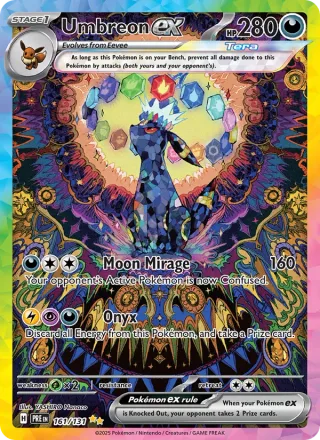
Umbreon ex 161
40
4
0
0
no data
Charizard ex 199
274
97
5
1
7
Mew ex 205
580
133
18
2
5
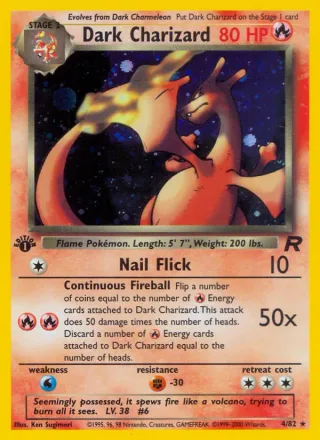
Dark Charizard (Team Rocket)
4
16
12
17
28
Venusaur (Base Set)
35
91
121
95
121
Charizard (Base Set)
5
14
50
39
69
Copies sold on TCGplayer. Vintage rows are Unlimited holo prints.
The modern cards sell mostly as Near Mint: 274 of 384 copies for 151's Charizard ex. The vintage holos sell mostly played: Base Set Charizard moved 5 Near Mint copies against 172 in Lightly Played or worse.
Unlimited holo. Raw NM $353.50, LP $272.61 (77.1%), Cardboard Alpha, October 2, 2026.
Modern chase cards: a thin discount
On Umbreon ex and Charizard ex the pattern runs the other way: Lightly Played priced 2 to 5 percent below Near Mint, while their graded prices sat far above both raw conditions.
Cardboard Alpha's 90-day median of PSA 10 sales was $1,400.00 for Charizard ex 199 and $5,370.00 for Umbreon ex 161 as of October 2, 2026, 4.2 and 4.6 times their Near Mint raw prices. PSA describes a Gem Mint 10 as "a virtually perfect card" with four perfectly sharp corners and full original gloss, a description that excludes the edge wear and scuffs LP allows.
On these two cards, the small LP discount also comes with a thinner market: Umbreon ex sold 4 LP copies on TCGplayer over the eleven weeks, against 40 NM. Grading costs are weighed in the fee-over-raw-price break-even math.
Pricing condition when you sell
Sellers pick the condition when they list, on TCGplayer and eBay alike. TCGplayer's Listing with Photo option covers cards its standards would push to Damaged, such as a miscut or a signed card, and lets the seller list them at the condition they would have without the defect.
What is the difference between Near Mint and Lightly Played?
On TCGplayer, a Near Mint card may carry up to 3 points of imperfections, such as slight edge wear or a minor scratch, and no whitening, grime or bend at all. A Lightly Played card may carry up to 6 points, including minor edge wear, minor scuffing, one small spot of whitening or a short bend with no crease, per TCGplayer's Card Conditioning Standards (updated March 2025).
How much cheaper is a Lightly Played Pokemon card than Near Mint?
It varies sharply by era. On October 2, 2026, Cardboard Alpha's evaluated prices put the median Lightly Played copy at 95.3 percent of Near Mint for Scarlet & Violet cards worth $20 or more, against 73.5 percent for Wizards of the Coast era cards and 58.9 percent for Diamond & Pearl, with about three in four of those LP prices taken from active listings rather than sales. On the six cards in this guide, the LP discount ran from 1.9 percent on Umbreon ex 161 to 38.4 percent on Base Set Charizard.
Does the Lightly Played discount hold on cheap cards?
In Cardboard Alpha's prices, mostly not. Across 2,597 cards with a Near Mint price between $1 and $5 on October 2, 2026, the median Lightly Played price was 103.3 percent of Near Mint, and 53.8 percent of those cards had an LP price at or above NM. The discount widened with price, from a median 85.1 percent of NM for $5 to $20 cards to 69.5 percent for cards at $500 or more. About seven in ten of these LP prices come from active listings rather than sales.
Does whitening make a card Lightly Played?
Usually. TCGplayer treats whitening as surface wear, which is not allowed at Near Mint, and one spot up to 2.5 square mm caps a card at Lightly Played. Wear that stays within 0.5mm of the edge counts as edge wear instead, and slight edge wear is allowed at Near Mint within its 3-point budget.
Can a Lightly Played card get a PSA 10?
PSA describes a Gem Mint 10 as a virtually perfect card with four perfectly sharp corners and full original gloss, while TCGplayer's Lightly Played condition allows minor edge wear, scuffs and scratches. This guide holds no data on how often a card sold as Lightly Played later grades a 10, but the wear that defines LP is the kind PSA's top grade description excludes.
Is a Near Mint card the same as a PSA 7?
No. PSA calls its 7 grade NM and its 8 NM-MT, but those are numeric grades a grading company assigns. TCGplayer's Near Mint is a non-numeric marketplace condition, and TCGplayer itself separates conditioning from grading.
Sources
Card Conditioning Overview, TCGplayer Official / primary source · accessed October 10, 2026
Understanding Card Condition Imperfections: A Comprehensive Guide, TCGplayer Official / primary source · accessed October 10, 2026
Card Conditioning Standards (Updated March 2025), TCGplayer Official / primary source · accessed October 10, 2026
Price history by condition for six Pokemon card products, TCGplayer Official / primary source · accessed October 10, 2026
Jay Montalbo writes about grading and selling for Cardboard Alpha. His background is in information technology, with nearly six years as an IT systems administrator and later work as an IT support analyst, and he brings the same troubleshooting habit to cards: break the problem into steps, check each one, and trust the answer only when every step holds. His articles work through when a grading submission pays for itself, how condition and grading-company standards move a card's value, and what a sale actually nets after marketplace fees and shipping, using published population reports, fee schedules, and completed-sale data. Every source is cited inline, and each piece is fact-checked against those sources before it is published.
Jay Montalbo's articles describe grading and selling mechanics using published population, fee, and pricing data. They are informational and are not personalized investment advice.