Documented Pokemon card downturns followed supply surges and shifting attention, and they fell unevenly: on October 19, 2026, POKE150 sat 31.2% below its July 1 base while the equal-weighted all-singles composite stood at a series high on October 18.
Documented Pokemon card downturns have followed supply surges and shifting attention, and the records below show them falling unevenly. Hasbro's annual report shows the first craze reversing by 2001, about two years after the English Base Set's January 1999 release, while Fortune and TCGplayer link the 2021 to 2022 cooling to a much larger print run.
Cardboard Alpha's own data shows the same unevenness in 2026. On October 19, 2026, POKE150 closed 31.2% below its July 1 base, and 147 of the 150 cards that made it up on July 1 carried a lower evaluated price on October 20. On October 18, the equal-weighted composite of all priced raw singles stood at the highest reading in its series, which begins in January 2021.
This guide uses the stock-market convention that a fall of 20% or more from a prior high is a bear market. It describes history and mechanics, not a forecast, and it makes no recommendation about any card.
A dated timeline
The first two rows are the publisher's sales, not collector prices.
Date
Recorded event
Source
2000
Pokemon cards made up 15% of Hasbro's net revenue; margins suffered from "overproduction"
Hasbro
2001
Games segment revenue fell from $1.84 billion to $1.11 billion, including about $469 million less from Pokemon products
Hasbro
Mar 2021 to Mar 2022
About 9 billion cards printed, more than double the year before
TCGplayer looks back: after 2021 the market "generally cooled off"
TCGplayer
Early Sep 2025
Umbreon VMAX passed $2,000, then sales dried up
TCGplayer
Around Jul 2026
Modern singles began to retrace as reprints caught up
TCGplayer
Jul 1 to Oct 19, 2026
POKE baskets fell 29.4% to 33.7%
Cardboard Alpha
1999 to 2001: the first fade
Cardboard Alpha's catalog dates the English Base Set to January 9, 1999. Hasbro acquired Wizards of the Coast, which published the Pokemon card game, in the fourth quarter of 1999, and its fiscal 2001 annual report says Pokemon cards contributed 15% of consolidated net revenue in 2000.
The same report blames a 2000 margin shortfall on "obsolescence cost incurred associated with overproduction of certain trading card games, primarily POKEMON related." In 2001, Games segment revenue fell to $1.11 billion from $1.84 billion, including an approximate $469 million decline in Pokemon products, primarily trading card games.
ICv2 reported on May 8, 2001 that Hasbro's first-quarter revenue had dropped 40%, to $463 million from $774 million, and that Hasbro attributed its worse-than-expected loss in part to rapidly falling sales of Pokemon toys and card games. Those are the publisher's sales, and no dated collector-price series from a primary source was found for those years.
2021 to 2023: a bigger print run
Fortune reported on July 6, 2022 that The Pokemon Company printed about 9 billion cards between March 2021 and March 2022, per its website, more than double the year before. TCGplayer's May 8, 2024 retrospective says the company then "tripled card production" and the market "generally cooled off."
Not every headline card collapsed. TCGplayer says the alternate-art Umbreon VMAX from Evolving Skies, a 2021 chase card, "fluctuated between $400 and $700 for years" until its first ungraded sale above $1,000 on TCGplayer, on May 6, 2024. Sealed-product prices in 2022 and 2023 are covered separately.
How deep and how long since 2021
Cardboard Alpha's equal-weighted composites show the long version. Each chains the moves of every priced raw Near Mint English single in its group, starting at 100 in January 2021 for Vintage and All singles and February 2021 for the rest.
Composite
Fall to low
Low
Continuously above first reading since
Vintage (WOTC)
-30.3%
Aug 2021
Apr 2025
Classic (EX, DP, HGSS)
-18.2%
Oct 2021
Dec 2024
Mid (BW, XY, SM)
-6.3%
Sep 2021
Nov 2023
All singles
-17.0%
Oct 2021
Apr 2025
Modern (SWSH, SV, MEGA)
-51.7%
Nov 2024
Never
Cardboard Alpha market-series composites through October 18, 2026; readings before February 8, 2024 are monthly.
By the 20% convention, only Vintage and Modern had bear markets here, yet even the shallower falls took between 2.7 and 4.3 years to climb back above their first readings for good. On October 18, 2026 the Modern composite stood 33.5% below its first reading and 37.9% above its November 2024 low.
The composites cannot show a peak that came before January 2021. Vintage versus modern compares the same groups over fixed windows.
2025 to 2026: segments split
TCGplayer's February 18, 2026 report put Umbreon VMAX at $1,673.95, after it passed $2,000 in early September 2025 and sales "all but disappeared." By October 13, 2026, its Market Price was $2,285.50, after what TCGplayer called "significant turbulence all year."
TCGplayer Market Price: $1,673.95 on February 18, 2026 and $2,285.50 on October 13, 2026.
On October 13, TCGplayer dated the turn in modern singles to around July 2026, "as the waves of reprints finally caught up with the demand," and said what interest remained was being absorbed by the 30th Celebration set.
Graded cards show the same split. For each era group, Cardboard Alpha's Graded Index tracks the 50 Grade 10 cards, from any grader, with the most traded dollars over the trailing 90 days. Its Modern basket fell 22.8% from a high of 115.9 in the week of June 8, 2026 to 89.5 in the week of October 12, while the Vintage, Classic and Mid baskets sat at or within 4.4% of highs set on October 5 and 12.
October 2026 in Cardboard Alpha data
POKE50, POKE150 and POKE250 hold the raw Near Mint cards that score highest on 90-day trading value and resting listings, among cards priced at $100, $25 and $10 or more. Each was set to 1,000 on July 1, 2026, which is also its highest close, and each is published at the indicative tier, the first public rung of the index ladder, with levels before the September 8, 2026 launch calculated retroactively.
Measure
Window
Change
POKE50
Jul 1 to Oct 19
-33.7%
POKE150
Jul 1 to Oct 19
-31.2%
POKE250
Jul 1 to Oct 19
-29.4%
Modern singles composite
Jul 1 to Oct 18
+5.0%
All singles composite
Jul 1 to Oct 18
+12.3%
Mid singles composite
Jul 1 to Oct 18
+13.9%
Vintage singles composite
Jul 1 to Oct 17
+15.5%
Classic singles composite
Jul 1 to Oct 18
+23.9%
Change from July 1, 2026 by measure
POKE50-33.7%
POKE150-31.2%
POKE250-29.4%
Modern singles+5%
All singles+12.3%
Mid singles+13.9%
Vintage singles+15.5%
Classic singles+23.9%
Cardboard Alpha index closes through October 19, 2026 and equal-weighted raw-single composites through October 18, 2026 (Vintage through October 17); priceDataEffectiveDate 2026-10-20.
The fall came in small steps. POKE150 first closed 10% below its base on August 6, 20% below on September 18 and 30% below on October 15. No basket fell more than 2.6% in a day, and the largest rise from any earlier closing low was 3.3%.
Breadth was wide. Of the 150 cards in POKE150's July 1 slate, its membership on the base date, 147 had a lower evaluated price on October 20 than at entry, the median change was -29.4%, and 74 had lost 30% or more. The three exceptions rose 3.2% to 10.4%.
An evaluated price is Cardboard Alpha's single daily number for a card variant, built from recorded sales when there are some and from asking prices or a published guide when there are not. On October 20, 121 of the slate's 150 prices drew on a recorded sale or sold-price bucket and 29 rested on the lowest asking prices blended with a prior.
Release date sorted the losses. The median change by set release year ran:
Sets from 2026 (26 cards, all Ascended Heroes): -47.2%
Sets from 2025 (46 cards): -33.4%
Sets from 2022 to 2024 (56 cards): -23.6%
Sets from 2021 or earlier (22 cards): -17.8%
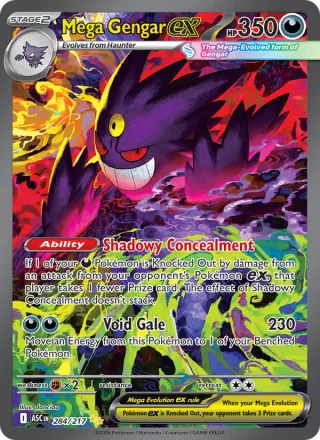
Mega Gengar ex 284, one of the slate's two heaviest weights at 3.0%, went from $1,330.00 at entry to $721.81 on October 20, down 45.7%. TCGplayer's October 13 report names it and Pikachu ex as the set's two four-figure chase cards and says the staggered release "slowly eroded" their value.
Index entry price $1,274.22 on July 1, 2026; evaluated price $1,129.21 on October 20, 2026, down 11.4%.
What tended to fall first
These are patterns in the records above, not rules.
The newest sets. The slate's median fall deepened with each later group of release years, and TCGplayer's October 13 report says few modern sets "have declined as much as Ascended Heroes." Why launch hype rarely holds traces the same pattern set by set.
Fast spikes. Per TCGplayer's February 18 report, Marshadow (Cosmic Eclipse reverse holo) went from $1.50 to almost $40 in a little more than a month, then stood at $18.64 once fans' attention moved on.
Sealed product after reprints. TCGplayer says a September 2026 reprint wave took Prismatic Evolutions Elite Trainer Boxes to their lowest point since February.
Older sets, less. From July 1 to October 17, 2026 the Vintage composite rose 15.5%, and the slate's cards from 2021 or earlier sets fell a median 17.8%, against 47.2% for Ascended Heroes.
Limits of this data
Dates differ. POKE closes run to October 19, composites to October 18, evaluated prices to October 20 and the Graded Index to the week of October 12. Vintage stops at October 17, because one-day jumps like its 1.5% rise on October 18 have reversed the next day.
The baskets are young. POKE levels are indicative and retroactive before launch, the highest close is the base itself, not a market peak, and the July 1 slate was ranked on trading activity, not price direction.
Composites are card averages. Equal weighting lets cheap cards dominate, readings rest on a monthly guide price before February 8, 2024 and a daily market guide after, and the base-day samples were small, at 681 cards for All singles and Vintage.
Sealed is thin. Cardboard Alpha's sealed series begin no earlier than September 2025 and rest on far fewer products than the singles, so no sealed-versus-singles ranking is drawn.
Prices are estimates. TCGplayer's Market Price and Cardboard Alpha's evaluated price are built differently and are quoted against their own dates.
There is no official definition. This guide borrows the stock-market convention of a fall of 20% or more from a prior high, which POKE150 first met on September 18, 2026. The answer depends on what is measured: through October 18, 2026 the equal-weighted all-singles composite never fell as much as 3% from a running 2026 peak.
How long have Pokemon card downturns lasted?
In Cardboard Alpha's composites, the shallower falls that began in 2021 took between 2.7 and 4.3 years to climb back above their first readings for good, and the Modern composite had not by October 18, 2026. The 2026 fall in the POKE baskets was 110 days old on October 19, with no rise from an earlier closing low above 3.3%. These are records, not forecasts.
Did the first Pokemon card craze fade?
Hasbro's fiscal 2001 annual report says Pokemon cards contributed 15% of its 2000 net revenue and that Pokemon revenue in its Games segment, primarily from trading card games, fell by an approximate $469 million in 2001. The same report ties a 2000 margin shortfall to overproduction of trading card games. Those are the publisher's sales, not collector prices, and no primary-source price series for those years was found.
Does a falling index mean every card is falling?
No. Of the 150 cards in POKE150's July 1 slate, 147 were lower on October 20, 2026, but three were higher, and the equal-weighted raw-single composites rose between 5.0% and 23.9% from July 1 to October 18. TCGplayer's October 13, 2026 report priced Umbreon VMAX at $2,285.50, above its $1,673.95 of February 18.
Why do print runs and reprints matter in a downturn?
Hasbro blamed a 2000 margin shortfall on overproduction of Pokemon trading card games, and Fortune and TCGplayer link the 2021 to 2022 cooling to a much larger print run. TCGplayer's October 13, 2026 report dated the latest retracement in modern singles to around July 2026, as reprints caught up with demand. In POKE150's July 1 slate, the newest sets fell furthest.
Brandon Valdez writes market analysis and sealed-product coverage for Cardboard Alpha, and comes to the Pokémon TCG market from a decade in financial planning and analysis. Brandon spent those years building budgets, forecasts, and financial models for Las Vegas hospitality and nightlife groups, rising from senior financial analyst to FP&A manager before moving into premium and VIP services leadership, and reads the card market the same way: what actually sold, what it cost delivered, and whether a sealed product's expected value survives the math. Market narrative stays separate from the numbers behind it, every source is cited inline, and each piece is fact-checked against those sources before it is published.
Brandon Valdez is a finance professional, not a licensed financial advisor. Articles under this byline describe market history and mechanics using published pricing and population data; they are informational and are not personalized investment advice.