Booster Box EV Compared: Evolving Skies, 151, and Prismatic Evolutions
Evolving Skies is the only one of the three with a real 36-pack booster box in Cardboard Alpha's catalog, and its expected raw-card return per pack runs about 12 percent of today's market price, well below 151's roughly 29 percent and Prismatic Evolutions' 25 to 30 percent.
Of these three sets, only Evolving Skies has a real 36-pack booster box in Cardboard Alpha's catalog. Its per-pack expected raw-card return, built from TCGplayer's own measured pull rates and Cardboard Alpha's live market ledger, comes to about $5.40 against a current market pack price near $45.91, an expected-value-to-price ratio of roughly 12 percent as of September 26, 2026.
151 never got a traditional booster box, per its official expansion page, and the catalog lists none for Prismatic Evolutions either. Run the same per-pack math against their single-pack market prices and 151 comes in far higher, near 29 percent. Prismatic Evolutions lands near 25 percent on the same hit tiers, and near 30 percent once its Master Ball and Poké Ball foil printings, which TCGplayer also measures, are counted.
Only Evolving Skies has a catalogued booster box
Evolving Skies shipped as a standard 36-pack booster box, 10 cards per pack, at a $143.64 Pokémon Center list price captured in August 2021. That is a real, catalogued SKU: sealed:tcgplayer:242436 in Cardboard Alpha's own product catalog.
151 and Prismatic Evolutions do not have one. Across 112 catalogued sealed SKUs spanning all three sets, the only two that carry a BOOSTER_BOX product kind both belong to Evolving Skies: the 36-pack box and a half-box listing. For 151, the set's official expansion page explains why: opening its packs means buying products like the Elite Trainer Box and Ultra-Premium Collection.
Evolving Skies: 36-pack Booster Box, launch list price $143.64, current market price $2,322.75.
151: no booster box. The highest pack count on any 151 product with a publisher pack count in the catalog is the 16-pack Ultra-Premium Collection, MSRP $119.99, current market price $880.33.
Prismatic Evolutions: no BOOSTER_BOX SKU in the catalog either. Its Elite Trainer Box currently prices at $140.40, with no publisher pack count recorded for it in Cardboard Alpha's catalog.
That gap in the third row is deliberate. Prismatic Evolutions' Elite Trainer Box and Booster Bundle pack counts were not confirmed from a Tier-1 source for this guide, so this guide prices what those products cost today without stating how many packs sit inside them. 151's full card-by-card pricing covers that set's chase-card values in more depth than the pull-rate averages below.
Special Illustration Rare; Cardboard Alpha live ledger, raw NM market price, read September 26, 2026.
How the EV math works
Expected value per pack is built the same way for every set here: TCGplayer's own measured pull rate for a rarity tier (packs per hit), divided into the average raw market price of the cards in that tier, gives the expected dollar return that one rarity contributes to a single pack.
Add every hit tier together and the sum is the pack's expected raw-card value. A worked example makes it concrete.
Evolving Skies' Ultra Rare tier hits once every 25.77 packs on average, per TCGplayer's published pull-rate data, and those cards carry a $67.69 average raw market price on Cardboard Alpha's live ledger. Divide $67.69 by 25.77 and Ultra Rares alone contribute about $2.63 of expected value to every pack opened.
Do that for every hit tier in a set and the total is the number this guide calls EV per pack. It assumes any card within a rarity tier is equally likely to be pulled, the same equal-odds assumption TCGplayer's own pull-rate articles use for card-level odds, and it is stated here rather than hidden.
Evolving Skies: EV of the 36-pack box
TCGplayer measured seven hit subrarities in Evolving Skies' rare slot, which this guide groups into four rarity tiers: Full-Art and Alternate-Art Pokémon V make up Ultra Rare, and Alternate-Art VMAX, Rainbow and Gold cards make up Secret Rare. TCGplayer's pull-rate data and Cardboard Alpha's live raw-price averages put each tier at a different expected contribution per pack.
Rarity tier
Pull rate
Avg. raw market price
EV per pack
Holo Rare V
1 in 9.47 packs
$2.46
$0.26
Holo Rare VMAX
1 in 17.86 packs
$9.65
$0.54
Ultra Rare
1 in 25.77 packs
$67.69
$2.63
Secret Rare
1 in 48.78 packs
$96.13
$1.97
Summed, that is $5.40 of expected raw-card value per pack. Scaled to the box's real 36 packs, expected value comes to about $194.30.
Evolving Skies: rarity-tier EV contribution per pack
Holo Rare V0.26USD
Holo Rare VMAX0.54USD
Ultra Rare2.63USD
Secret Rare1.97USD
TCGplayer Authentication Center pull rates (packs opened August 2021, published August 27, 2024) x Cardboard Alpha live raw-price averages, read September 26, 2026.
Against that $194.30 box EV, the box's current market price of $2,322.75 puts the EV-to-price ratio at about 8 percent. Against its $143.64 launch list price, the same $194.30 EV would have been worth 135 percent of the shelf price. Most of the Secret Rare tier's value sits in two alternate-art cards, Rayquaza VMAX and Umbreon VMAX, the tier's two highest raw prices on the ledger.
Secret Rare; Cardboard Alpha live ledger, raw NM market price, read September 26, 2026.
151: no booster box, but more EV per pack
151 has five hit tiers in this breakdown, one more than Evolving Skies, because the Scarlet & Violet rarity system adds Illustration Rare, Special Illustration Rare and Hyper Rare cards in a second reverse-holo slot alongside the Double Rare and Ultra Rare cards in the rare slot. TCGplayer also measured a Cosmos foil Energy in about 1 in 4 packs; the ledger does not price those Energy cards, so they are left out of 151's figure.
Rarity tier
Pull rate
Avg. raw market price
EV per pack
Double rare
1 in 7.53 packs
$2.73
$0.36
Illustration rare
1 in 11.76 packs
$45.26
$3.85
Ultra Rare
1 in 15.53 packs
$12.01
$0.77
Special Illustration Rare
1 in 32.15 packs
$108.43
$3.37
Hyper rare
1 in 51.55 packs
$11.44
$0.22
That totals $8.58 of expected raw-card value per pack, and the Illustration Rare tier alone supplies about 45 percent of it.
With no booster box to scale against, this guide applies the $8.58 figure to the three 151 products that carry a publisher pack count in the catalog instead.
Booster Bundle (6 packs): EV $51.46 against a $162.42 market price, about 32 percent.
Elite Trainer Box (9 packs): EV $77.19 against $469.14, about 16 percent.
Ultra-Premium Collection (16 packs): EV $137.24 against $880.33, about 16 percent.
At the list prices in Cardboard Alpha's catalog, all three products carry more EV than they cost at retail. The Elite Trainer Box's $77.19 is 154 percent of its $49.99 launch MSRP and the Ultra-Premium Collection's $137.24 is 114 percent of its $119.99 MSRP. The Booster Bundle's $51.46 is 191 percent of the $26.94 Pokémon Center list price recorded for it in November 2024, the steepest gap in this guide, though that list price is a later reading rather than the 2023 launch price.
Prismatic Evolutions: the rarest Hyper Rares
Prismatic Evolutions has no Illustration Rare tier at all, per TCGplayer, and adds an ACE SPEC Rare tier instead. Its Hyper rare tier is far thinner than 151's, at 1 in 178.57 packs against 1 in 51.55.
Rarity tier
Pull rate
Avg. raw market price
EV per pack
Double rare
1 in 6.06 packs
$2.70
$0.45
Ultra Rare
1 in 13.40 packs
$1.08
$0.08
ACE SPEC Rare
1 in 21.37 packs
$0.65
$0.03
Special Illustration Rare
1 in 45.05 packs
$131.04
$2.91
Hyper rare
1 in 178.57 packs
$17.53
$0.10
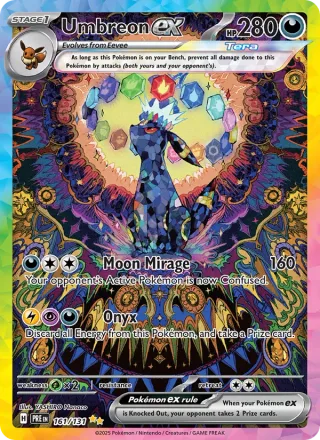
The total is $3.56 per pack, the lowest of the three sets in dollar terms, with about 82 percent of it carried by the Special Illustration Rare tier's $131.04 average. That average itself is stretched by a single card: Umbreon ex, whose live raw market price sits far above every other Special Illustration Rare in the set.
161 · Prismatic Evolutions · Special illustration rare
Special Illustration Rare; Cardboard Alpha live ledger, raw NM market price, read September 26, 2026.
Against a $14.31 current single-pack market price, that $3.56 EV puts Prismatic Evolutions at about 25 percent, ahead of Evolving Skies but behind 151.
That figure leaves out two special printings TCGplayer also measured for this set. Master Ball foil reverse holos turn up about once every 20 packs across 67 cards that average $9.14 raw on the ledger, and Poké Ball foil reverse holos about once every 3 packs across 100 cards that average $0.64. Together they add about $0.66 per pack, for roughly $4.22 in total, or about 30 percent of the pack price, roughly level with 151.
Per-pack EV side by side
Box sizes differ across these three sets, and two of them have no booster box in the catalog, so the only fair comparison point is a single pack.
Raw-card EV per pack, by set
Evolving Skies5.4USD
1518.58USD
Prismatic Evolutions3.56USD
Hit tiers only. TCGplayer pull rates x Cardboard Alpha live raw-price averages, read September 26, 2026.
151 returns the most expected raw-card value per pack in dollar terms, at $8.58, driven by a five-tier hit structure where Illustration Rare and Special Illustration Rare both contribute more than $3.00 apiece.
Evolving Skies returns the least expected value relative to price, at roughly 12 percent, because its $45.91 single-pack market price is the highest of the three by a wide margin.
Prismatic Evolutions sits close to 151's ratio, at about 25 percent on hit tiers and about 30 percent with its Master Ball and Poké Ball foils, despite having the lowest hit-tier dollar EV of the three, because its $14.31 pack price is also the lowest.
None of these ratios describe a fixed rule for the hobby. They are three sets, each read on one date, and a set's own chase-card prices or pack prices moving would change every number here.
What this does and doesn't tell you
EV per pack is not a promised return, and it is not the same thing as a resale price for the pack itself. It answers one narrower question: if every card in a rarity tier were equally likely to appear, what would the average pull be worth on today's raw market.
Real packs do not distribute evenly. A single high-value pull, like Evolving Skies' Rayquaza VMAX or Prismatic Evolutions' Umbreon ex, pulls the tier average up far above what most packs actually contain. Buying a pack for its EV assumes you will open enough of them to approach that average, which one pack alone will not do.
Box and bundle prices also carry demand beyond raw EV. Collectors buy sealed product to open on camera, to keep sealed, or simply for the experience, and none of that shows up in a pull-rate calculation. How sealed box prices have moved by release date covers that broader pattern; a low EV-to-price ratio here describes the math on one date, and says nothing about what a box or pack will be worth to open next year.
Cardboard Alpha's screener covers the market side of this comparison across the full covered card universe, and the sealed products hub gathers the rest of Cardboard Alpha's sealed-product coverage.
Frequently asked questions
What does "EV per pack" mean for a Pokemon booster pack?
EV, or expected value, per pack is the pull rate for each rarity tier divided into the average raw market price of the cards in that tier, summed across the hit tiers TCGplayer measures for that set (special foil reverse-holo printings are handled separately in the article). It estimates the average raw-card value a pack returns if pulls were evenly distributed within each tier, not a guaranteed outcome for any single pack.
Why don't 151 and Prismatic Evolutions have a booster box?
151's own official expansion page states that its packs are sold only inside boxed products like the Elite Trainer Box and Ultra-Premium Collection, never a traditional box. Cardboard Alpha's catalog shows the same pattern for Prismatic Evolutions: no BOOSTER_BOX-kind product exists for either set, while both BOOSTER_BOX-kind listings in the catalog belong to Evolving Skies (its 36-pack box and a half-box listing).
Why is Evolving Skies' EV-to-price ratio so much lower than 151's?
Evolving Skies' $5.40 EV per pack sits against a $45.91 current market pack price, a ratio near 12 percent. 151's $8.58 EV sits against a lower $29.64 pack price, near 29 percent. Most of the gap is the pack price: on the same date an Evolving Skies pack cost about 55 percent more than a 151 pack while returning less expected raw-card value.
Does a low EV-to-price ratio mean a box or pack is a bad buy?
A low ratio describes the raw-card math on one dated read; it is not investment guidance and does not predict what a set's cards or sealed product will be worth later. Collectors buy sealed product for reasons beyond expected raw-card value, including the experience of opening it and the chance at a specific chase card.
Would the same math have looked different at earlier retail prices?
Yes. Evolving Skies' $194.30 box EV would have been about 135 percent of its $143.64 Pokemon Center launch price, and 151's Booster Bundle EV of $51.46 is about 191 percent of the $26.94 Pokemon Center list price recorded for it in November 2024. Both figures use today's card prices against earlier shelf prices, so they describe history, not a live opportunity.
Ryan Shugars is an avid Pokémon card collector who builds the market-data tooling behind Cardboard Alpha. He collects across multiple eras, tracks population reports and price movement as a matter of habit, and started building Cardboard Alpha to get a straight answer to questions the existing price guides couldn't: what's actually trading, what's just an asking price, and what a grade is really worth on a given card right now. He writes from that same collector's vantage point, close to the data, skeptical of hype, and always checking a claim against the ledger before it goes in an article.
Ryan Shugars is a collector and the builder of Cardboard Alpha's data systems, not a licensed financial advisor. Articles he writes or edits describe market history and mechanics; they are informational and are not personalized investment advice.
Price Guides
Alternate Art and Full Art Pokemon Cards: What Drives Their Premium
Alternate-art and full-art Pokemon card premiums come from three things: the official rarity tier, how scarce that tier is inside the set, and demand for the character. TCGplayer prices read September 26, 2026 show Umbreon's alternate-art printings carrying a larger multiple over their standard versions than Charizard ex's Special Illustration Rare, despite an identical rarity tier.