Most Valuable Pokemon EX and GX Cards: A Price Guide
Pokemon-EX and Pokemon-GX are two generations of the same rule-box trade, extra power for extra Prize cards. This guide prices the top printings of both on Cardboard Alpha's own evaluated-price ledger, dated, with every quality tier disclosed.
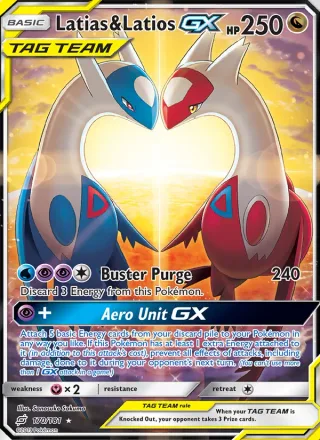
Latias & Latios GX from Team Up, the alternate full-art printing numbered 170, is the most valuable Pokemon-EX or Pokemon-GX card on Cardboard Alpha's own evaluated-price ledger. It priced at roughly $3,913.85 in near-mint, ungraded condition as of September 27, 2026.
That is the top of a two-generation lineage. In English, Pokemon-EX ran from 2012 through 2016, across the Black & White and XY eras. Pokemon-GX replaced it in 2017 and ran through 2019, across the Sun & Moon era. Both give up two Prize cards on a knockout instead of one, which is why this guide treats them as one universe.
What follows ranks the most valuable printings across both generations, looks at the TAG TEAM GX alternate full arts that hold the top two spots, and states plainly what this guide does not price.
Per Pokemon.com's official glossary, Pokemon-EX and Pokemon-GX share the identical rule-box drawback: "a stronger form of Pokemon with a special drawback: when your Pokemon-EX is Knocked Out, your opponent takes two Prize cards instead of one." The GX entry uses the same wording, swapping in "GX."
The GX entry adds one line: "Each Pokemon-GX has a powerful GX attack," and a separate glossary entry limits a player to one GX attack per game. Beyond that, the two share the same Prize-card trade, so this guide covers them as one universe.
Pokemon-EX (2012-2016 in English): returned with capital letters in Next Destinies (February 2012), five years after the lowercase-ex era ended, then ran through XY Evolutions (November 2016). Gives up two Prize cards on knockout.
Pokemon-GX (2017-2019 in English): replaced EX starting with the Sun & Moon expansion (February 2017; December 2016 in Japan). Also gives up two Prize cards on knockout, and each carries a GX attack, with one GX attack allowed per player per game.
TAG TEAM Pokemon-GX (2019 onward within the GX era): combines two or three Pokemon on one card. Per the official Team Up expansion page and Bulbapedia, a TAG TEAM-GX knockout gives the opponent three Prize cards instead of two, the steepest penalty of the three.
Every English release date above matches Cardboard Alpha's own catalog.
A naming note before the rankings
"EX" and "ex" have named three different Pokemon TCG mechanics across the game's history, and price lists do not always separate them.
The lowercase "ex" mechanic ran from 2003 to 2007, in the EX Ruby & Sapphire through EX Power Keepers block, and lowercase "ex" returned again as a third, separate mechanic starting in 2023. Neither is covered here. This guide prices only the capital-EX generation (2012-2016 in English) and its direct successor, Pokemon-GX (2017-2019 in English).
One enthusiast-press roundup on the older mechanic, published November 23, 2024, ranks cards like Rayquaza Star and Umbreon ex, which are lowercase-ex and Pokemon Star cards entirely outside this guide's scope. If a price list you find elsewhere mixes those cards in with Ultra Rare or Secret Rare capital-EX cards, it is describing a different rarity class.
The most valuable EX and GX cards right now
Every figure below is Cardboard Alpha's own evaluated price for the near-mint, ungraded printing, read for eval_date September 27, 2026. In the quality tier column, OFFICIAL means the figure was anchored to live asking prices against a prior evaluation, and INDICATIVE means it rests on a provider's quoted guide value. None of the ten printings recorded a same-day sale on that date, so no figure below is a sale price.
Card
Set
Rarity
Evaluated price (NM, ungraded)
Quality tier
Latias & Latios GX (170)
Team Up
Ultra Rare
$3,913.85
INDICATIVE
Gengar & Mimikyu GX (165)
Team Up
Ultra Rare
$1,725.99
OFFICIAL
M Charizard EX (108)
Flashfire
Secret Rare
$1,226.23
OFFICIAL
M Rayquaza EX (98)
Ancient Origins
Secret Rare
$1,200.00
OFFICIAL
Charizard GX (150)
Burning Shadows
Secret Rare
$991.53
OFFICIAL
Dialga EX (122)
Phantom Forces
Secret Rare
$971.26
OFFICIAL
Magikarp & Wailord GX (161)
Team Up
Ultra Rare
$947.78
OFFICIAL
Lugia-EX (134)
Plasma Storm
Ultra Rare
$938.50
INDICATIVE
Black Kyurem-EX (145)
Boundaries Crossed
Ultra Rare
$900.96
INDICATIVE
Gengar EX (114)
Phantom Forces
Ultra Rare
$801.00
OFFICIAL
The top two spots, and three of the top ten, belong to Team Up TAG TEAM-GX alternate full arts. The rest of the top ten splits between Mega-EX Secret Rares (M Charizard EX, M Rayquaza EX) and single-Pokemon GX/EX Secret and Ultra Rares from 2012 through 2017.
Top 6 EX/GX printings by evaluated price, September 27, 2026
The gap between first and second place ($2,187.86) is larger than the gap between second and tenth ($924.99). The first-place figure is an INDICATIVE guide-value reading, so the size of that lead deserves more caution than the ranking itself.
Team Up's alternate full arts
The three Team Up printings ranked above (cards 170, 165 and 161) are the alternate full-art versions of their TAG TEAM-GX Pokemon, per TheGamer's 2024 roundup. Other printings of the same Pokemon price far lower: Cardboard Alpha's ledger had the regular full-art Gengar & Mimikyu GX (164) at $483.89 and its rainbow secret rare (186) at $522.31 on September 27, 2026, against $1,725.99 for the alternate full art.
CardTrack.com's own tracker, read the same day as Cardboard Alpha's ledger (September 27, 2026), ranks Latias & Latios GX second and Gengar & Mimikyu GX fourth among all TAG TEAM-GX cards, with SM Black Star Promo printings in first and third, and orders the three Team Up alternate arts the same way Cardboard Alpha's ledger does. Its dollar figures run higher because each one is the higher of the ungraded or PSA 10 price, and Cardboard Alpha's own ledger carries no graded price for this universe.
The size of the move is worth stating plainly, with its own date attached. An enthusiast-press roundup put the same Latias & Latios GX printing at $858.18 on August 16, 2024. Two years and change later, Cardboard Alpha's own evaluated price for that printing sits at roughly $3,913.85. The two figures come from different sources and methods, so the comparison is directional only. It is historical movement, not a forecast, and it says nothing about where the price goes next.
Raw vs. graded: what this guide leaves out
Everything above is a raw, ungraded near-mint figure. Cardboard Alpha's own evaluated-price ledger carries no PSA, CGC, BGS, or TAG graded price for any Pokemon-EX, Pokemon-GX, or TAG TEAM-GX printing as of September 27, 2026, a gap confirmed by direct query rather than assumed.
CardTrack.com's higher figures suggest graded copies can carry a premium over raw, but that is external context, not a substitute number. This guide does not estimate one, and every figure here is a raw-card reference only.
Quality tier matters here too. Three of the ten rows in the table above, including the first-place card, carry an INDICATIVE tag, meaning the figure rests on a provider's quoted guide value rather than on live asking prices or a sale. That is disclosed per row rather than smoothed into a single blended number.
None of the ten printings recorded a same-day sale on September 27, 2026. Track a specific printing's price, depth, and score over time on the Wall rather than relying on a single dated snapshot, and compare it against the rest of the Sun & Moon era or against the Black & White era and the XY era it grew out of.
Frequently asked questions
What is the most valuable Pokemon EX or GX card?
On Cardboard Alpha's evaluated-price ledger read September 27, 2026, Latias & Latios GX from Team Up (the alternate full art, card 170) is the most valuable printing across both generations at roughly $3,913.85 in near-mint, ungraded condition. That figure carries an INDICATIVE quality tier, meaning it rests on a provider's quoted guide value rather than on a recorded sale.
What is the difference between Pokemon-EX and Pokemon-GX cards?
Both give up two Prize cards instead of one when knocked out, per Pokemon.com's official glossary. In English, Pokemon-EX ran from Black & White through the XY era (2012-2016); Pokemon-GX replaced it starting with the Sun & Moon expansion in February 2017 and added GX attacks, with a limit of one GX attack per player per game. The two are back-to-back generations of the same trade-off, not competing mechanics.
What is a TAG TEAM GX card and why are they worth more?
TAG TEAM Pokemon-GX, introduced in Team Up (2019), combine two or three Pokemon on one card and give up three Prize cards on knockout instead of two, per the official Team Up expansion page. The priciest printings on Cardboard Alpha's ledger, Latias & Latios GX and Gengar & Mimikyu GX, are their alternate full-art versions, not every TAG TEAM GX card in the set.
Are these the same cards as 'most expensive Pokemon ex' lists?
No, and the naming is genuinely confusing. Lowercase Pokemon-ex ran 2003-2007 and returned again in 2023 as a third, separate mechanic. This guide covers only the capital-EX generation (2012-2016 in English, Black & White through XY) and its direct successor, Pokemon-GX (2017-2019 in English).
Do PSA 10 graded copies of these cards cost more?
Often, yes: CardTrack.com, which reports the higher of the ungraded or PSA 10 price, listed Latias & Latios GX (Team Up 170) at $15,750 on September 27, 2026. But Cardboard Alpha's own evaluated-price ledger has no PSA-10 figure for any EX, GX, or TAG TEAM-GX printing as of September 27, 2026. This guide prices raw, ungraded cards only and does not substitute an external graded estimate for that gap.
Sources
Pokemon TCG Glossary, Pokemon.com (The Pokemon Company International) Official / primary source · accessed September 27, 2026
Pokemon TCG: Sun & Moon, Team Up, Pokemon TCG (The Pokemon Company International) Official / primary source · accessed September 27, 2026
Cardboard Alpha catalog and evaluated-price ledger (production database), Cardboard Alpha Official / primary source · accessed September 27, 2026
Jackie Chung covers the Pokémon TCG secondary market for Cardboard Alpha, with a focus on grading economics and set value guides. She spends most of her research time in population reports and grade-spread data, tracing how submission volume, print runs, and grading-company standards shape the premium between a raw card and its graded counterparts across different eras. Her set guides are built the same way: grounded in published pricing and pop data first, with market narrative kept separate from the numbers behind it.
Jackie Chung's articles describe market history and mechanics using published population and pricing data. They are informational and are not personalized investment advice.