How to Read an Order Book for Pokemon Card Liquidity
Pokemon cards have no centralized bid-and-ask order book like a stock, but the visible ask ladder on active listings still tells you how many sellers stand behind a price and how far a real trade would move it.
A Pokemon card has no single order book the way a listed stock does. What you can read instead is the ask side only: active, delivered-price fixed listings from cheapest to most expensive, for one specific card and condition.
Counting how many sellers stand behind that ladder, how concentrated it is, and how far a real purchase would move through it is the closest thing the hobby has to reading a stock's order book. This piece walks through how to do that on a real, deep book read from Cardboard Alpha's own live market-data ledger on September 26, 2026, then on the single-seller case at the other extreme.
What an order book actually is
On a stock exchange, a limit order is "an order to buy or sell a stock at a specific price," per the U.S. Securities and Exchange Commission. An order book is the running list of those resting orders, split into a bid side, buyers waiting at a price, and an ask side, sellers waiting at a price, stacked from the best price outward.
Depth is how many units sit at each price level. A thick book absorbs a large trade with barely a price move. A thin one can jump several price levels on a single order.
Why Pokemon cards don't post one
A Pokemon card trades across marketplaces, not one exchange, and neither TCGplayer nor eBay posts a public bid ladder for an individual card. TCGplayer's and eBay's active fixed-price listings are the ask side: a seller names a price and waits for a buyer.
The bid side barely exists in public. eBay's own seller guidance describes the two formats a listing can take: auction-style, where "buyers decide what your item is worth" by bidding, and Buy It Now, which "lets your buyers make a purchase right away" at a fixed price.
Fixed-price listings (TCGplayer, eBay Buy It Now): a real, visible ask. Anyone can see the price and quantity right now.
Auction listings (eBay): the closest thing to a visible bid, but only while the auction runs, and only the current price, not the maximum bids that interested buyers have set behind it.
Completed sales: not a live quote. They show where the last trade happened, not where the next one will.
On those two marketplaces, that structure makes a card's market one-sided by default. Every fixed-price ask is visible. No resting bid is, outside of a live auction.
Reading a deep book: Charizard ex 223/197
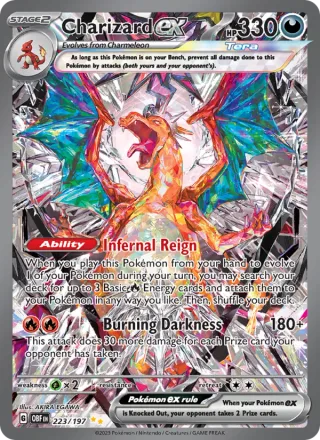
Charizard ex 223/197, the Special Illustration Rare from Obsidian Flames, is a useful example precisely because its book is deep. Cardboard Alpha's own live ledger read 119 active raw Near Mint TCGplayer listings, from 119 distinct sellers, on September 26, 2026 at 21:42 UTC.
The cheapest six rungs of that ladder, ordered by delivered price, cheapest first:
Delivered price
Units
Sellers
Cumulative units
Cumulative cost
$93.99
1
1
1
$93.99
$94.99
2
2
3
$283.97
$95.00
3
3
6
$568.97
$95.98
2
2
8
$760.93
$95.99
1
1
9
$856.92
$96.93
1
1
10
$953.85
Source: Cardboard Alpha's live market-data ledger, active raw Near Mint delivered-price listings, read September 26, 2026, 21:42 UTC.
Reading only the top line misreads the book. The single cheapest listing is $93.99, but buying ten copies costs $953.85 total, a $95.39 average, because the ladder climbs a little with every rung and the tenth unit comes off the sixth rung, at $96.93.
119 sellers, 142 raw Near Mint units live in Cardboard Alpha's order-book ladder as of September 26, 2026.
That six-rung sample is a fraction of the book the ledger captured. Across all 119 sellers, 142 total raw Near Mint units were listed on the same read, and the largest single seller held 4 of them, about 2.8 percent, so no one seller controlled more than a sliver of the supply.
When the book is one seller deep
The opposite case is a book with one listing from one seller. There is no second rung to check against. Whatever that seller decides next, raising the price, pulling the listing, or holding, is the book, because nothing else stands behind it.
A thin book is not automatically a bad sign for the card itself; it can simply mean few copies are for sale right now. It is a warning about the price, though. A lone ask has not been tested against a second seller the way Charizard ex 223/197's $93.99 was tested against 118 others.
Check more than one marketplace before calling a book one seller deep. A single source can show a lone listing for a print that another marketplace lists dozens of times, so a one-seller read is only as complete as the listings behind it.
Concentration, scored: the HHI
The U.S. Department of Justice scores market concentration with the Herfindahl-Hirschman Index: square each participant's market share, then add the squares. Its scale approaches zero when many firms of roughly equal size share a market and reaches a maximum of 10,000 when a single firm controls it, with 1,000 to 1,800 classified as moderately concentrated and anything above 1,800 as highly concentrated.
Cardboard Alpha's own ladder applies the same formula to each seller's share of listed units and reports it on a 0-to-1 fractional scale, one ten-thousandth of the DOJ number. Charizard ex 223/197's 0.0104 converts to roughly 104 on the DOJ's 10,000-point scale, far below the 1,000-point line where the DOJ starts calling a market moderately concentrated. A single-seller book scores 1.0, exactly 10,000, the DOJ's maximum for a market controlled by a single firm.
Book concentration on the DOJ's HHI scale
Charizard ex 223/197 book (119 sellers)104HHI points
DOJ moderately concentrated, from1,000HHI points
DOJ highly concentrated, above1,800HHI points
Single-seller book (DOJ maximum)10,000HHI points
Charizard ex 223/197 value from Cardboard Alpha's live market-data ledger, raw Near Mint book, read September 26, 2026 (0.0104 on the ledger's 0-1 scale). Thresholds and maximum per the U.S. DOJ's Herfindahl-Hirschman Index page.
What the ask ladder can't show you
Every number above describes supply, not demand. Nothing in a fixed-price ladder says how many buyers would pay $93.99, or whether the next sale clears there at all.
Auctions are the one exception, while they run. eBay's own bidding guidance describes automatic bidding: a buyer sets a maximum, and eBay "bid[s] in increments on your behalf to keep you in the lead but only up to your limit," in steps scaled from $0.05 when the current price is under $1 up to $100 once it reaches $5,000. eBay states plainly that a bid itself "is a contractual obligation," not a casual expression of interest.
A live auction's current bid is therefore the one moment TCGplayer and eBay show a real, escalating buy-side number for a card. Once the auction ends, that number is a finished result rather than a standing bid, and the book resets to ask-only until another auction opens.
Five checks before you trust a book
Count the sellers, not the listings. One seller can post several units at several prices; distinct-seller count, not listing count, is the real concentration signal.
Look past the cheapest rung. The size you actually want to buy or sell may sit several rungs deeper, at a materially different price.
Score the concentration. An HHI near the DOJ's low end means many sellers compete on price; an HHI near 10,000 means one seller sets it unchallenged.
Treat a single-seller book as unpriced, not cheap. A lone ask has not been tested against a competing seller the way a deep ladder's cheapest rung has.
Remember the bid side is mostly invisible. A live auction's current bid is the one real-time exception; everything else is an ask or already history.
Cardboard Alpha's own screener puts a depth figure beside price across the cards it covers, so a reader does not have to rebuild the ladder by hand. For what happens once real size actually trades into a book like these, see Absorption and Depth. For why a hammer price and a BIN floor are never the same number, see why auction prices and BIN floors tell different stories, and for why a thin population doesn't guarantee a thick book, see liquidity risk in Pokemon cards.
Frequently asked questions
What's the difference between an order book and TCGplayer's active listings?
A full order book shows both a bid side and an ask side. TCGplayer's active listings are only the ask side, the prices sellers are asking, with no buyers' resting bids shown alongside them.
Can you see actual buy orders for a Pokemon card the way you can for a stock?
Not on TCGplayer or eBay, outside of a live eBay auction. A running auction's current bid is a real, escalating buy-side number while the auction lasts; once it ends, that figure is a finished result rather than a standing order.
What does an HHI of 1.0 mean for a card's book?
It means one seller holds the entire visible ask side, per the Herfindahl-Hirschman Index's own definition of a fully concentrated market. The next unit sold at that print and condition has to come from that same seller, or from a listing that has not yet appeared.
Is a deep book, like Charizard ex 223/197's 119 sellers, the typical case?
Not necessarily. Depth varies card by card and hour by hour, so one card's deep book says nothing about another print or condition; each book has to be read on its own, ideally on more than one marketplace.
Does counting listings instead of distinct sellers give a false liquidity read?
Yes. One seller can list the same card at several price points or quantities, which inflates a raw listing count without adding real competition. Distinct-seller count and HHI correct for that.
Ryan Shugars is an avid Pokémon card collector who builds the market-data tooling behind Cardboard Alpha. He collects across multiple eras, tracks population reports and price movement as a matter of habit, and started building Cardboard Alpha to get a straight answer to questions the existing price guides couldn't: what's actually trading, what's just an asking price, and what a grade is really worth on a given card right now. He writes from that same collector's vantage point, close to the data, skeptical of hype, and always checking a claim against the ledger before it goes in an article.
Ryan Shugars is a collector and the builder of Cardboard Alpha's data systems, not a licensed financial advisor. Articles he writes or edits describe market history and mechanics; they are informational and are not personalized investment advice.