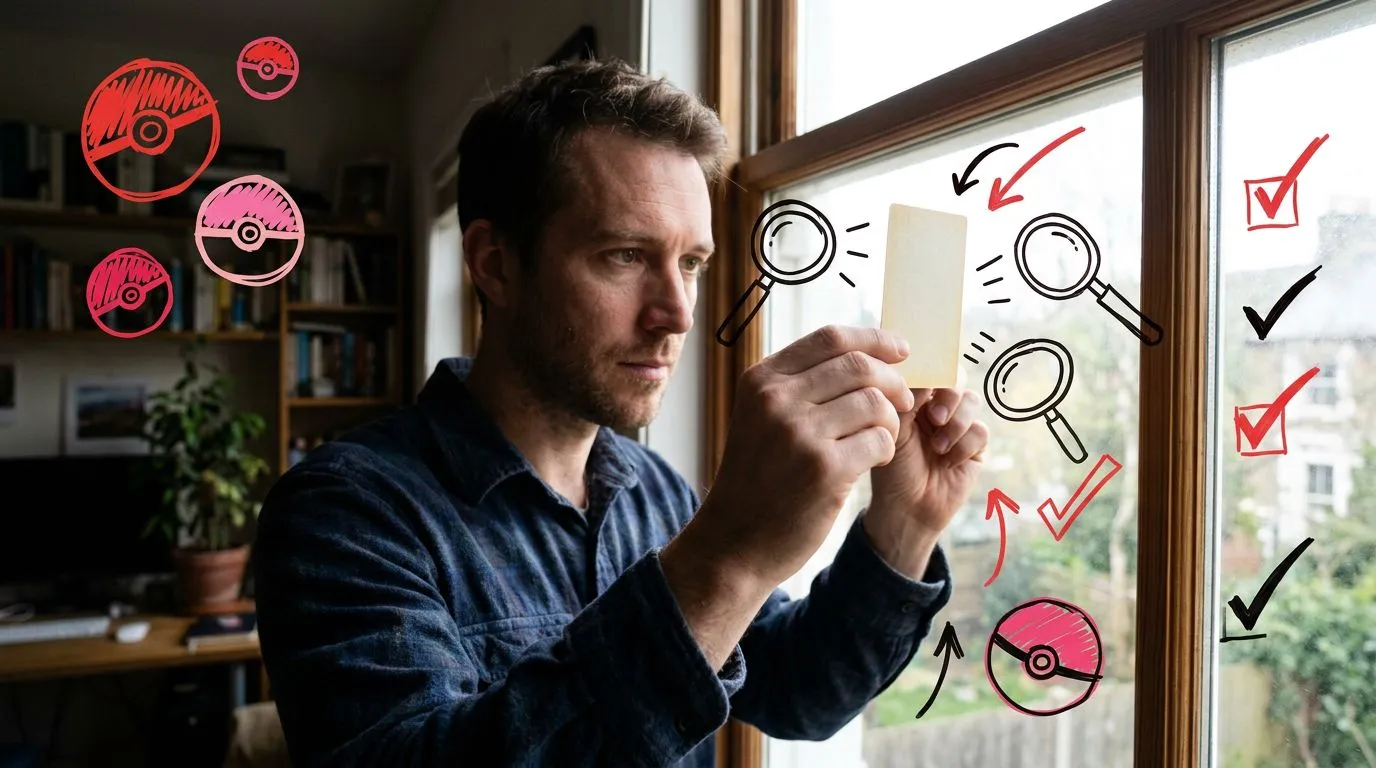
Pokemon Support's own guidance comes down to three checks: a bright-light test, knowing what official products look like, and skepticism of any pack priced far below suggested retail.
Three checks can help screen out fake Pokemon cards without any special tools. Hold the card up to a bright light, know what official decks and packaging look like, and treat any pack priced far below suggested retail as a warning sign. That is Pokemon Support's own guidance for a suspected counterfeit, not just a hobbyist rule of thumb.
None of those checks replaces a formal ruling from a grading company. CGC's published grading scale reserves its Authentic and Authentic Altered labels for cards that are genuine, and prints Authentic Altered for a genuine card that has been altered, naming recoloring and trimming as examples.
Counterfeiters do not target random cards. One well-documented case ties directly to high-demand chase cards, found at one seller's home in a 2023 Japanese counterfeiting case.
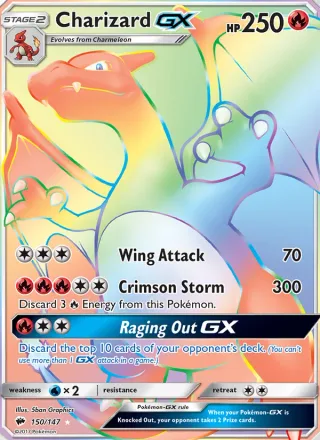
Burning Shadows rainbow Charizard GX cards were among about 400 suspected-counterfeit Pokemon cards seized from a single seller arrested in Japan in October 2023, per PokeBeach's reporting.
The fastest checks anyone can run
Pokemon Support's own troubleshooting guidance for a suspected fake or counterfeit card comes down to three practical checks, none of which require a loupe or a UV light.
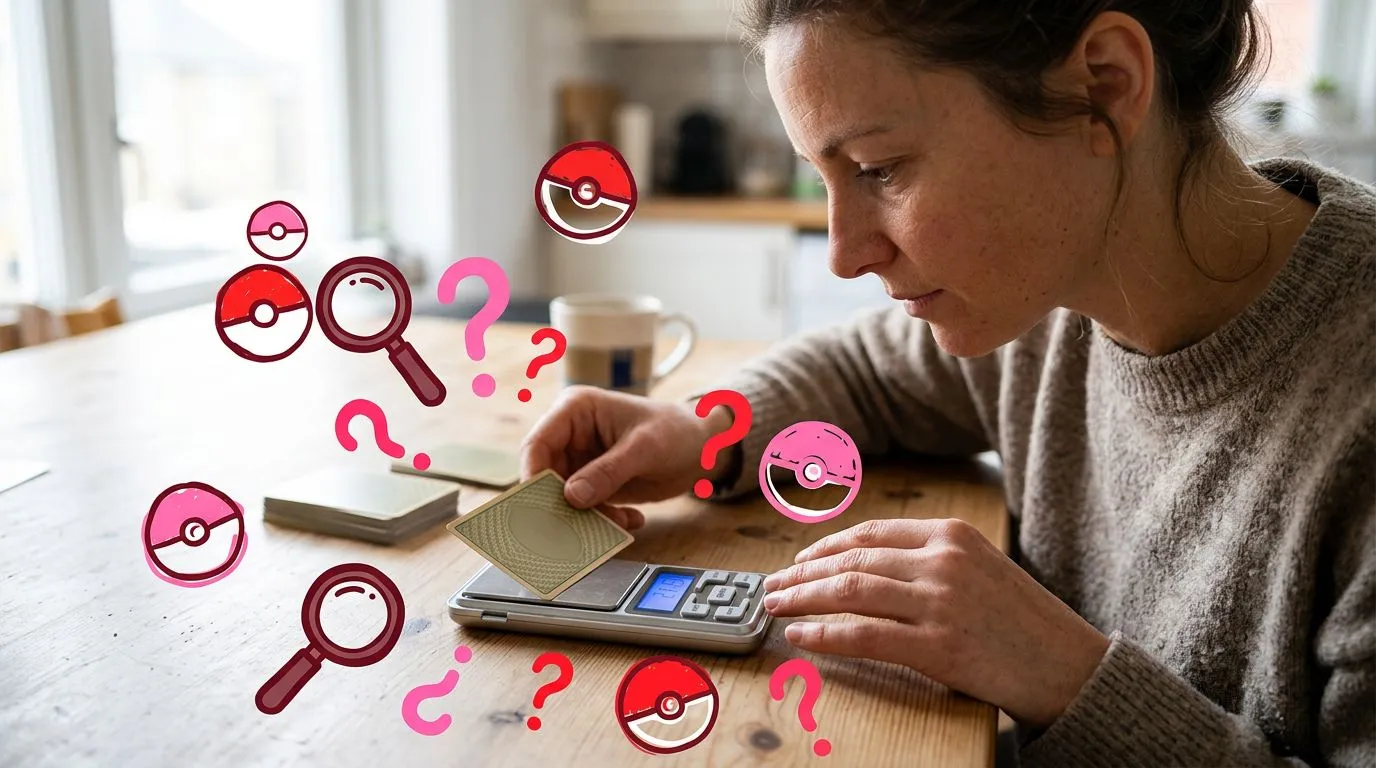
Hold it to a light. Counterfeit cards are often easy to see through when held up to a bright light, per Pokemon Support's guidance. A card that looks unusually see-through compared to cards you already know are genuine is a reason to look closer.
Know the real product. Pokemon Support points customers to the product images on its website: knowing what official decks and packaging look like keeps a knockoff that looks nothing like the real thing from fooling you.
Question a below-retail deal. A pack of cards priced dramatically below suggested retail is, in Pokemon Support's own words, a "near certain warning" that you are being sold counterfeit merchandise.
The light test, explained
The light test is not a hobbyist workaround. It is the method Pokemon Support's own counterfeit guidance calls "a good way to identify a fake," and it costs nothing beyond a lamp or a sunny window.
What Pokemon Support does not publish is a numeric threshold, a defined distance, or a description of exactly why some counterfeits let more light through than others. The guidance is a first screen: if a card looks obviously more translucent than a genuine copy, that is a reason for more scrutiny, not a lab result.
What it doesn't prove
A card that passes the light test is not automatically confirmed genuine. Neither Pokemon Support's guidance nor CGC's published grading scale gives a pass/fail brightness reading for it. Treat the light test as the fastest filter, not the final word, and follow it with the comparison step and, for anything valuable, a second opinion from a shop or a grading company.
Compare card back, font, and set symbol
Pokemon Support's advice to know the real product extends naturally to a side-by-side check, which works best with a genuine reference card from the same set in hand, or a trusted photo of one. A few details are worth lining up.
Font weight and spacing. Text that looks noticeably thicker, thinner, or more unevenly spaced than on your reference card is a mismatch worth investigating.
Set symbol and collector number. Line both up against the reference. A symbol that looks slightly redrawn, or a number in an unfamiliar font or position, is a reason to look closer.
Card back and packaging. Pokemon Support specifically calls out familiarizing yourself with official decks and packaging as protection against knockoffs that do not resemble the real product at all.
Genuine, altered, or counterfeit
Collectors sometimes use "fake" loosely, but a genuine card that has been altered and a card that was never genuine to begin with are different problems. CGC's published grading scale defines the genuine side of that line precisely, and trimmed and recolored cards fall on that side. Factory print errors on genuine cards are a separate question, covered in how miscut and error cards are priced.
Label
What it means
Where it comes from
Authentic (AU)
A genuine card that cannot receive a numeric grade, for example one with missing card stock or below CGC's minimum size requirement
CGC's published grading scale
Authentic Altered (AA)
A genuine card that has been altered, with recoloring and trimming given as CGC's own examples
CGC's published grading scale
Gem Mint 10 / Pristine 10
A genuine card meeting a company's top centering, corner, and surface standard, for example CGC's Gem Mint 10 centering ceiling of approximately 55/45 on the front and 75/25 on the back
CGC's published grading scale
Source: CGC Cards Grading Scale, accessed September 2026.
CGC's page defines Authentic and Authentic Altered for cards that are genuine but cannot take a standard number. It does not itself lay out a counterfeit-detection procedure, which is exactly why the checks earlier in this guide, run before you ever submit a card, matter on their own.
The numeric standards behind Gem Mint 10 and Pristine 10, covered in full in the PSA, CGC, and BGS grading criteria guide, only apply once a card's authenticity is already settled. Centering ratios and corner sharpness describe condition, not whether the card is real.
Which cards counterfeiters target, and why
Counterfeiters follow demand. In October 2023, police in Annaka City, Japan arrested a 21-year-old seller after he sold four counterfeit Pokemon cards to two buyers for a combined 186,100 yen, about $1,250, in October 2022. One buyer grew suspicious and alerted police the following month; Nintendo appraised the cards at police request and confirmed they were fake.
A search of the seller's home turned up about 400 suspected-counterfeit Pokemon cards, printed in English and Japanese. Among them were Sun & Moon Burning Shadows "rainbow" Charizard GX cards, like the one shown above, and cards from the 151 set, per PokeBeach's reporting. Investigators had not determined where the seller obtained the counterfeits.
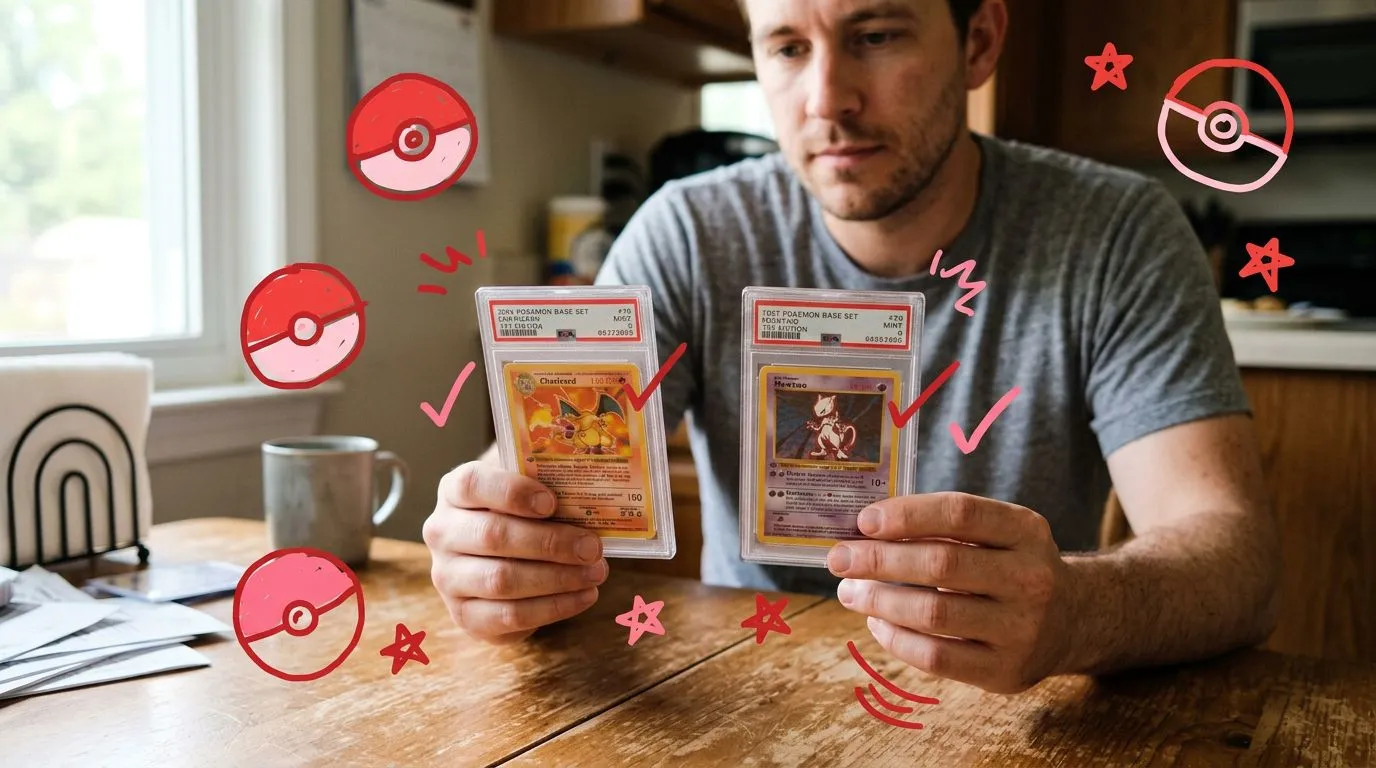
The same logic plausibly extends to vintage holo rares: high demand and a high resale price are what make faking a card worth a counterfeiter's time, in a way a common card never is.
Illustrative example of a high-demand vintage holo rare, the print tier the light test and comparison checks matter most for.
Why one bad sale costs more
A dated market price is only useful if it reflects a real transaction between two real cards. A counterfeit that trades hands and gets logged as a comparable sale, before anyone catches it, is a bad data point sitting inside the same pool of sales that price guides and screeners draw from.
That is a reason to flag a suspected fake to the platform it sold on right away, rather than quietly reselling it. The harm is not only to whoever buys it next.
The enforcement record, by the numbers
Counterfeiting Pokemon cards is not a fringe problem, and enforcement against it spans a company statement, a police arrest, and a customs seizure large enough to measure in tons.
Date
Action
Scale
September 2023
The Pokemon Company warns against "replica" and "metal" counterfeit cards, says it is working with sales-platform operators to halt their sale and is considering legal measures
Policy notice, no unit count given
October 2023
Annaka City police arrest one seller in Japan
About 400 suspected-counterfeit Pokemon cards seized; 4 cards had sold for ¥186,100 (about $1,250)
November 2021
Chinese customs intercept a shipment bound for the Netherlands
More than 7.6 tons, about 400,000 counterfeit booster packs
Source: The Pokemon Company's September 19, 2023 notice, PokeBeach (October 2023 reporting), and PokeGuardian (November 2021 reporting).
A company statement, a police arrest, and a customs seizure measured in tons do not share a common unit. Together, they show enforcement happening at three different levels: the rights holder, local police, and customs.
If you already own a suspected fake
Compare it against a card or product you already trust, and take anything you are still unsure about to a local trading-card shop; Pokemon Support names a specialist shop as one place that may be able to evaluate a suspect card. For anything valuable enough to be worth the fee, a grading company gives a more formal ruling: under CGC's published scale, its Authentic and Authentic Altered labels go only to cards that are genuine.
None of this replaces watching where a card actually comes from. A comparison against a trusted reference, a light test, and a healthy skepticism of any deal priced well under retail are a first screen, and they cost nothing but a few minutes. If a purchase does turn out to be fake, the steps after buying a fake card depend on the platform and how it was paid for.
What is the fastest way to check if a Pokemon card is fake?
Pokemon Support recommends holding the card up to a bright light, since counterfeit cards are often easy to see through, and knowing what official decks and packaging look like. A pack of cards priced dramatically below suggested retail is also, in Pokemon Support's own words, a near-certain warning sign.
Does passing the light test mean a card is genuine?
Not on its own. Pokemon Support recommends the light test as a first check, but publishes no numeric threshold or brightness reading to confirm authenticity. Treat it as the fastest filter, then compare the card to a trusted reference and, for anything valuable, get a second opinion from a shop or grading company.
Is a CGC Authentic Altered card the same as a counterfeit?
No. CGC's Authentic Altered label is for a genuine card that has been recolored or trimmed, per CGC's own published grading scale. A counterfeit card was never a genuine Pokemon-printed card to begin with, which is a different problem than an authentic card someone later altered.
Which Pokemon cards do counterfeiters target most?
One well-documented case is an October 2023 Japan arrest, in which police seized about 400 suspected-counterfeit Pokemon cards from one seller, including Sun & Moon Burning Shadows rainbow Charizard GX cards and cards from the 151 set, per PokeBeach's reporting. That pattern suggests high-demand, high-resale-value chase cards are what make counterfeiting worth a seller's time, in a way common cards are not.
What has Pokemon done about counterfeit sellers?
In a September 19, 2023 notice, The Pokemon Company warned against 'replica' and 'metal' counterfeit cards and said it was working with sales-platform operators to halt their sale while investigating and considering legal measures. The following month, police in Japan arrested a seller of counterfeit Pokemon cards after Nintendo confirmed the cards were fake. Separately, Chinese customs intercepted more than 7.6 tons of counterfeit Pokemon cards, about 400,000 booster packs, bound for the Netherlands in November 2021.
Japanese Police Arrest Suspect for Selling Counterfeit Pokemon Cards Online, PokeBeach Industry press · accessed September 26, 2026
Nearly 7000kg of Counterfeit Pokemon Cards Headed to the Netherlands Have Been Intercepted by Chinese Customs, PokeGuardian Industry press · accessed September 26, 2026
Ryan Shugars is an avid Pokémon card collector who builds the market-data tooling behind Cardboard Alpha. He collects across multiple eras, tracks population reports and price movement as a matter of habit, and started building Cardboard Alpha to get a straight answer to questions the existing price guides couldn't: what's actually trading, what's just an asking price, and what a grade is really worth on a given card right now. He writes from that same collector's vantage point, close to the data, skeptical of hype, and always checking a claim against the ledger before it goes in an article.
Ryan Shugars is a collector and the builder of Cardboard Alpha's data systems, not a licensed financial advisor. Articles he writes or edits describe market history and mechanics; they are informational and are not personalized investment advice.