Most bulk Pokemon cards are worth pennies: on October 12, 2026, the median common or uncommon from Sword & Shield through Mega Evolution was $0.21, against $6.38 for EX era cards. Age, reverse holos, Pikachu and Master Ball patterns separate the cards that clear $1.
Most bulk Pokemon cards are worth pennies, but older ones often are not. On October 12, 2026, Cardboard Alpha's evaluated raw Near Mint prices put 5,904 of 19,575 priced commons and uncommons (30.2 percent) at $1 or more, and 4,295 of those came from the four oldest eras, Wizards of the Coast through HeartGold & SoulSilver (1999 to early 2011).
From Sword & Shield through Mega Evolution, the median common or uncommon was $0.21 and 93.5 percent were under 50 cents. What lifts a card above that floor is a short list: its set's age, a reverse-holo finish, a Pokemon such as Pikachu, tournament demand, and a few special print runs, led by the Master Ball patterns in Prismatic Evolutions, Black Bolt and White Flare.
What bulk means here
TCGplayer's July 15, 2026 list of the 100 most expensive bulk cards defines bulk as Rare, Uncommon and Common cards, counts Near Mint copies only, and treats regular and reverse-holo prints as separate cards. A circle marks a Common, a diamond an Uncommon and a star a Rare, per TCGplayer's rarity guide, and Cardboard Alpha's rarity-symbol guide covers the rest.
A reverse holo, officially a parallel foil, has foil on everything except the art box, per the same guide.
The tables cover English commons and uncommons from main booster sets, with Rares in one table, and count each finish and foil pattern as its own print. They leave out 1st Edition and other stamped prints, Shadowless and other named variants, jumbo cards, and promo, trainer-kit and McDonald's products.
An evaluated price is one daily estimate per card and condition, built from recorded sales where they exist and from asking prices or a quoted market-guide value where they do not.
Bulk value by era
Age comes first. The four oldest eras hold 73 percent of the commons and uncommons priced at $1 or more and 88 percent of those at $10 or more.
Era
Prints
Median
$1 or more
$5 or more
$10 or more
Wizards of the Coast
1,361
$6.41
88.2%
54.6%
42.2%
EX
1,984
$6.38
80.2%
55.0%
43.0%
Diamond & Pearl
1,683
$2.06
64.9%
29.4%
14.8%
HeartGold & SoulSilver
604
$3.49
67.9%
41.2%
23.8%
Black & White
1,373
$0.69
39.4%
13.6%
5.5%
XY
1,876
$0.46
21.7%
6.2%
2.7%
Sun & Moon
2,535
$0.37
15.2%
4.2%
1.8%
Sword & Shield
2,844
$0.21
1.1%
0.1%
Under 0.1%
Scarlet & Violet
4,124
$0.21
5.6%
2.3%
1.7%
Mega Evolution
1,191
$0.22
0.8%
0%
0%
Commons and uncommons, regular and reverse-holo prints, raw Near Mint, Cardboard Alpha evaluated prices, October 12, 2026. Shares count priced prints; even-count medians are the midpoint of the two middle prints. The Wizards of the Coast row likely sits on the high side, as explained under How firm these prices are.
Commons and uncommons priced at $1 or more, by era
Wizards of the Coast88.2%
EX80.2%
Diamond & Pearl64.9%
HeartGold & SoulSilver67.9%
Black & White39.4%
XY21.7%
Sun & Moon15.2%
Sword & Shield1.1%
Scarlet & Violet5.6%
Mega Evolution0.8%
Share of priced prints, English main sets, raw NM. Cardboard Alpha, October 12, 2026.
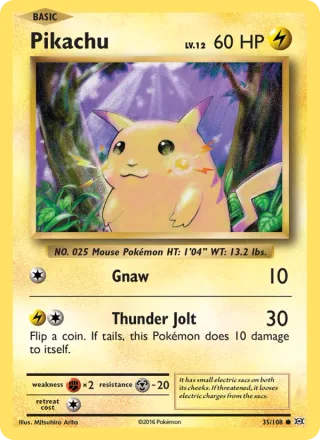
Older commons are not bulk by default. Base Set's Pikachu, a Common, was $10.79 on October 12, 2026, with three same-day sales behind the price.
Unlimited print. Raw NM $10.79, Cardboard Alpha, October 12, 2026.
From Sword & Shield on, the picture flattens: 64.1 percent of 8,159 priced prints were under 25 cents and 274 (3.4 percent) reached $1. Scarlet & Violet's 5.6 percent comes mostly from one kind of print: 168 of its 232 dollar-plus prints are Master Ball patterns, and without them 64 of 3,954 (1.6 percent) reach $1.
Finish and rarity
A reverse holo is priced above its regular twin almost every time. Across 8,889 commons and uncommons printed in both finishes, the reverse holo cost more in 98.1 percent of pairs, at a median 2.66 times. The multiple was 8.07 times in the four oldest eras, 2.58 times from Black & White to Sun & Moon and 1.85 times from Sword & Shield on.
Print
Oldest four eras
Black & White to Sun & Moon
Sword & Shield on
Common, regular
$1.06
$0.28
$0.14
Common, reverse holo
$18.75
$0.66
$0.26
Uncommon, regular
$1.73
$0.31
$0.15
Uncommon, reverse holo
$11.91
$0.70
$0.27
Rare, regular
$6.96
$0.60
$0.22
Rare, reverse holo
$29.66
$1.37
$0.31
Median raw NM evaluated price, Cardboard Alpha, October 12, 2026. Reverse-holo rows include foil-pattern prints; holofoil Rares are not in the table.
Rarity adds less than era or finish. A regular Rare was about 6.6 times a regular Common in the oldest eras ($6.96 against $1.06) and about 1.6 times from Sword & Shield on ($0.22 against $0.14).
Modern bulk that carries value
Four groups stand out from Sword & Shield on.
Master Ball patterns
Prismatic Evolutions, Black Bolt and White Flare add reverse holos with a Poké Ball or Master Ball foil pattern. TCGplayer's pull-rate articles report a Master Ball foil in about 1 pack in 20 for Prismatic Evolutions (4.92 percent of 1,200-plus packs, published January 17, 2025) and 1 in 19 for Black Bolt and White Flare (5.14 percent of 700-plus packs, published July 21, 2025), against about 1 in 3 for Poké Ball foils.
Set
Master Ball prints
Master Ball median
Poké Ball median
Regular median
Prismatic Evolutions
46
$2.52
$0.31
$0.13
Black Bolt
62
$11.26
$0.41
$0.14
White Flare
62
$10.64
$0.39
$0.14
Commons and uncommons, raw NM, Cardboard Alpha evaluated prices, October 12, 2026.
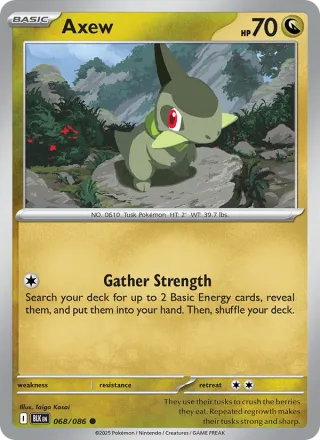
Of the 170 Master Ball commons and uncommons, 168 were at $1 or more and 72 at $10 or more. Black Bolt's Axew shows the spread: $0.16 regular, $0.32 with a Poké Ball pattern and $4.27 with a Master Ball pattern.
Common. Regular $0.16, Poké Ball $0.32, Master Ball $4.27. Raw NM, Cardboard Alpha, October 12, 2026.
TCGplayer left these patterns out of its July 15 bulk list because, in its words, "Otherwise, they would have been the entire list." One caution: 137 of the 170 Master Ball prices are anchored on asking prices rather than sales.
Pikachu and Eevee
Some Pokemon carry a premium: of 50 Pikachu common and uncommon prints from XY through Mega Evolution, 36 were at $1 or more, with a median of $2.25, against $0.25 for all other commons and uncommons from those eras. Eevee's 46 prints had a median of $0.79, and Evolutions' Pikachu was $1.31 regular and $6.01 reverse holo.
Common. Regular $1.31, reverse holo $6.01. Raw NM, Cardboard Alpha, October 12, 2026.
Gallery numbers
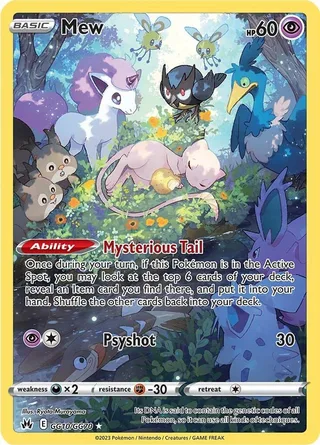
In Cardboard Alpha's catalog, Trainer Gallery cards are numbered TG01 onward and Crown Zenith's Galarian Gallery cards GG01 onward. Across the Brilliant Stars, Astral Radiance and Lost Origin Trainer Galleries and the Galarian Gallery, all 69 cards the catalog labels Rare were at $1 or more, with a median of $6.30. Mew GG10, the highest at $62.47, rests on seven same-day sales.
Rare. Raw NM $62.47, from seven same-day sales. Cardboard Alpha, October 12, 2026.
Tournament staples
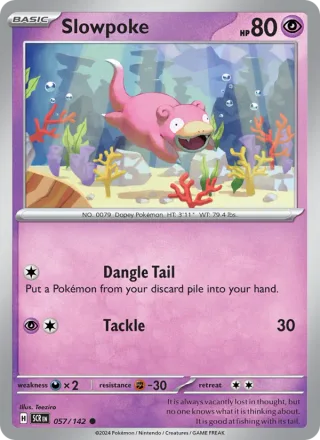
Demand from tournament players can lift a modern common. TCGplayer's July 15 bulk list put the Stellar Crown Slowpoke reverse holo first at $5.62 on July 7 and credited player demand and thin listings; Cardboard Alpha's October 12 price for it was $5.63.
Common. Reverse holo $5.63. Raw NM, Cardboard Alpha, October 12, 2026.
The Hilda, Mist Energy and Dunsparce reverse holos from that list were $2.24, $2.48 and $3.07 on October 12, and TCGplayer noted Mist Energy drifting down after a spike, so such prices can fade.
A sorting order for a bulk box
Set age: the four oldest eras had a median of $4.18 across commons and uncommons, against $0.21 from Sword & Shield on.
Finish: reverse holos are 49 percent of commons and uncommons but 62 percent of those at $1 or more and 81 percent of those at $10 or more.
Pokemon: Pikachu's median was $2.25 and Eevee's $0.79, against $0.25 for the rest, and tournament staples can lift a common too.
Patterns and numbers: 168 of 170 Master Ball prints and all 69 Rare-labelled TG and GG gallery cards were at $1 or more.
These are prices for single cards, not offers for a box. On TCGplayer, an order under $5 carries a $1.49 minimum shipping charge, and a Level 1 to 4 Marketplace seller pays a 10.75 percent commission on items and shipping plus a transaction fee of 2.5 percent of the order total and $0.30, per TCGplayer's fee examples, last updated June 18, 2026.
For one $1.00 card shipped at the $1.49 minimum, those fees come to about 63 cents before sales tax, with postage and supplies on top. On a single-card order the fees match or exceed the card's own price at 57 cents and below, which covers 94.6 percent of the 8,159 Sword & Shield-onward prints; how marketplace fees eat into a sale compares channels.
This guide quotes no shop buylist rate, because no published rate could be tied to a page version dated on or before October 12, 2026.
How firm these prices are
Of the 19,575 priced commons and uncommons, 17,722 (90.5 percent) rest on a quoted market-guide value, 1,137 on asking prices and 259 on recorded sales (some blended with asks), and 457 are carried forward from an earlier day. A further 110 had no price and are left out of every share.
The oldest era has the thinnest evidence: 435 of its 1,361 priced prints are carried forward. Using only fresh prices lifts that era's median from $6.41 to $14.84 and its $1-plus share from 88.2 to 90.2 percent.
For 98 Unlimited commons and uncommons, mostly Gym, Neo and Team Rocket cards, the carried price equals the 1st Edition price, which runs higher in 92 percent of Wizards-era cards where the two prices differ, so the era's median and shares likely sit on the high side.
TCGplayer defines its Market Price as compiled from recent completed sales and its Listed Median as the median of current listings only, which can differ sharply from sale prices. A sold price is the better check on any single card.
Cardboard Alpha's screener screens the covered card universe on current prices; every figure in this guide is a dated read.
Frequently asked questions
Are bulk Pokemon cards worth anything?
Mostly pennies. On October 12, 2026, the median common or uncommon from Sword & Shield through Mega Evolution was $0.21 in Cardboard Alpha's evaluated raw Near Mint prices, and 93.5 percent were under 50 cents. Older cards differ: 80.2 percent of EX era commons and uncommons were priced at $1 or more, and the Wizards of the Coast era's 88.2 percent likely sits on the high side because some of its Unlimited prices carry the 1st Edition value.
Which bulk Pokemon cards are worth money?
In Cardboard Alpha's prices, commons and uncommons at $1 or more cluster in the four oldest eras (73 percent of them), in reverse holos (62 percent) and, in Scarlet & Violet, in Master Ball pattern prints (168 of 232). Pikachu prints from XY onward had a median of $2.25, and all 69 Rare-labelled Trainer Gallery and Galarian Gallery cards were at $1 or more.
Are reverse holo Pokemon cards worth more than regular ones?
Almost always. Across 8,889 commons and uncommons printed in both finishes, the reverse holo was priced higher in 98.1 percent of pairs, at a median 2.66 times the regular print. The multiple was 8.07 times in the four oldest eras and 1.85 times from Sword & Shield on.
What is a Master Ball pattern Pokemon card?
It is a reverse holo with a Master Ball foil pattern, found in Prismatic Evolutions, Black Bolt and White Flare. TCGplayer's pull-rate articles put the odds at about 1 pack in 19 to 20. On October 12, 2026, 168 of 170 Master Ball commons and uncommons were priced at $1 or more, though 137 of the 170 prices are anchored on asking prices rather than sales.
Can I sell a box of bulk cards for these prices?
These are evaluated prices for single Near Mint cards, not offers for a box. On TCGplayer, fees come to about 63 cents on a $1.00 card shipped at the $1.49 minimum, and this guide quotes no shop buylist rate because none could be tied to a page version dated on or before October 12, 2026.
Do played bulk cards have the same value?
No. Every price here is for a Near Mint copy, and TCGplayer prices each condition separately. Cardboard Alpha's Near Mint vs Lightly Played guide measures the gap by era.
Janelle Sazon writes collecting guides and best-card roundups for Cardboard Alpha, with an eye on what makes a Pokémon card worth chasing: the artwork, the rarity tier, the condition it survives in, and what it really costs to own once the hype is set aside. Articles under this byline are written for collectors at every level, lean on published pricing and population data rather than speculation, cite every source inline, and are fact-checked against those sources before they are published.
Janelle Sazon's articles describe the collecting market using published pricing and population data. They are informational and are not personalized investment advice.
Market Analysis
Bear Markets in Pokemon Cards: What History Shows
Dated records from Hasbro's annual report, Fortune and TCGplayer show Pokemon card downturns following supply surges in 2000, 2021 and 2026. Cardboard Alpha's composites show how long the 2021 falls lasted, and its POKE baskets and July 1 slate show how uneven the 2026 fall was as of October 19 and 20, 2026.