Fake Slabs: How to Spot a Counterfeit PSA or CGC Case
A 2026 federal fraud conviction showed counterfeiters pairing altered PSA labels, forged grades and fabricated certification numbers with cases built to look genuine, so a slab's printed grade is never proof by itself.

By Ryan Shugars · Reviewed by Jackie Chung · (updated )
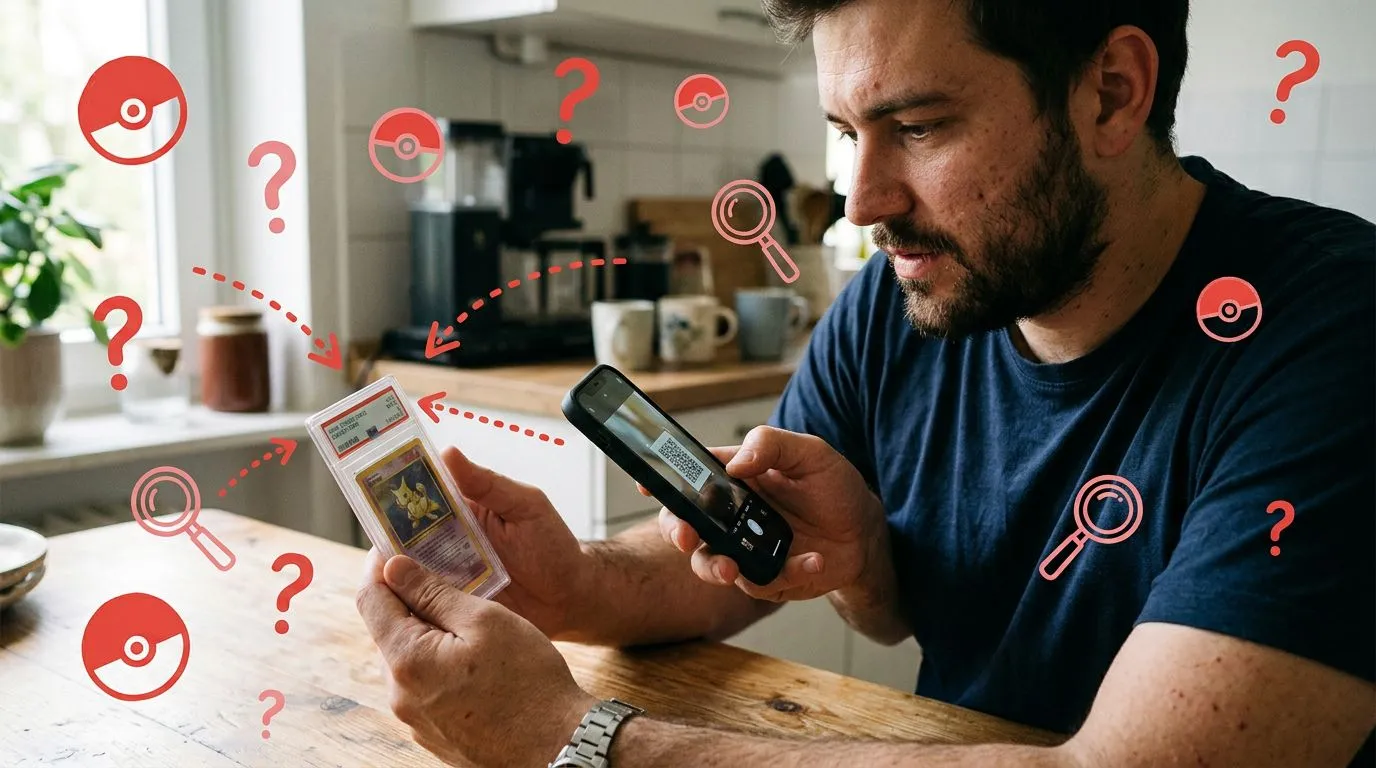
A fake slab is a counterfeit or altered grading-company holder, the hard plastic case and printed label that PSA, CGC or BGS issue, not a fake raw card. The card inside can be genuine, altered, or swapped for a worse copy; the fraud sits in the case and the grade printed on it.
That distinction matters because the fix is different. Spotting a counterfeit raw card starts before a card is ever graded. Spotting a fake slab starts after, and the most useful habit is pairing a certification-number lookup with a close look at the physical case and label, because the documented forgery scheme below printed fabricated certification numbers on altered labels and sealed the cards in PSA-style cases.
The scale of the counterfeiting problem is no longer a hobby rumor. PSA reported intercepting $200 million in projected market value of fraudulent collectibles in 2025, and a federal prosecution shows exactly how a forged-label scheme works.
What a fake slab actually is
A slab is not the card. It is the sealed holder and printed label a grading company issues after it examines a card, and a fake slab counterfeits that holder, that label, or both. Three distinct things can go wrong inside one:
- A genuine holder with a forged label. The case is real. The grade or certification number printed on the label is not.
- A cracked-out and reholdered card. A card is removed from its original slab and resealed, or a different card is sealed in its place, inside a case made to look untouched.
- A fully counterfeit case. Both the holder and the label are manufactured from scratch to imitate a real grading company's product.
This is a different failure mode from a counterfeit raw card, which CGC's own dated counterfeit alerts for specific Pokemon card counterfeits cover in detail. A fake slab can contain a perfectly real card. That is what makes it a harder problem: the object most collectors trust as proof, the sealed case itself, is the thing being faked.
How big the counterfeiting problem is
PSA reported that it intercepted $200 million in projected market value of fraudulent collectibles, a category that includes trading cards and tickets, in 2025. That was a 45.3% increase over 2024 for all counterfeit collectibles, according to Sports Collectors Digest's May 11, 2026 report on PSA's 2025 fraud report. In PSA's breakdown of the categories affected by counterfeit trading cards, trading card games made up 56.3%, sports cards 43.1%, and pop culture 0.6%.
Pokemon cards specifically grew far faster than the overall figure. Counterfeit Pokemon cards rose 125% year over year in the same report, against a 5.1% increase for sports cards.
- Counterfeit Pokemon cards125%
- All collectibles45.3%
- Sports cards5.1%
Sports Collectors Digest, reporting PSA's 2025 fraud report, published May 11, 2026.
Ryan Hoge, president of grading at Collectors, PSA's parent company, called the $200 million figure a conservative estimate and said counterfeiters are "generally pursuing modern cards that balance a recognizable name, strong resale value and simpler printing technology," per the same report. Note the scope: those figures and that targeting pattern describe counterfeit cards in general, not fake slabs specifically, and they point to modern cards rather than vintage ones.
Inside a real forged-label scheme
On January 28, 2026, a federal jury in Manhattan convicted Anthony Curcio of conspiracy to commit wire fraud and wire fraud. Co-defendant Iosif Bondarchuk had pleaded guilty to one count of each, according to reports on the case published January 29 and 30, 2026, which relay the announcement from the U.S. Attorney's Office for the Southern District of New York.
The scheme ran from at least 2022 through May 2024 and worked directly against the assumption that a slab's printed grade is trustworthy. Curcio targeted ungraded or lower-graded cards, removed or cleaned off the original rating and serial numbers from genuine PSA labels, and printed counterfeit labels showing elite grades of nine or ten along with fabricated certification numbers.
Prosecutors said he placed the cards in PSA-style tamper-resistant plastic cases, and investigators said he ordered tools and materials online to create forged card cases and labels. In total, the scheme sought to deprive buyers of more than $2 million across sports and Pokemon cards.
One detail from the case matters more than the dollar figure: the forgery worked on both the label and the case. Genuine PSA labels were altered and reprinted with fabricated numbers, and the cards sat in PSA-style cases built to look tamper-resistant, so neither a glance at the label nor a glance at the plastic was enough on its own.
What a genuine CGC holder is built to resist
CGC publishes its own account of what its holder and label are built to do, and it is the one grading company's security documentation this article could independently verify. According to CGC's own page:
- The label carries microprinting, UV ink, holographic foil, and a unique certification number and barcode.
- The case is ultrasonically welded, which CGC states is built to resist impacts and tampering.
- A QR code on the back of the label links to CGC's own website to look up the card and its images.
CGC also offers its own verification tool, described on its homepage as one that can help verify that a CGC holder is genuine and has not been tampered with. It is reached by entering the certification number on CGC's site or by scanning that QR code.
A checklist before you buy a graded slab
The Curcio case is why a checklist has to start with skepticism of the label itself, not end with a certification-number lookup.
- Look up the certification number on the grading company's own site, and confirm the card, grade, and year in the database actually match the listing you're looking at, not just that a number exists.
- Remember a lookup is not proof on its own. The Curcio case shows genuine PSA labels can be altered and reprinted with a forged grade and a fabricated certification number. Check that the record matches the card and grade in hand, not only that the number exists.
- Use a grading company's own verification tool where one exists. CGC says its lookup, reached by the certification number or the QR code on the back of its label, can help verify that a holder is genuine and has not been tampered with.
- Weigh the price against the report's targeting pattern. PSA's 2025 fraud report, as described by Collectors' Ryan Hoge, says counterfeiters generally pursue modern cards with a recognizable name, strong resale value and simpler printing technology, so a graded card that fits that profile and is priced well under other listings for the same grade deserves more scrutiny, not less.
None of these steps is a guarantee. They are the checks that a documented, prosecuted case and a grading company's own published materials actually support. If a slab bought online turns out to be fake anyway, the guide to counterfeit claims sets out the seller, platform and payment routes.
What we could not verify about PSA and BGS
This guide deliberately does not describe PSA's or BGS's specific hologram technology, UV-reactive ink, embossing, or other physical security features, because neither grading company's own documentation could be independently verified this cycle. PSA's site returned an access-denied response on every official page attempted, and Beckett's site was in a maintenance redirect throughout research for this piece.
That gap does not mean PSA and BGS lack comparable security measures. It means this article states only what could be confirmed directly: CGC's own holder and label documentation, fraud-scale statistics from PSA's 2025 fraud report as reported by Sports Collectors Digest, and case facts from news reports of the federal prosecution. A future update to this piece will add PSA's and BGS's own documentation once it can be verified directly.
What the case data and the fraud numbers agree on is the same conclusion regardless of which company issued the slab: a certification number that resolves is a starting point for verification, not the end of it. Track cards you're watching on the Wall to keep an eye on pricing and depth while you work through a slab's paper trail, and see the full conditions and authentication guide for how this fits alongside grading standards and raw-card counterfeit detection.
Frequently asked questions
- What exactly counts as a fake slab?
- A fake slab is a counterfeit or tampered grading-company holder and label, the hard plastic case and printed grade a service like PSA or CGC issues, not a counterfeit raw card. The card inside can be genuine, fake, or swapped; the fraud is in the case and the grade printed on it.
- If the certification number matches, is the slab real?
- Not by itself. In a federal case decided in January 2026, genuine PSA labels were altered to remove the original grade and serial number, then reprinted with elite grades and fabricated certification numbers, and the cards were placed in PSA-style cases. Confirm that the database record matches the card and grade in hand, and treat a matching number as a necessary check, not a sufficient one.
- How common is this right now?
- PSA reported intercepting $200 million in projected market value of fraudulent collectibles in 2025, a 45.3% increase over 2024, with counterfeit Pokemon cards up 125% in the same period, according to Sports Collectors Digest's May 11, 2026 report on PSA's 2025 fraud report. Those figures cover counterfeits broadly, not fake slabs specifically.
- What does CGC's holder actually do to resist counterfeiting?
- CGC's own published description lists microprinting, UV ink, holographic foil, a unique certification number and barcode on the label, and an ultrasonically-welded case built to resist impacts and tampering. CGC says its lookup tool, reached by entering the certification number or scanning the QR code on the back of the label, can help verify that a holder is genuine and has not been tampered with.
- Has anyone actually been prosecuted for faking slabs?
- Yes. Anthony Curcio was convicted by a federal jury on January 28, 2026, and co-defendant Iosif Bondarchuk pleaded guilty, over a scheme running from at least 2022 through May 2024 that forged elite grades onto altered PSA labels and sought more than $2 million from buyers of sports and Pokemon cards.
Sources
- Holder & Label - CGC Cards, CGC Official / primary source · accessed September 27, 2026
- CGC Cards homepage (verification tool description), CGC Official / primary source · accessed September 27, 2026
- Fraud, counterfeit trading cards rampant in hobby, PSA report shows, Sports Collectors Digest Industry press · accessed September 27, 2026
- Man convicted in nationwide scheme involving fraudulent sports and Pokemon trading card sales, Monroe County Reporter Industry press · accessed September 27, 2026
- Man Convicted In $2M Fake Trading Card Fraud Scheme, Daily Voice Industry press · accessed September 27, 2026
- Redmond man convicted in $2M fake card grading scheme involving Jordan, Pokemon cards, KIRO 7 News Seattle Industry press · accessed September 27, 2026
About the author
Ryan Shugars is an avid Pokémon card collector who builds the market-data tooling behind Cardboard Alpha. He collects across multiple eras, tracks population reports and price movement as a matter of habit, and started building Cardboard Alpha to get a straight answer to questions the existing price guides couldn't: what's actually trading, what's just an asking price, and what a grade is really worth on a given card right now. He writes from that same collector's vantage point, close to the data, skeptical of hype, and always checking a claim against the ledger before it goes in an article.
Ryan Shugars is a collector and the builder of Cardboard Alpha's data systems, not a licensed financial advisor. Articles he writes or edits describe market history and mechanics; they are informational and are not personalized investment advice.
Related articles

What to Do If You Bought a Fake Pokemon Card
Where you paid decides how you get your money back after buying a fake Pokemon card. This guide sets out the steps and, as of October 22, 2026, the deadlines and counterfeit rules at eBay, PayPal, TCGplayer and credit card issuers, plus what PSA and CGC guarantees leave uncovered on a fake slab.
9 min read
Holo vs Reverse Holo vs Non-Holo: Value and Condition
Holo, reverse holo and non-holo cards differ in where the foil sits, how they come out of a pack and how graders treat foil flaws. This guide compares Cardboard Alpha's evaluated raw Near Mint prices for the same cards in each finish on October 10, 2026, across 115 English sets, and reads TCGplayer, CGC, Beckett and PSA on surface condition.
7 min read
Trimmed and Recolored Cards: Card Doctoring Explained
A trimmed or recolored card is a genuine card altered to look better than it is, and PSA, CGC and TAG refuse it a numeric grade. This guide sets out how PSA, CGC, Beckett and TAG label such cards, what PSA's May 2026 fraud report found, and how the PSA 10 premium on four real cards on October 3, 2026 explains the incentive.
7 min read
Near Mint vs Lightly Played: A Raw Card Condition Guide
Near Mint and Lightly Played are measured, not felt: TCGplayer's standards cap NM at 3 points of imperfections and LP at 6, with whitening, grime and bends ruled out at NM. On October 2, 2026, the median LP copy priced at 95.3 percent of NM for Scarlet & Violet cards worth $20 or more and 73.5 percent for Wizards of the Coast cards.
7 min read