PSA vs CGC vs BGS vs TAG: Full Grading Company Comparison
PSA, CGC, BGS and TAG all grade a card on a 1-to-10 scale but define a perfect card differently, print different information on the slab, and have not always run the same services at the same time.

By Ryan Shugars · Reviewed by Jackie Chung · (updated )
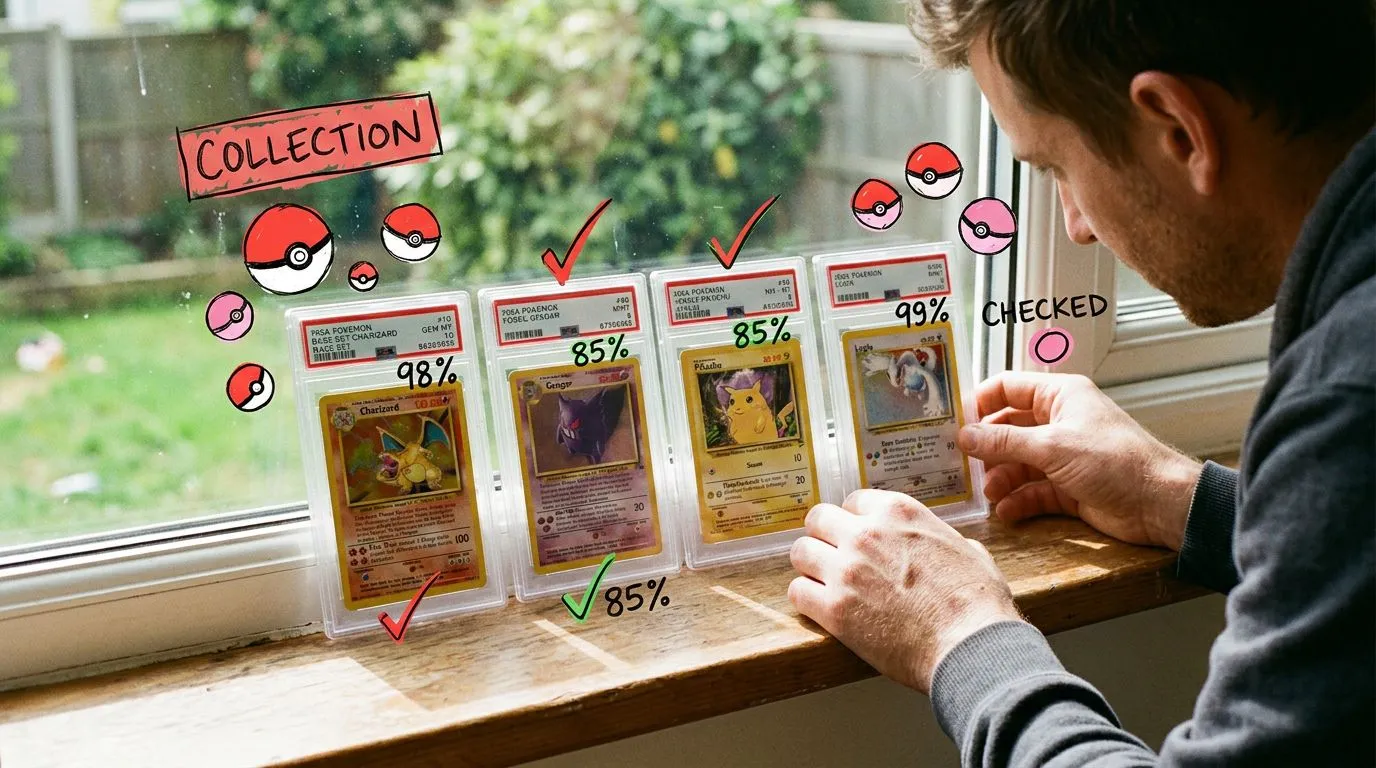
PSA, CGC, BGS and TAG all grade a Pokemon card's condition on a 1-to-10 scale. They do not define a perfect card the same way, they do not print the same information on the slab, and they have not been operating under the same conditions.
CGC issues two different labels inside one numeric 10. Beckett says it is the only grading company to display all four condition scores on the label. TAG grades with a multi-patented system on a 1000-point scale, and puts its per-attribute scoring in a digital report. PSA publishes a single overall number and a searchable population report.
What follows compares all four on scale, subgrades, submission economics and population data, using each company's own published pages.
The four companies, at a glance
Each company built its grading service around a different idea of what a collector needs from a slab.
| Company | What sets it apart |
|---|---|
| PSA | Single overall numeric grade; publishes a population report searchable by set and by individual card |
| CGC | Two labels inside one numeric 10 (Pristine 10 and Gem Mint 10); its site links sister brands CGC Comics, NGC and PMG |
| BGS (Beckett Grading Services) | Prints centering, corners, edges and surface as separate numeric subgrades on the label, which Beckett says no other grader does |
| TAG (Technical Authentication and Grading) | Grades with a multi-patented system using Photometric Stereoscopic Imaging on a 1000-point scale, with per-attribute scoring in a QR-linked digital report |
Source: each company's own published grading-scale, home and services pages, read September 26 and October 24, 2026.
How each company names its top grade
PSA, CGC and BGS each publish a numeric centering ceiling for their flagship grade, and the three numbers land close together: PSA's Gem Mint 10 requires roughly 55/45 front centering, CGC's Gem Mint 10 matches that same 55/45, and BGS's stricter Pristine 10 tightens it to 50/50. CGC also keeps a second, stricter label, Pristine 10 (50/50 centering), inside that same numeric 10.
That naming detail matters more for reading a slab than for choosing a company. A 10 from CGC is not automatically its stricter Pristine 10, and at BGS, Pristine is the name of the 10 itself, split into a Black label for perfect Pristine 10s and a Gold label for other Pristine 10s (Gold also covers Gem Mint 9.5). The economics below, what each company actually charges and how fast it turns a card around, matter more day to day than which word sits on the label.
Subgrades on the holder: BGS
BGS prints centering, corners, edges and surface as their own individual numbers on the holder, rather than showing one overall grade alone, and Beckett says no other grading company does.
- Subgrades on the label: Beckett's card grading page says all four condition scores are displayed directly on the label.
- Label color: Black for perfect Pristine 10s, Gold for Pristine 10 and Gem Mint 9.5, and Silver for all other grades.
- Without-subgrades option: Beckett's price list also shows a Base service level without subgrades, marked sold out on October 24, 2026.
A BGS label with subgrades shows, on the holder itself, which of the four traits held a card back from a higher grade. TAG surfaces per-attribute detail digitally instead, through a report reached by scanning the slab. The PSA and CGC pages reviewed here describe the overall number only.
TAG's imaging-based grading
TAG pairs its own imaging system with a finer number than a plain 1 to 10 scale allows.
- Photometric Stereoscopic Imaging: TAG's name for the imaging technology behind its multi-patented grading system, which scores a card on a 1000-point scale and translates that into the familiar 1 to 10 grade.
- TAG Score: on slabs graded with TAG's DIG Report Plus, exposes that underlying 1000-point number, so two cards that both carry a 10 can still be ranked against each other as a high 10 or a low 10.
- PROOF Security Technology: digital security measures embedded in every slab; TAG says a smartphone can instantly verify TAG authenticity.
- DIG Reports: every TAG graded card includes a Digital Imaging & Grading Report, reached by scanning the slab's QR code, with high-resolution images of identified defects, scoring breakdowns for individual card attributes, centering, population and leaderboard data. TAG calls the flagged defects DINGS (Defects Identified of Notable Grade Significance).
None of the other three companies' grading pages reviewed here describe a 1000-point score. TAG's own published scale table lists three columns, condition, grade and TAG Score range, and TAG calls the grade the Industry Equivalent Grade:
| TAG condition | Grade | TAG Score range |
|---|---|---|
| Pristine | 10 | 990-1000 |
| Gem Mint | 10 | 950-989 |
| Mint | 9 | 900-949 |
| Good | 2 | 200-249 |
| Poor | 1 | 100-149 |
Source: TAG Grading Scale, read October 24, 2026. Bands 8.5 through 2.5, and Fair 1.5 (150-199), omitted here; TAG's published table steps down in half-point grade bands, except between grades 9 and 10.
Two cards that both land in TAG's Gem Mint band still get read differently: a 985 and a 955 are both a Gem Mint 10, but the TAG Score tells them apart.

4 · Base Set · Rare
Base Set Charizard, shown only as a familiar grading candidate. No price or grade is claimed for this copy.
Submission tiers and what they cost
Submission economics are the part of this comparison that changes fastest, and the four companies were not in comparable states on the dates checked.
CGC had a full, published six-tier schedule:
| Tier | Fee per card | Max declared value | Turnaround |
|---|---|---|---|
| Bulk | $17 | $500 | about 150 business days |
| Economy | $20 | $1,000 | about 90 business days |
| Standard | $55 | $3,000 | about 10 business days |
| Express | $100 | $10,000 | about 5 business days |
| WalkThrough | $300 | $100,000 | about 2 business days |
| Unlimited Value | $300 + 1% of fair market value | no cap | about 2 business days |
Source: CGC Cards Services & Fees, accessed September 26, 2026. Fees are CGC's published rates for direct submissions by Collector members; Associate, Premium and Elite members save 10 to 20 percent, and Bulk requires a 25-card minimum. Turnaround is stated in working days; national holidays and the Fridays before a major convention do not count.
- Bulk (150 days)17USD
- Economy (90 days)20USD
- Standard (10 days)55USD
- Express (5 days)100USD
- WalkThrough (2 days)300USD
CGC Cards Services & Fees, accessed September 26, 2026. Unlimited Value ($300 + 1% FMV) omitted, no fixed fee to chart.
CGC also charges add-on fees: Pedigree service adds $5 to the tier fee, CrossOver for a card moved out of a PSA, Beckett or SGC holder is priced per tier, Custom Label adds $8, and a plain ReHolder runs $10 with about a 20 business day turnaround.
TAG's per-card fees could not be confirmed for this comparison, so no TAG price appears here.
On October 24, 2026, Beckett's grading page listed Express ($79.95 per card, 15 business days) as open, and Base, Standard and Priority as sold out.
PSA's current fee schedule could not be independently verified for this comparison, so no PSA price appears in the table above. Check psacard.com directly for its current tiers before submitting.
Population reports and public data
PSA's Population Report is the most granular of the four in what this research could confirm. It is organized by set, with a row for each card and separate rows for print varieties such as 1st Edition, each broken out by grade.
Those counts move every day. When Cardboard Alpha's gem-rate breakdown by set read PSA's report on September 1, 2026, Base Set showed an overall gem rate of 10.0 percent across 1,125,406 graded cards. The unqualified Charizard-Holo row, the Unlimited print, sat at just 0.5 percent of 102,533 graded, with PSA 6 as its most common grade rather than a 9 or 10. Across the five sets that breakdown covers, PSA's set-level gem rates ran from 3.2 percent to 59.2 percent.
CGC's main site lists a dedicated Pop Report tool in its navigation, alongside its Services & Fees pages. This research could not confirm how granular that tool is, whether it breaks a set down to the individual card and print variation the way PSA's does.
Beckett's site navigation also links a Population Report, but this research did not check its granularity. TAG's site navigation links to a TAG Pop Report, and each card's digital report includes population, leaderboard and chronology data; this research did not test how deep TAG's report goes for a given set.
What actually changes for a collector
The practical differences come down to four questions a collector can ask before choosing where to submit a card: does the company's top grade match the standard I care about, do I want a printed subgrade breakdown, do I want a conventional grade or TAG's imaging-based score, and is the company actually running full service on the day I want to submit.
None of those questions has a universally correct answer. A collector who wants a subgrade breakdown printed on the holder is looking at BGS specifically; TAG offers per-attribute scoring digitally, and the PSA and CGC pages reviewed here describe one overall grade.
A collector who wants the widest population-report visibility for a specific vintage card has more confirmed public data to check against at PSA than at the other three. And for a collector who needs a card back inside two weeks, CGC was the only one whose September 26 schedule this research could read, and it showed tiers at 10 business days or less. Beckett's 5 business day Priority tier was listed on October 24, marked sold out.
TAG's turnaround could not be confirmed here. Beckett's Express tier was listed at 15 business days on October 24, and PSA's schedule could not be verified.
Which grading tier makes sense for a given card is also a function of that card's own market, not just the grading company's fee schedule. Collectors sizing up a specific card's liquidity and depth before deciding whether a grading fee is worth it can open the screener to check that card's own market data across the covered universe.
Japanese-language cards raise a separate eligibility question: grading Japanese cards covers what graders say about them and how Japanese slab prices compare with English twins.
Grading standards, submission tiers and even which companies are accepting standard volume all change over time. This comparison reflects what each company's own pages showed on the dates cited throughout, not a permanent state of the industry.
Frequently asked questions
- How much does it cost to submit a card to CGC?
- As of September 26, 2026, CGC's published tiers for direct submissions by Collector members ran from $17 per card at Bulk (about 150 business days, $500 max declared value, 25-card minimum) up to $300 per card at WalkThrough (about 2 business days, $100,000 max), plus an Unlimited Value tier at $300 plus 1 percent of fair market value with no cap. Associate, Premium and Elite members save 10 to 20 percent. Add-ons like Custom Label or CrossOver from another holder cost extra on top of the tier fee.
- What makes TAG Grading different from PSA, CGC and BGS?
- TAG grades with a multi-patented technological system using what it calls Photometric Stereoscopic Imaging, scoring on a 1000-point scale that translates into the familiar 1 to 10 grade. Slabs graded with its DIG Report Plus receive a TAG Score that exposes that finer number, so two cards that both grade a 10 can still be ranked against each other. Every TAG graded card also comes with a digital report, reached by scanning the slab, and TAG says a smartphone can instantly verify a slab's authenticity.
- Which grading company prints subgrades on the slab?
- Beckett says it is the only grading company to display all four condition scores, centering, corners, edges and surface, directly on the label. TAG includes scoring breakdowns for individual card attributes in a digital report reached by scanning the slab's QR code. The PSA and CGC grading pages reviewed here describe one overall number.
- Are all four companies taking submissions on equal terms?
- Not on equal terms. On September 26, 2026, CGC published a full six-tier fee schedule with turnaround from about 2 to 150 business days. On October 24, 2026, Beckett's grading page listed Express at $79.95 per card (15 business days), with Base, Standard and Priority marked sold out. PSA's and TAG's current fee schedules could not be verified for this comparison; check each company's site directly for up-to-date pricing.
- Does PSA publish population data for specific cards?
- Yes. PSA's Population Report is organized by set, with a row for each card and separate rows for print varieties, broken out by grade. When Cardboard Alpha's gem-rate breakdown read it on September 1, 2026, Base Set showed an overall gem rate of 10.0 percent across 1,125,406 graded cards, while the unqualified Charizard-Holo row alone sat at 0.5 percent. How much that gem rate swings by set is covered in more depth in that breakdown.
Sources
- PSA Grading Standards - Card Grading, PSA Official / primary source · accessed October 24, 2026
- 1999 Pokemon Game (Base Set) TCG Cards - PSA Population Report, PSA Official / primary source · accessed September 1, 2026
- Grading Scale - CGC Cards, CGC Official / primary source · accessed October 24, 2026
- Services & Fees - CGC Cards, CGC Official / primary source · accessed September 26, 2026
- Card Grading: Beckett Grading Scale, Beckett Grading Services Official / primary source · accessed October 24, 2026
- Grading Scale - TAG Grading, TAG (Technical Authentication and Grading) Official / primary source · accessed October 24, 2026
- TAG Grading homepage, TAG (Technical Authentication and Grading) Official / primary source · accessed October 24, 2026
About the author
Ryan Shugars is an avid Pokémon card collector who builds the market-data tooling behind Cardboard Alpha. He collects across multiple eras, tracks population reports and price movement as a matter of habit, and started building Cardboard Alpha to get a straight answer to questions the existing price guides couldn't: what's actually trading, what's just an asking price, and what a grade is really worth on a given card right now. He writes from that same collector's vantage point, close to the data, skeptical of hype, and always checking a claim against the ledger before it goes in an article.
Ryan Shugars is a collector and the builder of Cardboard Alpha's data systems, not a licensed financial advisor. Articles he writes or edits describe market history and mechanics; they are informational and are not personalized investment advice.
Revision history
- — Ryan Shugars: Beckett's scale moved to beckett.com/grading and reads differently from the archived /grading/scale and /grading/about copies first cited: Pristine 10 back centering is 55/45 (was 60/40), subgrades display on the label, and label colours are Black, Gold and Silver (no White). The September 26 Beckett maintenance record is replaced by the October 24 read of Beckett's grading page. TAG's September pricing-page record (tiers paused) is dropped because the page has since changed, the CGC homepage source is folded into the CGC Services & Fees page, and the card block no longer quotes a September raw price. PSA's centering-discretion line re-quoted from its live eye-appeal note. Grader scale pages re-read live.
Related articles

Gem Mint 10 Odds by Set: Which Sets Grade the Hardest
Gem mint 10 rates are not one hobby-wide number: PSA's Population Report puts Neo Genesis at roughly 3.2 percent PSA 10 and 2021's Evolving Skies near 59.2 percent, an eighteen-fold spread inside the same grading company's own data. PSA publishes the counts behind each rate but no cause for the gap. Even within a single set, one chase card can grade far harder than the set's own average.
6 min read
How Population Reports Shape Pokemon Card Grading Value
Cardboard Alpha's Grading Opportunity model prices the expected value of grading thousands of cards at once. Swapping a generic assumption for a card's real population, when there is enough of it, moved that estimate down 93 percent on one card and up more than triple on another, dated September 21, 2026.
7 min read
How PSA Grading Works: Submission Tiers, Fees and Turnaround
PSA authenticates, grades and seals each card, and its fee, insured-value cap and turnaround estimate all depend on the service level you pick. This guide covers the submission steps, PSA's fee table as archived on October 16, 2026, the Value tier pause, packing rules, order statuses and returns.
8 min read
Grading Japanese Pokemon Cards: What's Different
TAG and CGC publish rules that cover Japanese-language Pokemon cards, each with exclusions or identification caveats. In eight same-art pairs between July 9 and October 6, 2026, the Japanese PSA 10 median was below its English twin's in seven pairs and tied in one, and the PSA 10 step over a PSA 9 was smaller on the Japanese copy in the four pairs with enough sales to compare. No Japanese population counts were available to say why.
6 min read