Auction vs Buy It Now: How Pokemon Card Market Structure Works
A fixed-price sale and an auction are two different mechanisms for setting a Pokemon card's price, and a winning bid should never be read as a stand-in for a Buy It Now ask, or the other way around.

By Ryan Shugars · Reviewed by Jackie Chung · (updated )
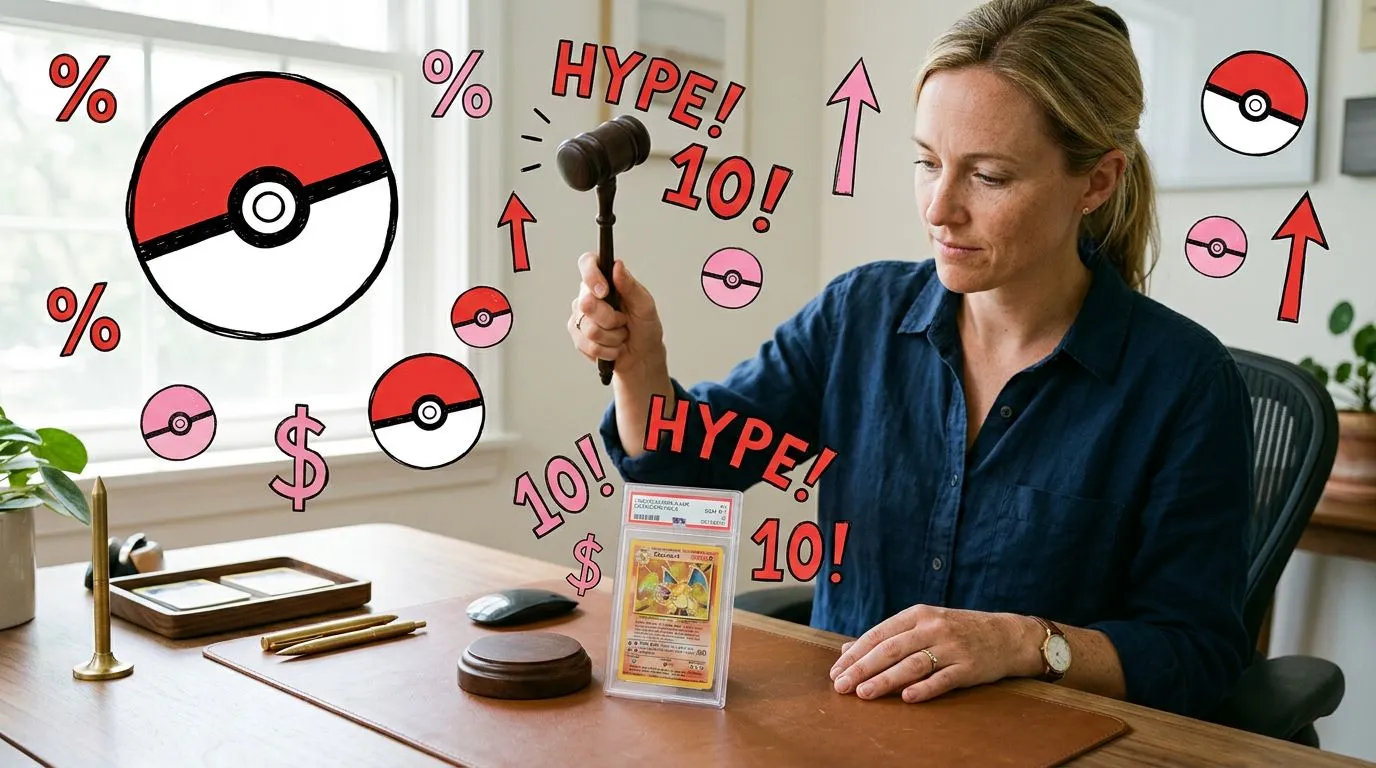
A Pokemon card does not have one market price. It has whichever price its selling mechanism actually produced, and Buy It Now sales and auctions produce two different kinds of numbers by two different mechanisms.
A fixed-price listing, TCGplayer or eBay Buy It Now, sells at the seller's posted ask the moment a buyer accepts it. The price is known before the sale happens.
An auction sells to the highest bidder only when the auction ends, so the price is discovered by competing bids (eBay, accessed September 26, 2026). A live auction house then adds a buyer's premium on top of the winning bid (Wikipedia, "Buyer's premium," accessed September 26, 2026). Reading one as a stand-in for the other is a common, avoidable mistake.
How a fixed-price sale works
A fixed-price listing has no bidding. The seller sets one number, and the first buyer willing to pay it completes the purchase immediately (eBay, accessed September 26, 2026). eBay's fixed-price listings default to a "Good 'Til Canceled" duration, so an unsold listing simply relists itself every month until it sells or the seller ends it.
TCGplayer works the same way at the listing level, but its headline number, Market Price, is not any single seller's ask. TCGplayer describes Market Price as a figure built from actual recent sales, averaged across many transactions across many sellers, rather than a snapshot of what happens to be listed right now (TCGplayer, accessed September 26, 2026).
Three things worth knowing before comparing a fixed-price number to anything else:
- Market Price is an average of recent sales, not today's cheapest ask. It reflects what copies have actually sold for, so it can differ from whatever happens to be listed right now.
- Shipping is per store, not per card. A TCGplayer buyer pays one flat shipping fee for everything ordered from one store, regardless of how many cards are in the order (TCGplayer, accessed September 26, 2026).
- A fixed-price listing can sit unsold indefinitely. Good 'Til Canceled means no price discovery forces a sale; an overpriced listing just relists.
How an auction sets a price
An eBay auction starts differently: the seller sets a starting price, and the price only resolves when bidders compete and the clock runs out (eBay, accessed September 26, 2026). Two mechanics change what that resolution actually means.
Reserve price
A reserve price is a minimum the seller will accept, and bidders do not see it unless the seller states it in the listing. A bid that falls under it displays "Reserve not met," and that bidder cannot win the item even if no one else bids higher (eBay, accessed September 26, 2026).
The seller still has options when the reserve is not being met. They can lower the reserve while the auction is running, or make a Second Chance Offer to a bidder once it ends (eBay, accessed September 26, 2026).
Buy It Now on an auction listing
A seller can attach a Buy It Now price to an auction so an impatient buyer can skip bidding entirely. eBay requires that price to sit at least 30 percent above the auction's starting price in most categories.
Once a real bid lands, that Buy It Now option usually disappears. The exception is a reserve-price listing, where it stays available until the reserve is met (eBay, accessed September 26, 2026).
| Mechanic | Fixed-price (TCGplayer, eBay Buy It Now) | Auction (eBay) |
|---|---|---|
| How the price is set | Seller posts an ask; first buyer to accept it wins | Seller sets a starting price; bidders compete |
| When it resolves | The moment a buyer accepts, or never if the seller cancels | Only when the auction clock ends |
| What the buyer pays | The posted price, plus shipping | The winning bid on eBay; at a live auction house, the winning bid plus its buyer's premium |
Source: eBay, "Selling with Buy It Now" and "How reserve prices work," both accessed September 26, 2026; buyer's premium per Wikipedia, "Buyer's premium," accessed September 26, 2026.
The hammer price is not the realized price
At a live auction house, the number announced as the winning bid, the hammer price, is not the final bill. A buyer's premium is added on top of it, a percentage of the hammer price that the auction house keeps, separate from whatever the seller receives (Wikipedia, "Buyer's premium," accessed September 26, 2026).
When an auction house reports a lot's price "with buyer's premium," that figure is this combined total, hammer plus premium, not the bid itself.
Heritage Auctions' December 12 to 13, 2025 Trading Card Games event is a clear example. A PSA 10 1st Edition Base Set Charizard realized $550,000 with buyer's premium included, which Heritage said surpassed the prior public-auction record for the card (Intelligent Collector, Heritage Auctions' own magazine, based on a Heritage press release dated December 16, 2025).
The full event totaled $5,279,820, which Heritage described as an all-time high for a trading card games auction.

4 · Base Set · Rare
A PSA 10 1st Edition copy of this card realized $550,000 with buyer's premium at Heritage Auctions' December 12-13, 2025 Trading Card Games auction, a new public-auction high for the card (Intelligent Collector, accessed September 26, 2026).
That $550,000 figure describes one PSA 10, 1st Edition copy, at one auction house, on one date. It says nothing about what a different grade, a different printing, or a fixed-price listing of the same card would fetch on the same day, and it should never be quoted as if it did.
Why these markets should not be mixed
Cardboard Alpha's own methodology keeps auctions and fixed-price sales as separate markets throughout. It never reads a single winning bid as a fixed-price floor for the same card.
That rule extends naturally to the buyer's-premium gap covered here. A hammer price, a realized price with premium included, and a fixed-price ask are three different figures, and only the last one, plus shipping, is what a Buy It Now buyer would actually pay today.
Treating any one of the three as a universal "market price" overstates how much the number actually tells you. A single record auction result says a specific bidder wanted a specific graded copy on a specific day, not that every copy of that card, or every grade, now trades at that level.
Which market tells you what
A fixed-price ask tells you what a seller is willing to accept right now, and a completed sale tells you what a buyer actually paid, with shipping already known upfront. Neither guarantees a future price; both are simply what a specific transaction, on a specific platform, actually recorded.
An auction result tells you what one bidder was willing to pay for one specific item on one specific day, once premium and any reserve are accounted for. It is a data point about that item and that moment, not a forecast for the same card's next sale. This article describes how each of those numbers gets produced, not where either one goes next.
For a collector deciding where to look, the practical habit is matching the question to the market. Use a fixed-price search for what a card costs to buy today, and an auction archive for what a specific graded rarity has actually changed hands for.
Reading the full ask ladder before you sell covers the fixed-price side of that in more depth. How gem rates differ by set is useful context before assuming a graded auction result generalizes across a set.
Cardboard Alpha's screener lets you check liquidity and depth across the covered universe instead of leaning on any single auction result or listing.
Frequently asked questions
- What is the main difference between an auction and Buy It Now for a Pokemon card?
- A Buy It Now or other fixed-price listing sells the moment a buyer accepts the seller's posted price, with no bidding. An auction only sells to the highest bidder once the auction ends, so the price is discovered through competing bids rather than set in advance.
- What does "Reserve not met" mean on an eBay auction?
- It means the current highest bid is still below the reserve, the seller's minimum acceptable price, which bidders do not see unless the seller states it in the listing. That bidder cannot win the item at that bid, even if no one else bids higher, unless the seller lowers the reserve during the auction or sends a Second Chance Offer after it ends.
- Why did Heritage Auctions' PSA 10 Charizard sell for $550,000 if the winning bid was lower?
- $550,000 is the realized price, which includes the buyer's premium, a percentage fee the auction house adds on top of the hammer price and keeps for itself. The hammer price, the bid itself, was lower than the $550,000 total the winning bidder actually paid.
- Can a single auction result be used as a card's current market price?
- Not on its own. One auction result reflects what one bidder paid for one specific copy, grade, and printing on one specific day. A TCGplayer Market Price figure, by contrast, is drawn from many recent fixed-price transactions, so the two describe different things and should not be substituted for each other.
- Can a seller add a Buy It Now price to an eBay auction listing?
- Yes. eBay requires that Buy It Now price to be at least 30 percent above the auction's starting price in most categories. Once a bid is placed, that option usually disappears, unless the listing also has a reserve price, in which case it stays available until the reserve is met.
Sources
- Selling with Buy It Now, eBay Official / primary source · accessed September 27, 2026
- How reserve prices work, eBay Official / primary source · accessed September 27, 2026
- TCGplayer Market Price, TCGplayer Official / primary source · accessed September 27, 2026
- How is shipping applied to marketplace orders?, TCGplayer Official / primary source · accessed September 27, 2026
- A PSA 10 Charizard Sets a New Public-Auction High as Heritage's TCG Auction Reaches $5.28 Million, Intelligent Collector (Heritage Auctions) Official / primary source · accessed September 27, 2026
- Buyer's premium, Wikipedia Industry press · accessed September 27, 2026
About the author
Ryan Shugars is an avid Pokémon card collector who builds the market-data tooling behind Cardboard Alpha. He collects across multiple eras, tracks population reports and price movement as a matter of habit, and started building Cardboard Alpha to get a straight answer to questions the existing price guides couldn't: what's actually trading, what's just an asking price, and what a grade is really worth on a given card right now. He writes from that same collector's vantage point, close to the data, skeptical of hype, and always checking a claim against the ledger before it goes in an article.
Ryan Shugars is a collector and the builder of Cardboard Alpha's data systems, not a licensed financial advisor. Articles he writes or edits describe market history and mechanics; they are informational and are not personalized investment advice.
Related articles

Liquidity Risk in Pokemon Cards: Why Rare Doesn't Mean Easy to Sell
A thin PSA population and a high sticker price both describe scarcity. Neither one tells you how many buyers are actually waiting to pay it, and that gap is where liquidity risk lives.
6 min read
Vintage vs Modern Pokemon Cards: Which Outperforms Long Term
Vintage Pokemon cards have outperformed modern Pokemon cards on every multi-year window Cardboard Alpha's own market-series data covers. This guide breaks the return gap down by era bucket through September 17, 2026, grounds the vintage side in dated Heritage Auctions results for the 1st Edition Base Set Charizard, and names what the data does not explain.
6 min read
Why Auction Prices and BIN Floors Tell Different Stories
An auction's winning bid and a TCGplayer or eBay Buy It Now floor are not interchangeable. Auction houses add a buyer's premium on top of the hammer price, a TCGplayer or eBay fixed-price ask carries none, and a vanished listing is never automatically a sale. This piece walks through the mechanics that make the two numbers diverge.
6 min read
Bear Markets in Pokemon Cards: What History Shows
Dated records from Hasbro's annual report, Fortune and TCGplayer show Pokemon card downturns following supply surges in 2000, 2021 and 2026. Cardboard Alpha's composites show how long the 2021 falls lasted, and its POKE baskets and July 1 slate show how uneven the 2026 fall was as of October 19 and 20, 2026.
8 min read