Sealed vs Graded vs Raw: Comparing Investment Vehicles
Cardboard Alpha's own Graded Index shows the price premium a Grade 10 commands over a raw copy has shrunk in every era group since October 2024, while the Modern sealed products it tracks with a known MSRP trade at a median of 10.7 times that original price.
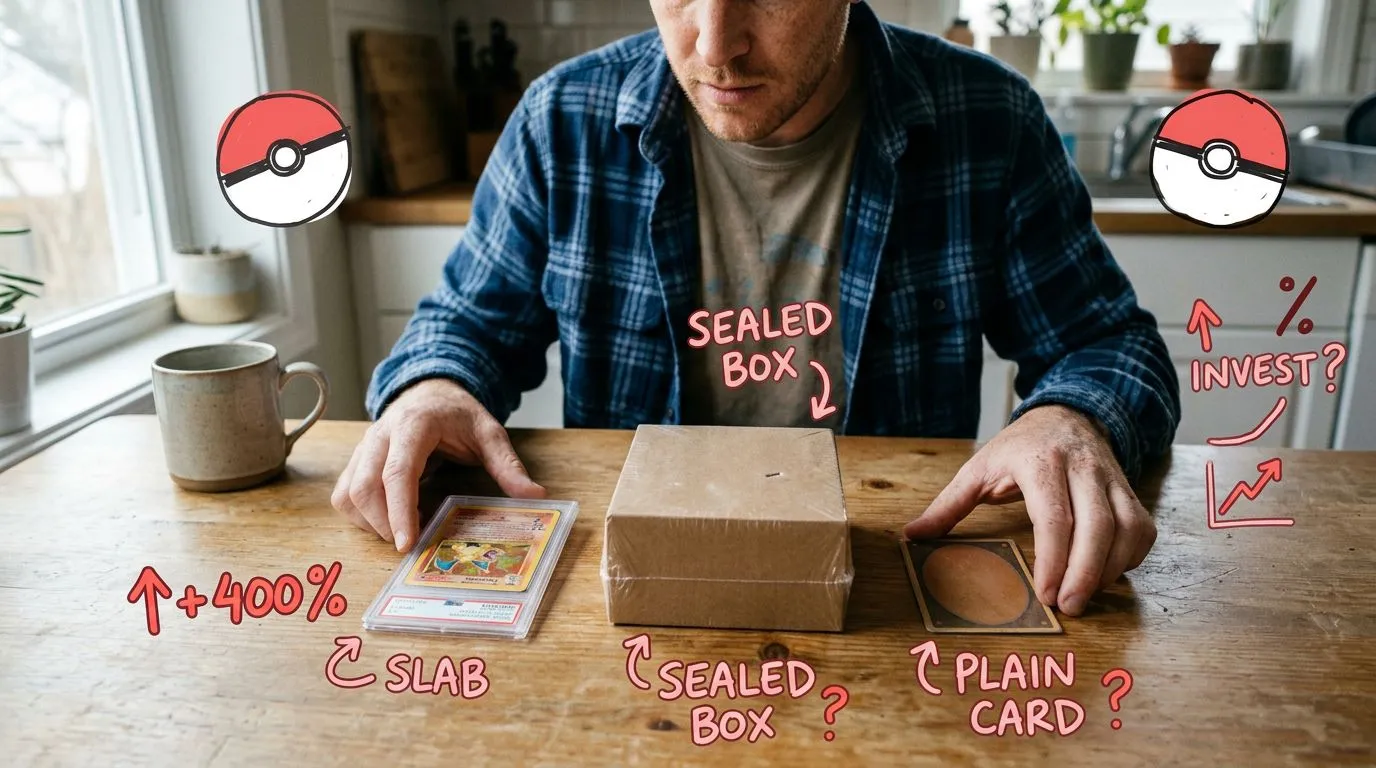
Raw, graded and sealed are three different vehicles built on the same cardboard, not three prices on one card. A raw copy typically trades well below a Grade 10 of the same card, and it needs no grading step before it can be listed. Sealed product sits at the other end: an unopened unit priced against its original MSRP, not against any one card inside it.
Graded cards sit in between, and the premium they command over a raw copy is not fixed. Cardboard Alpha's own Graded Index shows that premium shrank in every era group between October 2024 and September 2026, from a 5 percent slide in Classic to a 48 percent slide in Modern (Cardboard Alpha Graded Index, as of September 14, 2026).
TCGplayer near-mint market price $348.31 as of September 26, 2026, used below as a Modern-era raw benchmark.
What sets the three vehicles apart
Before any numbers, the three vehicles differ on four things: how much one unit costs, what a sale depends on, what it costs to verify, and what can go wrong after you buy it.
Lists with no grading step; condition is argued on every sale
None until resale; buyer trusts the seller's condition grade
Condition disputes, counterfeits
Graded card
Raw price plus a grading-company premium
Condition is settled on the label, so copies compare by grade
Done once, at grading, by PSA/CGC/BGS/SGC
Premium can compress; grading fee is sunk either way
Sealed product
A whole unopened unit, priced against its MSRP
Buyer has to want the whole unit, not one card
Weight, shrink-wrap pattern and seal checks, no numbered card grade
Resale value depends on a thin market of other collectors, not a graded population
eBay's own Authenticity Guarantee draws a line at $200: any ungraded or graded trading card priced at or above that gets a mandatory third-party inspection by PSA before it reaches the buyer, corners, edges and surface for raw cards, and the sealed holder and label for graded ones (eBay Authenticity Guarantee, accessed September 26, 2026). Below $200, a raw card trades without that inspection, and boxes and packs are outside the program entirely.
Raw cards: the liquidity baseline
Raw is the vehicle with the fewest moving parts. A raw card's price is a single TCGplayer or eBay read, not a grading company's opinion layered on top of one.
Two reads a generation apart show the range. Base Set Charizard, Unlimited print, carried a TCGplayer near-mint market price of $944.53 as of September 26, 2026 (TCGplayer, Base Set Charizard). Charizard ex 199/165 from 151, a 2023 release, sat at $348.31 on the same date.
TCGplayer near-mint holofoil market price $944.53 as of September 26, 2026.
Raw also carries the least verification cost. Nothing is spent confirming a raw card's grade until the day it is sold, which keeps the entry cost low but pushes the condition question onto every single transaction instead of settling it once.
Graded cards: a shrinking premium
Grading turns a raw card into a fixed, third-party-verified condition, and buyers have historically paid up for that certainty. Cardboard Alpha's Graded Index tracks the fifty most actively traded Grade 10 cards in each of four era groups, chain-linked weekly from real graded sales (Cardboard Alpha Graded Index).
As of September 14, 2026, that index (rebased to 100 at its October 2022 start) read 175.7 for Vintage, 140.5 for Classic, 208.9 for Mid, and 87.7 for Modern. Only Modern sits below its own starting point.
Grade 10 index level by era group
Vintage175.7index (Oct 2022 = 100)
Classic140.5index (Oct 2022 = 100)
Mid208.9index (Oct 2022 = 100)
Modern87.7index (Oct 2022 = 100)
Cardboard Alpha Graded Index, fifty most-traded Grade 10 cards per era, as of September 14, 2026.
The premium a Grade 10 commands over the same card raw is a separate line, and it has moved the same direction everywhere. Rebased to 100 at October 2024, that premium index read 77.4 for Vintage, 94.7 for Classic, 70.0 for Mid, and 52.0 for Modern by September 14, 2026, a decline in every era group since that October 2024 base.
Vintage: premium index down about 23 percent since October 2024; a Grade 10 still trades at roughly 20.3 times its matched raw price.
Classic: premium index down about 5 percent, the smallest move; Grade 10s trade at roughly 42.7 times raw, the highest multiple of the four groups.
Mid: premium index down about 30 percent; Grade 10s trade at roughly 23.3 times raw.
Modern: premium index down about 48 percent, the sharpest compression; Grade 10s trade at roughly 2.7 times raw, the lowest multiple by a wide margin.
Grading cost is not free, and it does not move with the premium. PSA's cheapest orderable tier was Standard at $59.99 per card in mid-September 2026, with faster tiers reaching $999 for Premium 1 and further Premium levels above that for higher declared values; its cheaper Value tiers remained paused for new US trading-card submissions (CardGrade.io, PSA fee tracker). Cardboard Alpha's break-even math for a single grading submission works through what that fee needs a card to gain before grading pays for itself.
One more wrinkle sits inside the Grade 10 number itself. A Grade 9 of the same card holds a different share of the Grade 10 price by era: 15.7 percent in Classic, 17.9 percent in Mid, 20.8 percent in Vintage, and 27.5 percent in Modern (Cardboard Alpha Graded Index, 9-vs-10 spread). Modern's Grade 10 premium over raw is the smallest of the four eras, but its Grade 9 holds relatively more of that Grade 10 value than a Classic or Mid Grade 9 does.
Sealed product: priced against MSRP
A sealed box carries no numbered card grade. Buyers judge its condition by shrink-wrap, box weight and seal pattern, checked by themselves or a specialist authenticator.
Cardboard Alpha's Sealed Index has two baskets with enough history to read as a trend: out-of-print Modern-era products (Sword & Shield onward) and products still in print.
The Modern basket rose 54.3 percent from its first tracked week in mid-September 2025 through September 2026, and 52.1 percent over the latest 52 weeks, even as its most recent 30-day reading slipped 1.2 percent (Cardboard Alpha Sealed Index, as of September 18, 2026). The in-print basket fell 21.6 percent from January 2026 through September, despite a 7.1 percent bounce in the most recent 30 days.
Pulled from Evolving Skies packs; the set's booster box is the sealed-vehicle example below.
MSRP multiples measure how far sealed product has moved from its retail price. Only a handful of tracked products carry a known original MSRP: seven in the Modern basket, all from 151 and Evolving Skies, and four in print, all from Pitch Black.
The Modern seven sit at a median of 10.7 times MSRP; the in-print four sit at a median of 1.45 times. The highest of the Modern seven, the Evolving Skies Booster Box, had a $143.64 MSRP and a $2,450.44 price on the same read, a 17.06 times multiple.
Basket
52-week change
30-day change
Median multiple of MSRP
Modern (sealed, out of print)
+52.1%
-1.2%
10.7x (7 products)
In-print (sealed)
not yet 52 weeks of history
+7.1%
1.45x (4 products)
Sealed vintage has reached far higher absolute prices. A sealed, shrink-wrapped 1st Edition Base Set booster box sold for $360,000 at a Heritage Auctions sale that closed in mid-November 2020, a record at the time (Heritage Auctions sale, reported by Bleeding Cool). It is a historical high-water mark from a single auction, not a current price.
Modern era, graded vs. sealed
Modern is the one era group where both graded and sealed have a usable, dated multiple: Grade 10 price against raw price, and sealed price against MSRP.
How many times the baseline, Modern era
Graded 10 vs. raw2.7multiple
Sealed vs. MSRP (median)10.7multiple
Cardboard Alpha Graded Index (Grade 10 vs. matched raw, 576 samples) and Sealed Index (median price vs. MSRP across 7 out-of-print Modern products from 151 and Evolving Skies), both as of mid-September 2026.
The gap is large, though the two multiples use different baselines. The median Modern sealed product with a known MSRP sits at roughly four times the multiple a Modern Grade 10 commands over its own raw price, and Modern's grading premium has also compressed the most of the four era groups. Neither multiple says how quickly a unit sells: a sealed box still needs a buyer who wants the whole unopened unit rather than one card.
What none of this tells you
None of these figures says which vehicle will do better from here. A shrinking grading premium describes what has already happened to matched sales; it is not a forecast, and Cardboard Alpha does not publish one.
Liquidity risk cuts across all three vehicles differently, and a high multiple today says nothing about how fast that vehicle would sell tomorrow. Cardboard Alpha's liquidity-risk guide covers that side in full, including what actually signals a thin market.
Grading and opening sealed product both carry their own separate math, a per-card fee against a possible grade bump, or a box's shelf price against the expected value of what is inside it. Cardboard Alpha's grading break-even math and sealed-product EV math work through each separately. Cardboard Alpha's live indices carry the Graded and Sealed Index numbers in this article forward, updated weekly.
Frequently asked questions
Is a graded card always a better investment than the same card raw?
Not by these numbers. Cardboard Alpha's Graded Index shows the premium a Grade 10 commands over a raw copy shrank in every era group between October 2024 and September 2026, most sharply in Modern at about 48 percent. A shrinking premium describes history; it is not a guarantee the trend continues.
Why does Modern have the smallest grading premium?
As of September 14, 2026, a Modern Grade 10 traded at roughly 2.7 times its matched raw price, the lowest multiple of the four era groups Cardboard Alpha tracks, against 42.7 times in Classic. The index measures that gap; it does not isolate a single cause for it.
How much more does sealed product cost than its original retail price?
Cardboard Alpha's Sealed Index puts the seven out-of-print Modern sealed products it tracks with a known MSRP, all from 151 and Evolving Skies, at a median of 10.7 times their original MSRP as of September 18, 2026. The four in-print products with a known MSRP sat at a median of 1.45 times. The Evolving Skies Booster Box was the highest of the seven, priced at $2,450.44 against a $143.64 MSRP, a 17.06 times multiple.
Is sealed product more or less liquid than a graded card?
This article does not measure sell-through time for either vehicle. Structurally, a sealed box or case needs a buyer who wants the whole unopened unit, while a graded card's condition is already settled on its label, so it can be priced against other copies in the same grade. Cardboard Alpha's liquidity-risk guide covers how thin trading affects each.
Does eBay require grading before it will sell a raw card?
No, but any ungraded or graded trading card priced at $200 or above on eBay goes through the platform's Authenticity Guarantee, a mandatory PSA inspection before it ships to the buyer: corners, edges and surface for an ungraded card, the holder and label for a graded one. Cards below $200 trade without that inspection.
Ryan Shugars is an avid Pokémon card collector who builds the market-data tooling behind Cardboard Alpha. He collects across multiple eras, tracks population reports and price movement as a matter of habit, and started building Cardboard Alpha to get a straight answer to questions the existing price guides couldn't: what's actually trading, what's just an asking price, and what a grade is really worth on a given card right now. He writes from that same collector's vantage point, close to the data, skeptical of hype, and always checking a claim against the ledger before it goes in an article.
Ryan Shugars is a collector and the builder of Cardboard Alpha's data systems, not a licensed financial advisor. Articles he writes or edits describe market history and mechanics; they are informational and are not personalized investment advice.