Miscut and Error Pokemon Cards: Are They Worth More
Graders treat most miscuts and one-off misprints as condition flaws that lower the grade. A short list of documented errors and variants can carry a premium, like Near Mint Shadowless Red Cheeks Pikachu at about 2.4 times the yellow-cheek print on TCGplayer on October 7, 2026.
Most miscut and error Pokemon cards are not worth more than a clean copy. Graders treat a slight miscut, an off-center cut or a one-off ink spot as condition: PSA says off-centering and print defects "most typically will impact the numerical grade," applies its Miscut (MC) qualifier when warranted, and can leave a badly abnormal cut with no number at all. CGC, which does grade miscuts as errors, calls them "relatively common compared to most other error types."
A small group of documented, repeating errors and recognized variants is the exception. On TCGplayer's own price history for October 7, 2026, a Near Mint Shadowless Red Cheeks Pikachu had a market price of $109.95, against $45.66 for the yellow-cheek Shadowless print of the same card, about 2.4 times as much.
Defects, errors and recognized variants
Collectors call all of these "errors," but for pricing the word covers three different things.
Production defects: one-off flaws on a single copy, such as an off-center cut or a stray ink spot. PSA's June 2021 customer update says off-centering, staining, print defects and focus problems "most typically will impact the numerical grade rather than carrying a qualifier."
Catalogued errors: a mistake repeated across a print run and documented card by card. Bulbapedia's error list says errors corrected within a run had "a very limited production size," while uncorrected ones were mass-produced, "making them notable, but not rare or desirable to collectors."
Recognized variants: systematic print differences treated as errors. Bulbapedia files Red Cheeks Pikachu under "variants incorrectly regarded as errors," because Wizards of the Coast changed the cheek color deliberately, then changed it back.
The label matters less than three questions: does the difference repeat, is it documented, and how many copies carry it. A unique flaw fails the first test, and a mass-produced one fails the third.
Error types and what they do to value
The table shows how each type is usually treated, not a price: neither PSA nor CGC publishes a premium or discount figure for any error type.
Error type
Usual effect
Why
Off-center
Lower grade
PSA's Gem Mint 10 allows about 55/45 front centering; off-centering mostly lowers the number
Minor miscut
Lower grade or a qualifier
CGC's bar is half an alignment dot in a corner; PSA applies its MC qualifier when warranted
Miscut or major miscut
Depends on the card
CGC grades cuts showing one or two other cards as Miscut or Major Miscut; PSA can return an abnormal factory cut ungraded
Pack crimp
Depends on the card
CGC designates Partial Crimp, Crimped and Crimped & Cut; the crimper can cut a piece off the card
Ink spots and print lines
Lower grade, unless catalogued
A PSA 10 tolerates only a slight printing imperfection; repeating ink errors get named Bulbapedia entries
Holo errors
Rare when genuine
CGC calls Missing Holo Layer "very rare" and designates Missing Holo Pattern, but not so-called holo bleeds
Blank or wrong back
Can carry a premium
CGC calls Blank Back rare and a mismatched wrong-back error "highly desirable"
Missing or wrong text
Usually no premium
Bulbapedia calls mass-produced, uncorrected design errors "not rare or desirable"
Stamp errors
Can carry a premium
CGC says inverted foil stamps, as on prerelease Clefable, "often command a large premium"
Recognized variants
Can carry a premium
Near Mint Shadowless Red Cheeks Pikachu: about 2.4 times the yellow-cheek print on TCGplayer, Oct 7, 2026
CGC also calls miscuts "the most popular type of error submitted to CGC." Popular and common rarely add up to scarce.
How PSA and CGC grade miscuts
PSA mostly treats a miscut as a condition question. CGC grades it as a named error type.
PSA: a qualifier or no grade
MC qualifier: PSA's June 2021 update says its Marks (MK) and Miscut (MC) qualifiers "will continue to be applied when warranted," while the other qualifiers moved to grader's discretion.
N8 Miscut: a no-grade code for when "the factory cut is abnormal for the issue," per PSA's grading standards. No grading fee is charged, and the card can be slabbed as "Authentic" at the grader's discretion if that was the requested minimum.
CGC: a named error type
CGC's error guide sorts miscuts into three named types. A Minor Miscut shows "at least half of one alignment dot in a corner," a Miscut shows part of at least one other card, and a Major Miscut shows parts of at least two.
CGC also designates crimp, holo, back and stamp errors, but not so-called holo bleeds, and it will not grade a Wizards-era Square Cut card without proven provenance back to a Wizards employee.
Cardboard Alpha's catalog tracks several documented Wizards of the Coast errors and variants as their own entries, separate from the standard print of the same card.
Cardboard Alpha evaluated market price for a raw, Near Mint copy, October 7, 2026. "None on file" means the pricing engine had no qualifying evidence to publish a figure for that variant.
Every standard print in the table had a price that day; no error or variant entry did. An evaluated price needs recent evidence matched to the exact variant, so here dated sales records matter more.
1st Edition holo $502.30, Cardboard Alpha evaluated raw Near Mint price, October 7, 2026. Non-holo error variants: no price on file.
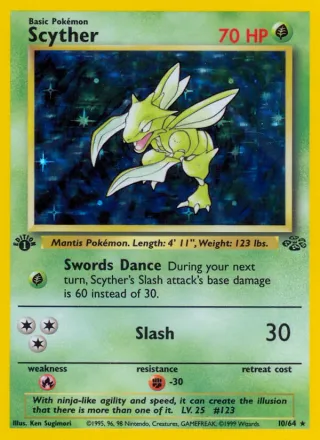
Jungle shows the limits most clearly. Bulbapedia describes "a large print run" of Unlimited Jungle holo rares printed without the set symbol, and our catalog lists all 16 as separate variants. On October 7, 2026, none of the 16 carried an evaluated price, and only 2 of the 16 standard Unlimited holos did.
1st Edition holo $190.01, Cardboard Alpha evaluated raw Near Mint price, October 7, 2026. Unlimited and no-symbol holos: no price on file.
Red Cheeks Pikachu, priced
Red Cheeks is the cleanest measured premium here because TCGplayer lists it as its own product. Bulbapedia places red cheeks on 1st Edition, Shadowless and E3 promo prints; Fanatics Collect's lot notes say Unlimited came only in yellow.
On October 7, 2026, TCGplayer's Near Mint Shadowless Red Cheeks market price was $109.95, against $45.66 for the yellow-cheek print. Red Cheeks had sat at $101.70 for six days before two Near Mint sales that day, so the gap ran from about 2.2 to 2.4 times that week.
Neither market is deep: from September 12 to October 7, 2026, TCGplayer recorded 7 Near Mint Red Cheeks units sold and 8 yellow-cheek.
Cardboard Alpha evaluated raw Near Mint price, October 7, 2026: 1st Edition $180.50, Unlimited $13.52. TCGplayer Near Mint Shadowless market price that day: Red Cheeks $109.95, yellow cheeks $45.66.
At the top grade, two dated auction records show what the variant brings and how far it can move.
Sale date
Venue
Grade
Price with buyer's premium
Bids
June 19, 2026
Fanatics Collect Premier Auction
PSA 10
$29,400
48
July 24, 2026
Fanatics Collect Premier Auction
PSA 10
$21,600
32
1st Edition Shadowless Red Cheeks Pikachu. Both listings gave a PSA 10 population of 260.
Same card, same grade, five weeks apart, and the second copy brought about 27 percent less. Two sales make a range, not a value. The wider Pikachu price ladder shows where this card sits among other printings.
When an error is worth less
Some errors carry no premium; one documented case runs the other way.
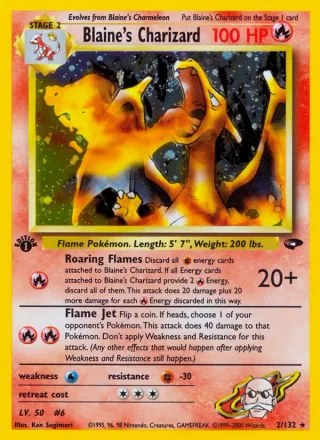
Blaine's Charizard from Gym Challenge was printed with a Fighting Energy symbol where its attack needed Fire. Per Bulbapedia, 1st Edition copies were never corrected and the Unlimited print was corrected very late, which makes the corrected Unlimited card "rarer and more desirable among collectors rather than the error version."
Unlimited holo $599.34, Cardboard Alpha evaluated raw Near Mint price, October 7, 2026. The catalog has no separate entry for the late-corrected Unlimited copies.
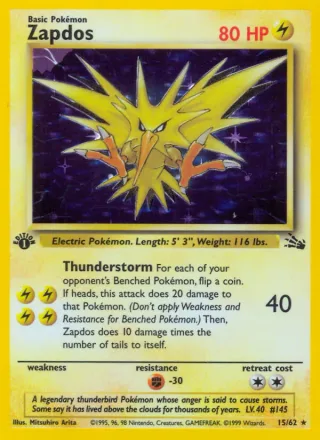
Fossil Zapdos has a non-holo patch in the top-left of the art where an evolution box would sit. CGC says it appears on all 1st Edition English copies, "and therefore is not mentioned on the label," and on perhaps half of Unlimited ones. Bulbapedia's verdict: "Neither are rare to find."
1st Edition holo $172.40, Unlimited holo $44.67, Cardboard Alpha evaluated raw Near Mint prices, October 7, 2026.
Volume is the common thread. Bulbapedia counts the 1st Edition Jungle Butterfree "d Edition" stamp among the most common Wizards-era errors, with over 100 copies. An error printed in volume is just what that card looks like.
Fakes dressed up as errors
One risk is paying an error premium for a card that was never a factory error. CGC's error guide says uncut Pokemon sheets have occasionally entered the secondary market, "where dishonest resellers cut away individual cards and mark them as miscuts or square-cut errors to mislead collectors."
Both graders guard against that:
CGC keeps an internal registry of all known uncut sheets and will not grade a Wizards-era Square Cut card without provenance back to a Wizards employee.
PSA will not grade cards cut from sheets that could be obtained in a normal fashion, and returns cards showing signs of trimming, such as hooked or unusually sharp edges, under its N1 no-grade code.
None of this rates any card as a good or bad purchase. It does suggest a few checks before a premium changes hands.
Name the error precisely. Find it on a documented list, such as Bulbapedia's error pages or CGC's designations, not just in a listing title.
Ask whether it repeats and how many exist. A one-off flaw is condition; a correction partway through a run creates scarcity, and a mistake on every copy does not.
Price the standard print first. Without a recognized premium, the card trades on condition.
Look for authentication when the premium is large. CGC checks claimed errors against its uncut-sheet registry; PSA will not grade trimmed cards or cards cut from sheets that could be obtained normally.
Read dated sales, not asks. For thin variants, records like the two Red Cheeks auctions above say more than one listing price.
Cardboard Alpha's screener tracks raw prices across the covered catalog, a quick way to price the standard print first. More on condition and authenticity lives in the condition and authentication hub.
Frequently asked questions
Are miscut Pokemon cards worth more money?
Usually not. A slight miscut or off-center cut is graded as a condition flaw: PSA applies its Miscut (MC) qualifier when warranted and can return an abnormal factory cut with no numeric grade under its N8 code. CGC does grade Miscut and Major Miscut cards as named errors, but it also calls miscuts relatively common compared to most other error types, and neither grader publishes a premium for them.
What does MC mean on a PSA graded card?
MC is PSA's Miscut qualifier. In its June 2021 customer update, PSA said the Marks (MK) and Miscut (MC) qualifiers would continue to be applied when warranted, while off-center, staining, print defect and focus problems would mostly lower the numeric grade instead. Separately, PSA's N8 Miscut code returns a card ungraded when its factory cut is abnormal for the issue.
Is the Red Cheeks Pikachu an error card?
Bulbapedia classes it as a variant incorrectly regarded as an error, because Wizards of the Coast changed the cheeks to red deliberately and later changed them back. It still trades at a premium: on October 7, 2026, TCGplayer's Near Mint Shadowless Red Cheeks market price was $109.95, against $45.66 for the yellow-cheek print.
Which Pokemon error cards are actually worth more?
The ones that repeat across a print run, are documented, and exist in limited numbers. Bulbapedia notes that errors corrected partway through a run had very limited production, while mass-produced uncorrected errors are not rare or desirable to collectors. Gym Challenge Blaine's Charizard shows the difference: its late-corrected Unlimited print is the more desirable one, not the error.
How can you tell a real factory miscut from a fake one?
Have it authenticated. CGC warns that resellers have cut cards from uncut sheets and sold them as miscuts or square-cut errors, keeps a registry of known uncut sheets, and will not grade a Wizards-era Square Cut card without provenance back to a Wizards employee. PSA will not grade cards cut from sheets that could be obtained normally, and returns trimmed cards ungraded.
Why does Cardboard Alpha show no price for some error variants?
An evaluated price needs recent evidence matched to the exact variant. On October 7, 2026, Cardboard Alpha's catalog listed error variants such as the 1st Edition Red Cheeks Pikachu and the 16 Jungle holos without a set symbol, but none had enough evidence to publish a figure, while the standard 1st Edition Pikachu was priced at $180.50.
Janelle Sazon writes collecting guides and best-card roundups for Cardboard Alpha, with an eye on what makes a Pokémon card worth chasing: the artwork, the rarity tier, the condition it survives in, and what it really costs to own once the hype is set aside. Articles under this byline are written for collectors at every level, lean on published pricing and population data rather than speculation, cite every source inline, and are fact-checked against those sources before they are published.
Janelle Sazon's articles describe the collecting market using published pricing and population data. They are informational and are not personalized investment advice.