Liquidity Risk in Pokemon Cards: Why Rare Doesn't Mean Easy to Sell
A thin PSA population and a high sticker price both describe scarcity. Neither one tells you how many buyers are actually waiting to pay it, and that gap is where liquidity risk lives.

By Ryan Shugars · Reviewed by Jackie Chung · (updated )
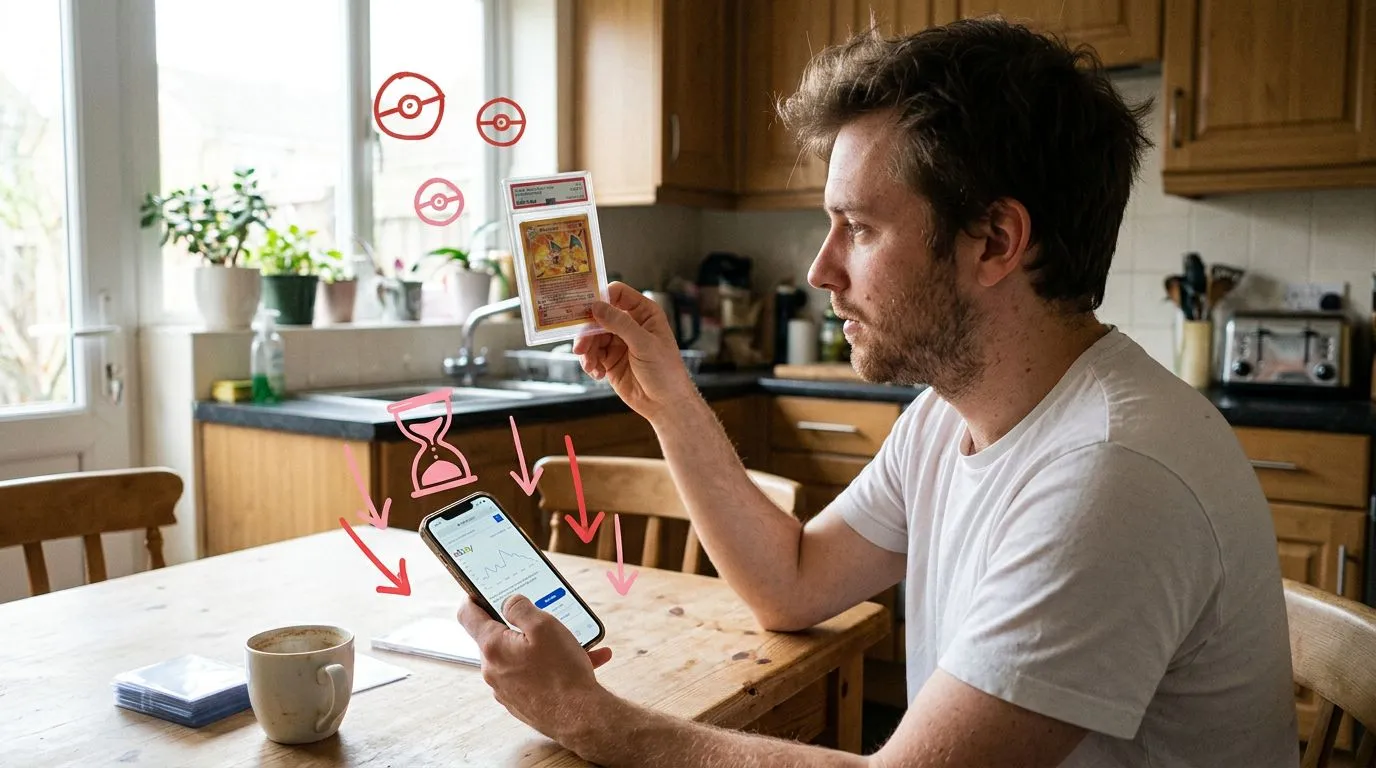
Liquidity risk in Pokemon cards is the risk that a card cannot be sold quickly near its last quoted price, and it moves independently of rarity. A card can carry a thin graded population and a high market price and still take a long time to convert to cash without a discount, because population counts and market prices both describe scarcity and value, not how many buyers are actively ready to transact.
That distinction matters to anyone who may one day need to sell. A number that looks strong on a population report or a price chart can still leave a holder stuck if the card only changes hands a handful of times a year.

4 · Base Set · Rare
PSA Population Report: the Unlimited printing's gem rate is 0.5% (488 of 102,533 graded) versus 2.3% for the 1st Edition printing of the same artwork, as of September 1, 2026.
What liquidity risk actually means
Market liquidity describes how easily a holder can sell an asset quickly without causing a steep move in its own price, per the general definition of the term. An asset is illiquid when converting it to cash fast requires accepting a real discount, not because it lacks value, but because trading in it is infrequent or the pool of willing counterparties is small.
Scarcity and worth do not, on their own, establish liquidity. A one-of-a-kind object can be genuinely valuable and still sit on a shelf for years waiting for the one buyer who wants exactly that object at exactly that price.
Pokemon cards inherit this fully. A card's rarity tier or grading population tells you how few copies exist. It says nothing about how many people are shopping for one this month, which is the other half of what determines whether a quoted price is real money or a hopeful number.
Population data measures scarcity, not turnover
PSA's own Population Report is the clearest illustration, because it is explicit about what it counts. It counts graded cards, one row per card with a count for each grade, and nothing else. It contains no column for sales, no column for active listings, and no column for how long a listed copy typically sits before it sells.
Base Set shows how far a population number can diverge from a price story. The set's overall gem rate is 10.0 percent (112,429 of 1,125,406 cards graded, PSA Population Report, accessed September 1, 2026), but its Charizard-Holo row splits sharply by printing.
| Printing | Graded population | PSA 10 population | Gem rate |
|---|---|---|---|
| Base Set, overall | 1,125,406 | 112,429 | 10.0% |
| Charizard-Holo, Unlimited | 102,533 | 488 | 0.5% |
| Charizard-Holo, 1st Edition | 5,375 | 123 | 2.3% |
Source: PSA Population Report, Base Set page, accessed September 1, 2026.
- Unlimited0.5%
- 1st Edition2.3%
PSA Population Report, Base Set page, accessed September 1, 2026.
The 1st Edition printing is scarcer by population on both counts in the table: fewer copies graded and fewer PSA 10s. None of that tells you how many of those 5,375 graded copies are currently for sale, or how many buyers are shopping for one this week. PSA does not publish that, because a population report was never built to.
A high price is not proof of an active market
A market price carries the same limitation. It reports the level a card is valued at, not the volume of trading that produced it or how many comparable transactions back it up.
Base Set Charizard shows the same gap again, this time in price instead of population. As of September 26, 2026, TCGplayer's market price for a raw near-mint Unlimited copy was $944.53.
TCGplayer lists the Shadowless printing as a separate product with several price tiers by condition and edition. Its highest tier, a raw 1st Edition Holofoil copy in only Moderately Played condition, showed a market price of $10,000.00 with zero recorded TCGplayer sales in the trailing quarter. The raw near-mint Unlimited Holofoil tier of that Shadowless product carried its own market price of $2,146.38, also with zero sales in the same trailing quarter (TCGplayer, accessed September 26, 2026).
Read on its own, $10,000.00 looks like a confirmed, tradable value. Read next to zero trailing sales on either tier, it is a posted price nobody has tested recently. Sparse trading leaves comparable sales spaced far apart, which is why TCGplayer's own trailing sale count, not just its posted market price, is the more honest liquidity read.
Modern chase cards show the other side of the same split. Charizard ex 199/165, the Special Illustration Rare from Scarlet & Violet: 151, carried a TCGplayer market price of $348.31 as of September 26, 2026, the highest of any single card in that set on that date. Its near-mint tier recorded 307 copies sold on TCGplayer over the trailing quarter (TCGplayer, accessed September 26, 2026).

199 · 151 · Special illustration rare
TCGplayer market price $348.31 as of September 26, 2026, the highest of any single card in Scarlet & Violet: 151 on that date.
The Shadowless tiers post the far higher prices, but the 151 card's much lower price is the one backed by steady recent turnover. The price alone does not tell a buyer which situation they are looking at; the trailing sale count does.
Grading data was never built to measure liquidity
PSA's own Gem Mint 10 standard is a condition-assessment protocol: four sharp corners, full original gloss, freedom from staining, and centering within roughly 55/45 on the front and 75/25 on the back (PSA Grading Standards, accessed September 26, 2026). Every criterion in it describes the physical card. None of it describes a market.
CGC's scale carries the same limitation, and its own structure makes the point sharper. CGC's current Gem Mint 10 folded in what used to be a separate Gem Mint 9.5 label, and its scale also includes a Pristine 10 tier above Gem Mint 10, reserved for cards with perfect 50/50 centering and flawless color and registration (CGC Cards Grading Scale, accessed September 26, 2026).
That kind of change reshuffles which slabs carry which label. It has nothing to do with how many of those slabs are listed for sale or how fast one would move. Grading companies publish condition data and population counts because that is their business; neither one was ever meant to answer a liquidity question, and reading either as if it does is the mistake this article is naming.
What actually signals thin liquidity
Liquidity shows up in market structure, not in a population report or a single price tick. A few patterns describe a thin market more directly than either number does:
- Few active counterparties. A card with almost no one currently listing it, and almost no one currently shopping for it, is illiquid by definition, regardless of how few copies were ever graded.
- Infrequent trading. A market where comparable sales are rare and spaced far apart cannot confirm a price the way a market with continuous turnover can; the quoted number is older and less tested.
- Price uncertainty. When buyers and sellers cannot agree on what a fair price even is right now, deals take longer to close, which is itself a form of illiquidity even before any discount changes hands.
None of these three show up in a PSA or CGC population table, and none of them show up as a separate line item on a price chart. They describe the market around a card, not the card itself, which is why rarity and price are the wrong tools for measuring them on their own.
Cardboard Alpha's own screener covers depth and turnover across the covered universe alongside price, precisely because a card's fair value and a card's tradability are two different questions with two different answers. For the mechanics behind that split, how Cardboard Alpha reads market depth and absorption walks through what the platform actually measures beyond a single price number.
A grading company's population report and the four criteria a grader actually checks both describe the card in your hand. They were never going to describe the market around it, and that gap is the whole of what liquidity risk means. Browse the full Pokemon set catalog for how any specific card's rarity and print history compare to the rest of its set.
Frequently asked questions
- What is liquidity risk in Pokemon cards?
- Liquidity risk is the risk that a card cannot be sold quickly near its last quoted price. It is separate from rarity and from price: a scarce, expensive card can still be illiquid if few buyers are actively shopping for it and comparable sales are infrequent.
- Does a low PSA population mean a card is hard to sell?
- Not by itself. PSA's Population Report counts graded copies, not sales, listings, or trading frequency. Base Set's 1st Edition Charizard-Holo has a much smaller graded population than the Unlimited printing (5,375 versus 102,533 graded copies, PSA Population Report, accessed September 1, 2026), but that comparison describes scarcity, not how quickly either one would sell.
- Why can an expensive card be harder to sell than a cheap one?
- A high price only reports the level a card is valued at, not how many recent comparable sales support that number. Base Set Shadowless Charizard shows it directly: its raw 1st Edition Holofoil tier in Moderately Played condition carried a TCGplayer market price of $10,000.00 as of September 26, 2026, with zero recorded TCGplayer sales in the trailing quarter. When comparable sales are that sparse, any single quoted price is harder to confirm.
- How is liquidity different from market price?
- Market price is a level. Liquidity is how easily a holder could convert the asset to cash near that level without a steep discount. A card can have a strong, current market price and still be illiquid if very few transactions actually happen at or near it.
- Can PSA or CGC's grading data show how liquid a card is?
- No. PSA's Gem Mint 10 standard and CGC's grading scale, including CGC's current scale that folded its former Gem Mint 9.5 label into today's Gem Mint 10 and includes a Pristine 10 tier above it, are condition-assessment protocols. They describe the physical card, not how many buyers or sellers are active for it.
Sources
- 1999 Pokemon Game (Base Set) TCG Cards - PSA Population Report, PSA Official / primary source · accessed September 1, 2026
- PSA Grading Standards - Card Grading, PSA Official / primary source · accessed September 26, 2026
- Grading Scale - CGC Cards, CGC Official / primary source · accessed September 26, 2026
- Charizard - Base Set - Pokemon, TCGplayer Official / primary source · accessed September 26, 2026
- Charizard - Base Set (Shadowless) - Pokemon, TCGplayer Official / primary source · accessed September 26, 2026
- Charizard ex - 199/165 - SV: Scarlet & Violet 151, TCGplayer Official / primary source · accessed September 26, 2026
- Market liquidity, Wikipedia Industry press · accessed September 26, 2026
About the author
Ryan Shugars is an avid Pokémon card collector who builds the market-data tooling behind Cardboard Alpha. He collects across multiple eras, tracks population reports and price movement as a matter of habit, and started building Cardboard Alpha to get a straight answer to questions the existing price guides couldn't: what's actually trading, what's just an asking price, and what a grade is really worth on a given card right now. He writes from that same collector's vantage point, close to the data, skeptical of hype, and always checking a claim against the ledger before it goes in an article.
Ryan Shugars is a collector and the builder of Cardboard Alpha's data systems, not a licensed financial advisor. Articles he writes or edits describe market history and mechanics; they are informational and are not personalized investment advice.
Related articles
Vintage vs Modern Pokemon Cards: Which Outperforms Long Term
Vintage Pokemon cards have outperformed modern Pokemon cards on every multi-year window Cardboard Alpha's own market-series data covers. This guide breaks the return gap down by era bucket through September 17, 2026, grounds the vintage side in dated Heritage Auctions results for the 1st Edition Base Set Charizard, and names what the data does not explain.
6 min read
How Floor Price Is Calculated and Why It Moves
Floor price is not a sales average or an auction result: it is the delivered price, item plus required shipping, of the cheapest live fixed-price listing for a card. This guide walks the calculation step by step and names the four market events, a sale, a delisting, a reprice, or new cheaper supply, that move it.
6 min read
Bear Markets in Pokemon Cards: What History Shows
Dated records from Hasbro's annual report, Fortune and TCGplayer show Pokemon card downturns following supply surges in 2000, 2021 and 2026. Cardboard Alpha's composites show how long the 2021 falls lasted, and its POKE baskets and July 1 slate show how uneven the 2026 fall was as of October 19 and 20, 2026.
8 min read
Sealed vs Graded vs Raw: Comparing Investment Vehicles
Raw, graded and sealed Pokemon cards behave like three different investment vehicles, not three prices on one card. Cardboard Alpha's Graded Index, as of September 14, 2026, shows the grading premium over raw compressed in every era group since October 2024, from a 5 percent slide in Classic to a 48 percent slide in Modern. The Sealed Index shows the Modern basket up 52 percent over the past 52 weeks even as its 30-day reading slipped, and the in-print basket down 22 percent since January despite a recent bounce.
7 min read