Common Pokemon Card Counterfeits and How to Catch Them
CGC's own dated counterfeit-alert case studies name the exact tells (wrong weight, an unusual UV-light reaction, a weaker holofoil pattern, a missing security stamp) that separated three documented fakes from the genuine cards they copied.
Between March and July 2026, CGC published three separate, dated "Counterfeit Alert" case studies for Pokemon cards, and each one names the exact, checkable tells that gave the fake away rather than a general warning. The specific details differ by card: weight, holofoil pattern, missing security marks, and font or symbol errors each show up in at least one alert, and an abnormal UV-light reaction shows up in all three.
None of the three alerts rests on a single giveaway. Each lists several mismatches, in texture, print sharpness, color, or a missing security mark, and in each one CGC shows the suspect card beside a genuine example to make the differences visible.
Counterfeit versus altered
Collectors use "fake" loosely, but the word covers more than one problem, and only counterfeiting is what this guide addresses.
A counterfeit was never printed by the Pokemon Company or a licensed printer. That is a different problem from an authentic card that someone later altered, which is exactly the distinction CGC's own published grading scale draws with two specific labels. A factory miscut or misprint is a third case, a genuine card with a printing flaw.
Term
What it is
CGC label available
Counterfeit
Never a genuine Pokemon Company print
None; the scale lists no counterfeit designation, and its Authentic and Authentic Altered labels both require an authentic card
An authentic card that has been altered, for example recolored or trimmed
Authentic Altered (AA)
Authentic (no numeric grade)
An authentic, unaltered card that cannot take a numeric grade, for example one missing a portion of stock or below CGC's minimum size
Authentic (AU)
Source: CGC Cards Grading Scale, accessed September 26, 2026.
Both CGC definitions start from a card that is authentic, so a card CGC identifies as counterfeit fits neither one.
Three CGC counterfeit case studies
CGC published three separate Pokemon counterfeit alerts between March and July 2026, each naming one specific card and the tells that exposed it. Together they span a 2025 Japanese Black & White Rare, a Japanese starter-Pokemon card from 2000, and a 2025 Simplified Chinese alternate-art Art Rare.
Card
Set
Alert date
One key tell (of several)
Reshiram ex, Black & White Rare
White Flare (Japanese, 2025)
July 9, 2026
Weighs 2.51g against 1.59g genuine, and has no core
Cyndaquil
Gold, Silver, to a New World (Japanese, 2000)
May 7, 2026
Missing its set symbol entirely
Umbreon Art Rare
Gem Pack Volume 2 (Simplified Chinese, 2025)
March 12, 2026
Missing its bottom-left security stamp
Source: CGC Cards counterfeit alerts, accessed September 26, 2026.
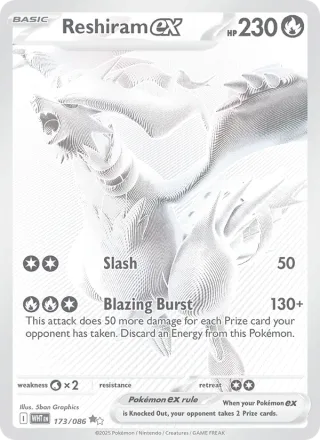
Reshiram ex, Black & White Rare (White Flare, 2025). CGC's July 9, 2026 alert found the counterfeit weighed 2.51 grams against 1.59 grams for the genuine card, and that it was much thicker than the genuine card, with no core. The background line art behind Reshiram ran in the opposite direction from the genuine print, the card back looked washed out and blurry, and the fake was missing the small "taxi-cab" pattern inside the P of the Pokemon logo.
Under UV light, the Reshiram ex counterfeit was far more reactive across the card, while the genuine card reacted only in certain places, highlighting its text and design.
This is the English White Flare printing of the Black & White Rare Reshiram ex. CGC's July 9, 2026 alert concerned a counterfeit of the Japanese version: 2.51g versus 1.59g genuine, with no core.
Cyndaquil (Gold, Silver, to a New World, 2000). CGC's May 7, 2026 alert described a counterfeit that ran more yellow and muted than the genuine card's colors, with fuzzy black outlines on the wall behind Cyndaquil where the genuine print carries thin lines. The fake was missing its set symbol entirely, which CGC calls an immediate indicator that a Neo-era card is fake, since all Neo-era sets included set symbols.
The Cyndaquil fake's font ran bigger, bolder, and more tightly spaced, with a typo in the card's second attack name, and its back-side copyright text was fuzzier and sat just off-center relative to a light ray coming off the Poke Ball. Under UV light, the fake appeared very light compared to the genuine card, which appeared normal.
Umbreon Art Rare (Gem Pack Volume 2, 2025). CGC's March 12, 2026 alert covered a Simplified Chinese alternate-art card that, per CGC, fetches hundreds of dollars in online auctions. The counterfeit was missing the thick black line detailing Umbreon's closed eye, making it look as if Umbreon had no second eye at all, and it lacked details such as shading and deeper line art on the toes and tail curve, which made the artwork look flat.
The Umbreon fake's holofoil reflected fewer bars and shone less brightly than the genuine card's diagonal bar pattern, and it was missing the small security stamp that CGC says Simplified Chinese cards carry in the bottom left-hand corner, on the silver edge just under the set symbol. Under UV light, the fake looked lighter and washed out on the front, where the genuine card looked vibrant, and lighter with an almost glowing quality on the back.
The checks, case by case
Pulling the individual tells out of CGC's three alerts gives five checks. Only the UV check appeared in all three; the others each came from one or two cases:
Weight and thickness: the Reshiram ex counterfeit was heavier and thicker than genuine, and had no core.
UV light reaction: every one of the three counterfeits reacted differently under UV light than its genuine counterpart, though the exact difference (reacting far more broadly, appearing very light, or looking washed out) varied by case.
Holofoil pattern: the Umbreon Art Rare counterfeit reflected fewer bars and shone less brightly than the genuine card's holofoil.
Security marks and set symbols: a missing security stamp exposed the Umbreon fake, and a missing set symbol exposed the Cyndaquil fake outright.
Font, spacing, and small typos: the Cyndaquil counterfeit ran a bigger, bolder font with a typo in an attack name, and the Reshiram ex counterfeit had a blurry copyright symbol next to a crisp genuine one.
Each of CGC's alerts describes what it found on one specific fake, not a universal counterfeit signature. A card that passes every check listed here has not thereby been formally authenticated.
Why a counterfeit fits no CGC designation
CGC's published grading scale lists three card designations: Authentic (AU), for an authentic, unaltered card that cannot take a numeric grade, such as one missing a portion of stock or under minimum size; Authentic Altered (AA), for an authentic card that has been altered, with recoloring and trimming as CGC's examples; and Authentic ART, for cards with custom art applied that originate from a CGC Artist Account holder or a qualified CGC Signature Series submission.
The scale lists no designation that says "counterfeit." Authentic and Authentic Altered are both defined for cards that are authentic, so a card identified as counterfeit fits neither, and CGC's alerts state that the cards it certifies are guaranteed authentic under the CGC Guarantee.
Where buyers actually get caught out
General hobby coverage cautions buyers about fake cards sold through e-commerce sites and individual sellers, separate from any specific grading-company case. A related but different scam runs on livestreaming platforms: a seller reseals a booster pack after quietly removing the valuable card, then sells the resealed pack anyway, sometimes sending a counterfeit card or nothing at all.
That scam happens before any card reaches the buyer's hands, so the print-level tells above only help once whatever was sent actually arrives. Checking a card's weight or its reaction under UV light is a test of the card; it says nothing about whether a pack was resealed. Once a counterfeit has arrived, refund and chargeback options depend on how the card was paid for.
What is the difference between a counterfeit card and a CGC Authentic Altered card?
A counterfeit was never printed by the Pokemon Company or a licensed printer. CGC's Authentic Altered (AA) designation is different: it is reserved for a genuine card that has been physically changed after printing, recoloring and trimming are the two examples CGC gives, per CGC's published grading scale.
Does a missing set symbol always mean a Pokemon card is fake?
Not for every era. CGC calls it an immediate indicator for Neo-era cards specifically. In CGC's May 7, 2026 alert, a fake Japanese Cyndaquil from the 2000 Gold, Silver, to a New World set was missing its set symbol entirely, and CGC notes that, unlike Pokemon's first-generation sets, all Neo-era sets included set symbols.
Can a UV flashlight really catch a fake Pokemon card?
In all three of CGC's 2026 counterfeit alerts, the fake reacted differently under UV light than the genuine card did, though the exact difference varied: one reacted far more strongly across the card, one appeared very light, and one looked washed out on the front and glow-like on the back. In each alert CGC presents the UV result alongside several other tells, and describes UV light as a way to help further confirm whether a suspicious card is fake.
Is a card's weight enough to prove it is a counterfeit?
One documented case is not a hobby-wide rule. CGC's July 9, 2026 alert on a Japanese Reshiram ex found the counterfeit weighed 2.51 grams against 1.59 grams for the genuine card and had no core, a finding specific to that one alert rather than a published standard weight for every Pokemon card.
Will CGC grade a card it determines is counterfeit?
CGC's published grading scale defines its Authentic (AU) and Authentic Altered (AA) designations only for cards that are authentic, and it lists no counterfeit designation, so a card CGC identifies as counterfeit fits neither. CGC's counterfeit alerts also state that cards it certifies are guaranteed to be authentic under the CGC Guarantee.
Ryan Shugars is an avid Pokémon card collector who builds the market-data tooling behind Cardboard Alpha. He collects across multiple eras, tracks population reports and price movement as a matter of habit, and started building Cardboard Alpha to get a straight answer to questions the existing price guides couldn't: what's actually trading, what's just an asking price, and what a grade is really worth on a given card right now. He writes from that same collector's vantage point, close to the data, skeptical of hype, and always checking a claim against the ledger before it goes in an article.
Ryan Shugars is a collector and the builder of Cardboard Alpha's data systems, not a licensed financial advisor. Articles he writes or edits describe market history and mechanics; they are informational and are not personalized investment advice.