Loading category…
Grading
PSA/CGC/BGS grading standards, population data and raw-vs-graded value spreads.
Articles

Grading
What to Do If You Bought a Fake Pokemon Card
Where you paid decides how you get your money back after buying a fake Pokemon card. This guide sets out the steps and, as of October 22, 2026, the deadlines and counterfeit rules at eBay, PayPal, TCGplayer and credit card issuers, plus what PSA and CGC guarantees leave uncovered on a fake slab.
9 min read
Grading
How PSA Grading Works: Submission Tiers, Fees and Turnaround
PSA authenticates, grades and seals each card, and its fee, insured-value cap and turnaround estimate all depend on the service level you pick. This guide covers the submission steps, PSA's fee table as archived on October 16, 2026, the Value tier pause, packing rules, order statuses and returns.
8 min read
Grading
Holo vs Reverse Holo vs Non-Holo: Value and Condition
Holo, reverse holo and non-holo cards differ in where the foil sits, how they come out of a pack and how graders treat foil flaws. This guide compares Cardboard Alpha's evaluated raw Near Mint prices for the same cards in each finish on October 10, 2026, across 115 English sets, and reads TCGplayer, CGC, Beckett and PSA on surface condition.
7 min read
Grading
Grading Japanese Pokemon Cards: What's Different
TAG and CGC publish rules that cover Japanese-language Pokemon cards, each with exclusions or identification caveats. In eight same-art pairs between July 9 and October 6, 2026, the Japanese PSA 10 median was below its English twin's in seven pairs and tied in one, and the PSA 10 step over a PSA 9 was smaller on the Japanese copy in the four pairs with enough sales to compare. No Japanese population counts were available to say why.
6 min read
Grading
Trimmed and Recolored Cards: Card Doctoring Explained
A trimmed or recolored card is a genuine card altered to look better than it is, and PSA, CGC and TAG refuse it a numeric grade. This guide sets out how PSA, CGC, Beckett and TAG label such cards, what PSA's May 2026 fraud report found, and how the PSA 10 premium on four real cards on October 3, 2026 explains the incentive.
7 min read
Grading
Near Mint vs Lightly Played: A Raw Card Condition Guide
Near Mint and Lightly Played are measured, not felt: TCGplayer's standards cap NM at 3 points of imperfections and LP at 6, with whitening, grime and bends ruled out at NM. On October 2, 2026, the median LP copy priced at 95.3 percent of NM for Scarlet & Violet cards worth $20 or more and 73.5 percent for Wizards of the Coast cards.
7 min read
Grading
Common Pokemon Card Counterfeits and How to Catch Them
CGC has published three separate, dated counterfeit alerts for Pokemon cards in 2026, each naming the specific checkable tells that gave a fake away: card weight, UV-light reaction, holofoil pattern, security stamps, set symbols, and font accuracy. Each alert lists several red flags rather than one. This guide walks through all three cases, the checks each one turned up, and where CGC's own Authentic and Authentic Altered designations do, and don't, apply.
6 min read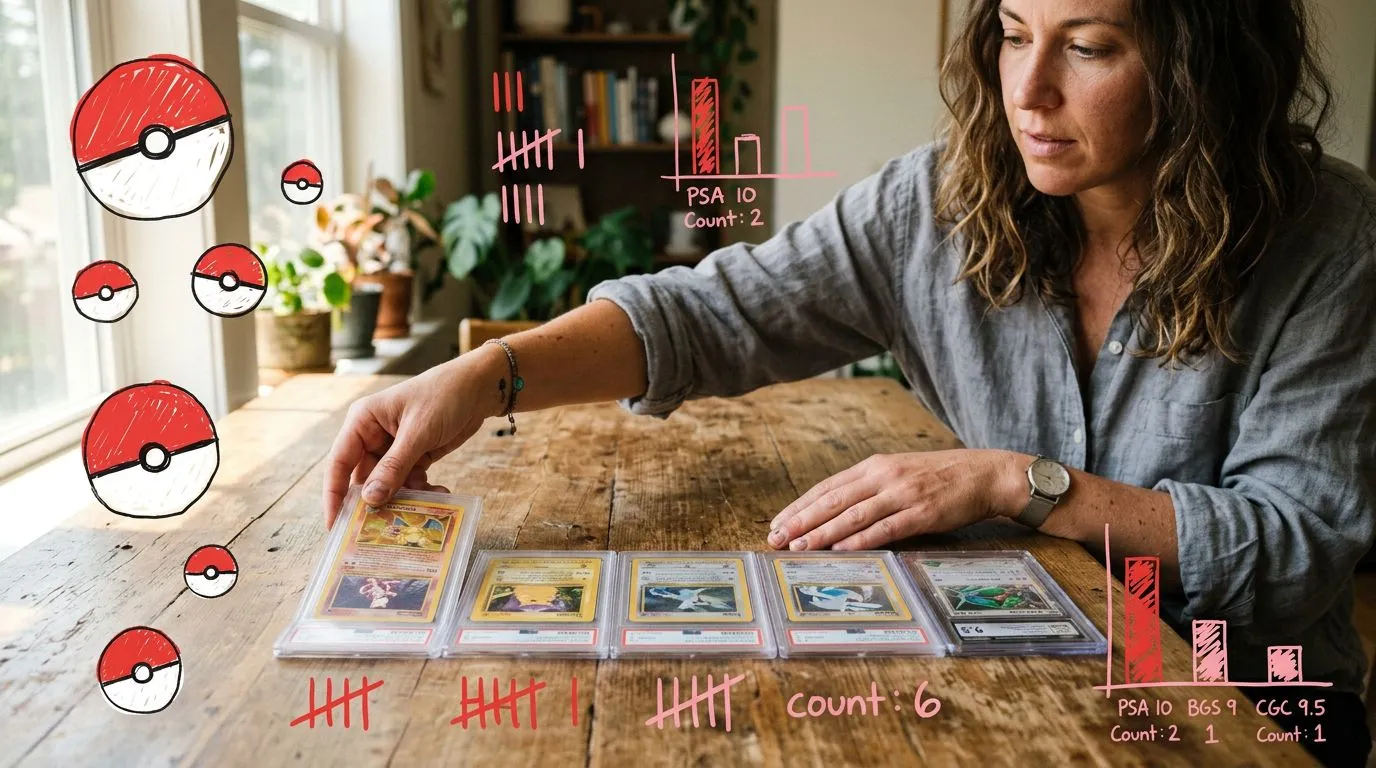
Grading
How Population Reports Shape Pokemon Card Grading Value
Cardboard Alpha's Grading Opportunity model prices the expected value of grading thousands of cards at once. Swapping a generic assumption for a card's real population, when there is enough of it, moved that estimate down 93 percent on one card and up more than triple on another, dated September 21, 2026.
7 min read
Grading
Fake Slabs: How to Spot a Counterfeit PSA or CGC Case
A fake slab is a counterfeit or altered grading-company holder, not a fake raw card. PSA reported intercepting $200 million in projected market value of fraudulent collectibles in 2025, and a federal case shows exactly how a forged-label scheme deceived buyers.
6 min read
Grading
PSA 10 vs PSA 9: How Much Is the Grade Jump Worth
The gap between a Grade 9 and a Grade 10 slab of the same card is not one number. Cardboard Alpha's Grading Opportunity model (build 2026-09-21, sales from all graders pooled) shows it ranging from 1.83x to 8.13x across five tracked cards, while only 19.8% of the 2,963 cards it evaluated clear a positive grading expected value.
8 min read
Grading
How to Spot Fake Pokemon Cards: A Complete Guide
Spotting a fake Pokemon card starts with the light test and knowing what official products look like, both straight from Pokemon Support's own guidance, not a hobbyist trick. This guide adds what CGC's Authentic and Authentic Altered designations actually mean, a documented 2023 Japan arrest that shows which cards counterfeiters target, and the enforcement record behind it.
6 min read
Grading
Is PSA Grading Worth It? The Break-Even Math
PSA's orderable per-card grading fees run from $59.99 to $999 for cards declared up to $25,000, as reported in mid-September 2026. A $348 chase card needs about a 17 percent price gain to clear the cheapest tier; a $2.91 Hyper Rare needs a graded sale above 21 times its raw price just to cover that same fee. Here is the math, tier by tier.
6 min read
Grading
Pokemon Card Grading Scale Explained: What Each Grade Means
A Pokemon card's grade is a number from 1 to 10 assigned after inspecting centering, corners, edges and surface, but PSA, CGC, BGS and TAG do not all use that number the same way. This guide lines up all four companies' scales side by side, explains what actually separates a 9 from a 10 at each one, and covers the authentication step that has to happen before any number gets assigned.
6 min read
Grading
PSA vs CGC vs BGS vs TAG: Full Grading Company Comparison
PSA, CGC, BGS and TAG do not define a top grade the same way. CGC issues two labels inside one numeric 10, BGS prints separate centering, corners, edges and surface grades on its label, and TAG grades with a multi-patented system on a 1000-point scale with a per-attribute digital report. On September 26, 2026, CGC was running a full six-tier service; on October 24, Express was Beckett's only open tier.
8 min read
Grading
Centering, Surface, Corners, Edges: Four Grading Criteria
PSA, CGC, and BGS each describe a Pokemon card's centering, corners, edges, and surface in their published grade definitions. Here is what each company actually publishes, where their numbers agree, and where they do not.
7 min read
Grading
Gem Mint 10 Odds by Set: Which Sets Grade the Hardest
Gem mint 10 rates are not one hobby-wide number: PSA's Population Report puts Neo Genesis at roughly 3.2 percent PSA 10 and 2021's Evolving Skies near 59.2 percent, an eighteen-fold spread inside the same grading company's own data. PSA publishes the counts behind each rate but no cause for the gap. Even within a single set, one chase card can grade far harder than the set's own average.
6 min read