Trimmed and Recolored Cards: Card Doctoring Explained
PSA, CGC and TAG will not give a trimmed or recolored card a numeric grade, and PSA's 2025 Fraud Report put the year-over-year rise in altered Pokemon cards at 407.2 percent. On October 3, 2026, Cardboard Alpha's 90-day median for a PSA 10 copy of 151 Charizard ex #199 was $1,403.41, against an evaluated price of $334.92 for a raw Near Mint copy.
A trimmed or recolored card is a genuine card that someone altered to look better than it is, and PSA, CGC and TAG all refuse to give it a numeric grade. PSA's 2025 Fraud Report, published in May 2026, put the year-over-year increase in altered Pokemon cards at 407.2 percent, against 1.6 percent for altered sports cards.
The incentive shows up in the price ladder. On October 3, 2026, Cardboard Alpha's evaluated price for a raw Near Mint 151 Charizard ex #199 was $334.92, while the 90-day median for a PSA 10 copy was $1,403.41, about 4.2 times as much. PSA's report places that card second on its list of the ten most-altered cards by volume.
Second on PSA's 2025 list of the ten most-altered cards by volume. Raw Near Mint $334.92, PSA 10 90-day median $1,403.41 (Cardboard Alpha, October 3, 2026).
PSA's report describes altered cards as authentic cards manipulated to look better or grade higher. It lists five common attempts: trimming, corner and edge recoloring, layer reconstruction (rebacking), surface manipulation or gloss enhancement, and flattening or chemical treatment.
Because altered cards often start as genuine material, PSA says detecting them can be more complicated than spotting an outright counterfeit. The counterfeit side has its own tells, covered in CGC's dated counterfeit alerts.
The grading companies' own pages name the same acts under their own codes.
Alteration
How PSA describes it
PSA code
CGC label
Trimming
The card's edge appears altered
N1
Evidence of Tampering/Alteration
Restoration
Paper stock built up, such as rebuilt corners
N2
Evidence of Tampering/Alteration
Recoloring
The card's color appears artificially improved
N3
Evidence of Color Added
Altered stock
Pressed creases or wrinkles, removed scratches, enhanced gloss, or a foreign substance such as wax
N5
Evidence of Tampering/Alteration
Cleaning
Whitening borders, or using a solution to remove stains
N7
Evidence of Tampering/Alteration
Source: PSA Grading Standards and CGC Cards, Cards We Grade, as published in September 2026. CGC lists trimming, restoration, power erasing, chemical cleaning, pressing and stain removal as evidence of alteration.
No grader reviewed here puts a numeric grade on a card it judges altered. The policies below are as published in September 2026, except TAG's help article (September 2024) and Beckett's walkthrough (2018). What differs is the exception.
PSA: The card comes back without a grade in a card saver sleeve, under one of the codes above, and PSA still charges the grading fee. Each of those codes can qualify for encapsulation as Authentic Altered (AA) at the grader's discretion, but only if AA was listed on the submission form as the minimum grade. N4, a suspected counterfeit, never qualifies.
CGC: A card its graders judge altered gets no numeric grade and no CGC holder, and the submitter is charged the grading fee. CGC reserves the right to assign an Authentic Altered designation instead.
TAG: It says it will not grade trimmed or altered cards. They come back unslabbed, and a card flagged for evidence of trimming is not eligible for a refund.
Beckett: Its process walkthrough, last modified in 2020, says a card is checked for authenticity and alteration before condition is assessed. An altered card goes back with a note naming the alteration or, if the customer chose it, is sealed with an Authentic-Altered label. Beckett's current grading pages could not be read for this guide, so treat that as a baseline, not current policy.
An Authentic Altered slab is an exception, not a grade. Fake slabs are a separate problem: a counterfeit or tampered holder and label.
What PSA's fraud report shows
PSA's report gives year-over-year increases of 108.7 percent for all altered cards, 407.2 percent for altered Pokemon cards and 1.6 percent for altered sports cards. For altered cards it publishes percentages, not counts, and it does not split the rise between more alteration and better detection.
Category: Pokemon ranks first among categories of altered cards, and Pokemon characters fill nine of the ten most-altered subjects. Pikachu is first and Charizard second, with Mew, Gengar and Umbreon fourth to sixth.
Cards: Eight of the ten most-altered cards by volume carry a JP label for Japanese-language prints. The other two are 151 Charizard ex #199 and a 2025 Prismatic Evolutions Eevee promo.
Types: The report names trimming and corner and edge recoloring among its five common attempts but gives no breakdown by type, so it cannot say which kind is most common.
The grade premium behind the incentive
The price gap between a raw copy and a PSA 10 shows what a higher grade is worth, which is the outcome PSA says alterations are meant to produce. Of these four, only 151 Charizard ex #199 is a card PSA names; the other three stand in for characters on its most-altered list.
Card
Raw Near Mint
PSA 10 median
PSA 10 as multiple of raw
Charizard ex #199, 151
$334.92
$1,403.41
4.19x
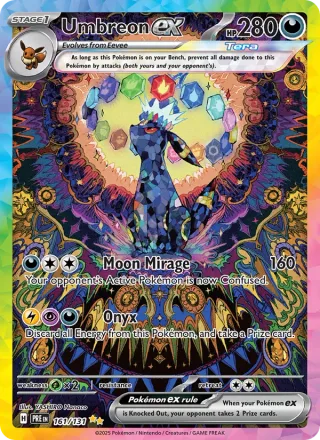
Umbreon ex #161, Prismatic Evolutions
$1,167.24
$5,356.00
4.59x
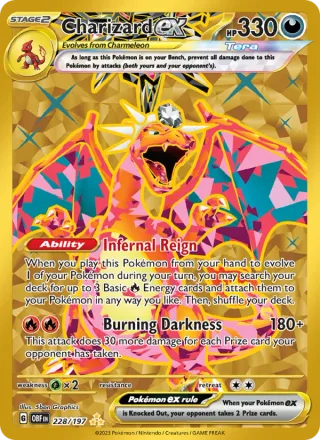
Charizard ex #228, Obsidian Flames
$34.00
$276.00
8.12x
Gengar VMAX #157, Fusion Strike
$42.42
$210.00
4.95x
Source: Cardboard Alpha evaluated prices, October 3, 2026, English standard-size copies. Raw figures are delivered prices (item plus required shipping) anchored on that day's sales: seven for Charizard ex #228, two for Charizard ex #199, one each for Umbreon ex and Gengar VMAX, with the thinner days blended with active listings and earlier prices. PSA 10 figures are 90-day medians of PSA 10 item prices, so each multiple, if anything, understates the premium.
PSA 10 median as a multiple of raw Near Mint
Charizard ex #228, Obsidian Flames8.12x
Gengar VMAX #157, Fusion Strike4.95x
Umbreon ex #161, Prismatic Evolutions4.59x
Charizard ex #199, 1514.19x
Cardboard Alpha evaluated prices, October 3, 2026. Raw figures are delivered prices; PSA 10 figures are 90-day sale medians.
Raw Near Mint $34.00, PSA 10 90-day median $276.00, 8.12x (Cardboard Alpha, October 3, 2026). Charizard is second on PSA's most-altered subjects.
The step below the top is small by comparison: the PSA 9 evaluated price for Charizard ex #199 was $385.00, carried forward from October 1, about 15 percent above raw Near Mint against about 319 percent for the PSA 10. The premium sits at the 10, whose definition calls for four perfectly sharp corners and full original gloss. Two attempts on PSA's list, corner recoloring and gloss enhancement, bear directly on those features.
PSA's report lists six checks, and it notes that many alterations are nearly invisible in standard imaging, so a single look is a weak test.
Dimensional measurement: A trimmed card can end up outside the manufacturer's specification, and PSA stresses that a fraction of a millimeter counts. Its standards define an undersized card only as one significantly below factory specifications, with no figure given.
Edge beveling: Cards cut at the factory share a consistent, slightly beveled edge, while a trimmed edge changes the natural profile and fiber pattern. PSA's standards describe a trimmed edge as hooked, unusually sharp for the issue, uneven in color, or wavy.
Recoloring and edge touch: Added color can bleed past the original printed boundaries, and under magnification altered corners and borders often have an unnaturally even color.
Gloss and surface: Cleaning or a surface treatment can strip a card's natural gloss or leave areas that look overly polished, and patchy reflectivity can point to manipulation.
Paper structure and warping: A card that was soaked or chemically treated can show faint warping or softened fibers.
Layer integrity: For rebuilt or rebacked cards, graders look for separated layers and misaligned printing.
PSA images each item under multiple lighting conditions and angles and compares it with a library of more than 270 million images of authentic, counterfeit and altered cards. Its buyer advice is simpler: benchmark a card against known authentic examples. Corners, edges and surface are three of the four things a grade measures, and the four grading criteria explains each.
How marketplaces treat altered cards
TCGplayer's Card Conditioning Overview (last revised March 2025, per its change log) classes a card with alterations such as stamps, signatures, paint or marker as Damaged. It says a Listing with Photo may suit such a card, and the seller may then list the condition the card would have without the alteration.
The page names those alterations; it does not name trimming or recoloring. The Near Mint versus Lightly Played guide covers the rest of TCGplayer's condition scale.
PSA's report also tells buyers to question deals far below market value and points them to eBay's Authenticity Guarantee, under which PSA inspects eligible items before delivery.
If you suspect an altered card
PSA's report separates a bad actor from a collector who unknowingly bought a counterfeit or altered item, and encourages collectors to follow up with the original seller or marketplace. A grader's ruling is the formal route, and it has a cost: PSA charges its grading fee on the trimming, restoration, recoloration, altered-stock and cleaning codes, and its report says it returns the item to the submitter when it identifies fraud.
Cardboard Alpha had no evaluated price for any CGC Authentic Altered slab on October 3, 2026, so this guide quotes no value for an altered card. To compare a card's price, liquidity and supply with the rest of the covered catalog, open Cardboard Alpha's screener.
Frequently asked questions
What is the difference between a trimmed card and a recolored card?
Trimming alters a card's edge and dimensions, while recoloring adds or improves color, which PSA's report associates with corners and edges. PSA codes them separately, N1 for trimming and N3 for recoloration. CGC files trimming under Evidence of Tampering/Alteration and recoloring under Evidence of Color Added.
Will PSA or CGC grade a trimmed or recolored Pokemon card?
Neither assigns a numeric grade to a card it judges altered. PSA can encapsulate some such cards as Authentic Altered at the grader's discretion if the submitter listed AA as the minimum grade, and CGC reserves the right to assign the same designation. Both charge the grading fee when they return a card as altered.
Is an Authentic Altered card the same as a counterfeit?
No. Authentic Altered is an exception label for a card that is genuine but altered, and PSA's suspected-counterfeit code, N4, never qualifies for a slab. PSA's report treats the two differently, noting that altered cards often begin as legitimate material, which can make detection more nuanced and complex. A counterfeit was never a genuine print at all.
How common are altered Pokemon cards?
PSA's 2025 Fraud Report gives its altered-card figures as percentages rather than counts: altered Pokemon cards rose 407.2 percent year over year, against 108.7 percent for all altered cards and 1.6 percent for altered sports cards. Pokemon is the top category of altered cards, and eight of the ten most-altered cards by volume carry a JP label for Japanese prints. The report does not say how much of the rise is more alteration and how much is better detection.
Can I tell if a card was trimmed by measuring it?
A measurement is one of the six checks PSA lists, but PSA says even fractions of a millimeter matter and defines an undersized card only as one significantly below factory specifications, with no figure. PSA also compares edge profile, edge and corner color, gloss and paper structure, and it notes that many alterations are nearly invisible in standard imaging. A single reading at home cannot clear or condemn a card; PSA's buyer advice is to compare against known authentic examples.
Sources
PSA Grading Standards, PSA (Professional Sports Authenticator) Official / primary source · accessed October 24, 2026
2025 Fraud Report, PSA (Professional Sports Authenticator) Official / primary source · accessed October 24, 2026
Cards We Grade, CGC Cards (Certified Guaranty Company) Official / primary source · accessed October 24, 2026
Jay Montalbo writes about grading and selling for Cardboard Alpha. His background is in information technology, with nearly six years as an IT systems administrator and later work as an IT support analyst, and he brings the same troubleshooting habit to cards: break the problem into steps, check each one, and trust the answer only when every step holds. His articles work through when a grading submission pays for itself, how condition and grading-company standards move a card's value, and what a sale actually nets after marketplace fees and shipping, using published population reports, fee schedules, and completed-sale data. Every source is cited inline, and each piece is fact-checked against those sources before it is published.
Jay Montalbo's articles describe grading and selling mechanics using published population, fee, and pricing data. They are informational and are not personalized investment advice.