Why Pokemon Card Prices Spike: The Mechanics of a Rally
A spike needs buyers arriving faster than copies are listed. On October 18, 2026, the 4.2% of priced raw Near Mint English card variants at $100 or more held 66.3% of the combined value, and the POKE150 basket sat 30.9% below its July 1 base.
Pokemon card prices spike when buyers arrive faster than copies are listed at the old price. TCGplayer's 2026 price-trend reports describe the pattern repeatedly: a set reveal, a rotation date or one buyer's bulk purchase draws down the cheapest Near Mint listings, and the card's Market Price jumps, often with no broad rise in sales.
Most Pokemon cards are cheap, and Cardboard Alpha's data shows where the expense sits. On October 18, 2026, 51.4% of priced raw Near Mint English variants cost under $1, while the 4.2% priced at $100 or more held 66.3% of the combined value. From July 1 to August 31, 2026, an equal-weighted composite of every priced single rose 7.9% while the POKE150 basket of the most traded cards fell 15.6%, and by October 18 POKE150 sat 30.9% below its July 1 base.
This guide separates the supply, demand and structural mechanics behind that gap. It describes past movement, not a forecast or a recommendation about any card.
Supply: reprints, rotation, thin listings
The Pokemon Company's March 27, 2025 notice said it was printing more of the affected products at maximum capacity and would keep reprinting to restock retailers, but it gave no volumes. Its figures page reports a cumulative total instead: over 85 billion Trading Card Game cards produced as of the end of March 2026. Neither page states a print run for any single set.
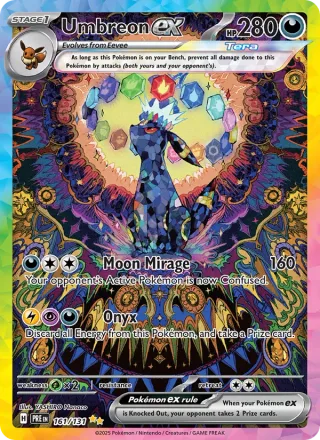
Reprints change what sellers can list. TCGplayer's October 13, 2026 report dates the turn in modern singles to around July 2026, when waves of reprints began to catch up with demand after months of steep gains. In September a wave of Prismatic Evolutions reprints took that set's Elite Trainer Boxes to their lowest price since February, and Umbreon ex 161/131 fell with them, losing $119.04 in 30 days to a Market Price of $1,323.45.
161 · Prismatic Evolutions · Special illustration rare
TCGplayer Market Price $1,323.45 on October 13, 2026, down $119.04 in 30 days.
The effect is not always immediate or one-way. After a reprint wave reached stores in early April 2026, TCGplayer's May 27 report found Prismatic Evolutions singles rising, and guessed that buyers who opened packs without finding their cards bought singles directly.
Rotation shapes expectations about future supply. The same report notes a widely held belief that The Pokemon Company International never reprints a set after it leaves the Standard format. It ties a rise in G-block singles over the preceding months, with many of the biggest gainers from Paldean Fates, to that belief and to the block's April 2026 rotation.
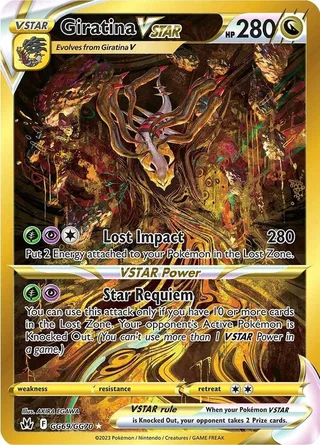
Thin listings then amplify demand. Giratina VSTAR (Secret) from Crown Zenith Galarian Gallery grew 36% in the 30 days to May 25 after three months of ordinary sales, which TCGplayer put down to the market running out of lower-priced listings. Its Market Price was $333.25 on May 27, 2026 and $428.87 on June 23.
TCGplayer Market Price $333.25 on May 27, 2026 and $428.87 on June 23, 2026.
Large single purchases do the same job faster. TCGplayer's reports cite the average number of copies per buyer, and its 2026 examples include days far above the usual:
Card (set)
What TCGplayer observed
Market Price
Wiglett 206/198 (Scarlet & Violet)
April 24: average of 5.2 copies per buyer, up from 1.2 the day before
$37.94 on May 27, up $20.74 in 30 days
Terapagos ex 170/142 (Stellar Crown)
April 29: average of 28.0 copies per buyer
Briefly $80 from $33; $69.27 on May 27
Mew ex 232/091 (Paldean Fates)
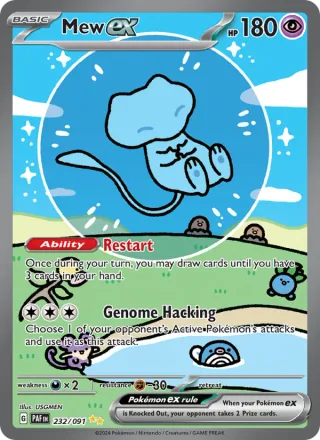
June 8: one buyer took 10 copies
Over $1,000 for the first time; $1,026.76 on June 23
TCGplayer Market Price $1,026.76 on June 23, 2026, after a 10-copy purchase on June 8.
Demand: attention and announcements
Demand shocks have dates. On June 1, 2026, The Pokemon Company revealed that its 30th anniversary set would include a 30-card subset of reprints stamped with an anniversary logo. TCGplayer's June 23 report says speculators then bought more copies of the Team Up Pikachu & Zekrom-GX in one day than normally sell in a month.
At 2.4 copies per buyer, TCGplayer noted, most of that demand may have been organic. The card still stood about $40 below its June 3 peak by June 23.
Wider attention sets the backdrop. CNBC's May 22, 2026 report credited nostalgia, blockbuster card sales and speculation for the boom, with 2026 hype driven by 30th anniversary products, and cited the February sale of a Pikachu Illustrator card for more than $16 million after its owner paid just over $5 million in 2021. It also described new releases selling out in minutes in Britain and the United States, and a trading-card expert at an auction house said high-profile sales encourage others to think they can profit from more common cards.
Attention is also finite. TCGplayer's October 13 report says whatever interest remained in modern singles was being absorbed by 30th Celebration, released September 16, 2026, and that even that set's singles had not held steady. A guide to affordable 30th Celebration Illustration Rares follows their prices from September 22 to October 11.
Where the value sits
Cardboard Alpha's evaluated price is one number per card variant per day, built from recorded sales when there are some and from a published market guide or the lowest asking prices when there are not. A variant is one card in one finish or edition. On October 18, 2026, 35,025 unstamped, standard-size raw Near Mint English variants had an evaluated price, and one copy of each was worth $741,081 in total.
Evaluated price
Variants
Share of variants
Combined value
Share of value
Under $1
17,989
51.4%
$6,398
0.9%
$1 to $9.99
9,364
26.7%
$36,702
5.0%
$10 to $99.99
6,205
17.7%
$206,549
27.9%
$100 to $999.99
1,404
4.0%
$360,017
48.6%
$1,000 and up
63
0.2%
$131,415
17.7%
Cardboard Alpha evaluated prices, October 18, 2026. Shares are rounded.
Share of total value by evaluated price band, October 18, 2026
Under $10.9%
$1 to $9.995%
$10 to $99.9927.9%
$100 to $999.9948.6%
$1,000 and up17.7%
Cardboard Alpha evaluated prices, raw Near Mint English variants, one copy of each; priceDataEffectiveDate 2026-10-18.
The median variant was priced at $0.90, while the 351 variants priced at $350 or more, about 1% of the count, held 38.7% of the combined value.
The expensive layer also trades thinly in Cardboard Alpha's evidence. On October 18, evaluated prices for 63 of the 1,467 variants at $100 or more (4.3%) drew on a sale recorded that day, and the share ran from 4.3% to 6.5% across the five days from October 14 to 18. Only one of the 63 variants at $1,000 or more did that day; the other 62 rested on a market guide, the lowest asking prices or a carried-forward price.
Cardboard Alpha has no count of physical copies, so these shares weigh one copy of each variant, not dollars traded. A thin top layer means a few buyers can move the cards that hold most of the value, which is why rarity does not guarantee an easy sale. Reading the ask ladder shows what a deep book and a one-seller book look like.
What moved in 2026
Two Cardboard Alpha measures answer different questions. The equal-weighted composite gives each priced raw Near Mint English single one vote, so a bulk common counts as much as a four-figure chase card. POKE50, POKE150 and POKE250 hold the 50, 150 and 250 cards that score highest on 90-day trading value and resting listings, among cards priced at $100, $25 and $10 or more.
Measure
Window
Start
End
Change
Equal-weighted composite, all priced singles
Dec 31, 2025 to Jul 1, 2026
111.07
147.30
+32.6%
Same composite
Jul 1 to Aug 31, 2026
147.30
158.98
+7.9%
Modern-era composite (Sword & Shield, Scarlet & Violet, Mega Evolution)
Jul 1 to Aug 31, 2026
63.36
66.68
+5.2%
POKE150
Jul 1 to Aug 31, 2026
1,000.00
844.04
-15.6%
POKE250
Jul 1 to Oct 18, 2026
1,000.00
710.23
-29.0%
POKE150
Jul 1 to Oct 18, 2026
1,000.00
691.13
-30.9%
POKE50
Jul 1 to Oct 18, 2026
1,000.00
670.57
-32.9%
Cardboard Alpha market composites through August 31, 2026 and POKE index closes through October 18, 2026. The POKE baskets launched September 8, 2026, with levels from the July 1 base calculated retroactively; their status is indicative, meaning coverage is still building.
At its July 1 reconstitution, 98.2% of POKE150's weight sat in Sword & Shield, Scarlet & Violet and Mega Evolution era cards, and 22.1% in Ascended Heroes alone. POKE150 fell in every month since its base, closing July at 912.92, August at 844.04 and September at 756.70. Over July and August the modern-era composite still rose 5.2% while POKE150 fell 15.6%, which suggests the decline sat in the higher-priced, most-traded layer rather than in the average modern card.
Breadth is tracked separately: the Market Momentum score is the share of actively traded cards above their own 30-day average.
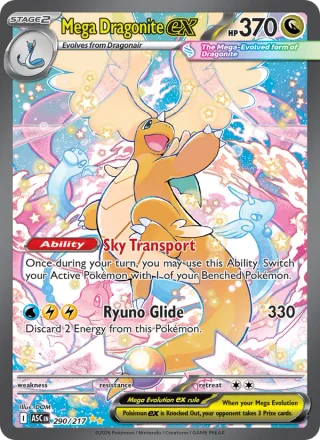
One Ascended Heroes card shows the whole arc in a single TCGplayer report. Mega Dragonite ex 290/217 ran from $500 at the start of February 2026 to $875 in June, and its Market Price was $506.15 on October 13, down $101.40 in 30 days.
TCGplayer: $500 at the start of February 2026, $875 in June, Market Price $506.15 on October 13, 2026.
Limits of this data
Evaluated prices are estimates. Across October 14 to 18, 2026, 66% to 75% of these variants were priced from a published market guide, about 16% from lowest-ask estimates, 6% to 16% from recorded sales and 2% to 3% from carried-forward prices.
Exclusions barely matter. Counting the 2,234 stamped and jumbo variants gives 49.1% under $1 and 67.1% of value at $100 or more.
Each measure has a bias. The composite is dominated by cheap variants, and the POKE baskets are indicative, launched in September 2026 and concentrated in modern sets. Vintage versus modern compares era-level windows.
Two price measures differ. TCGplayer's Market Price and Cardboard Alpha's evaluated price are built differently, so each figure is quoted against its own source and date.
This is history. A spike or a decline in 2026 says nothing about the next move of any card, and the risk and return basics cover what a price chart does not show.
Most are not. On October 18, 2026, the median priced raw Near Mint English variant cost $0.90 and 51.4% cost under $1. The high prices sit in a thin layer: the 4.2% of variants priced at $100 or more held 66.3% of the combined value, and TCGplayer's 2026 reports tie those prices to scarce listings of specific cards and bursts of demand around reveals, anniversaries and bulk buying.
What makes a Pokemon card price spike suddenly?
TCGplayer's 2026 reports point to buyers clearing the cheapest Near Mint listings, sometimes with one buyer taking 10 or more copies in a day, as with Mew ex 232/091 on June 8. Once those listings are gone, the next sales happen higher, so the Market Price can rise even when sales volume does not. Announcements, such as the June 1, 2026 reveal of the 30th anniversary reprint subset, can start the buying.
Do reprints always lower Pokemon card prices?
No. TCGplayer's October 13, 2026 report links waves of reprints to the retracement in modern singles from around July 2026, but its May 27 report found Prismatic Evolutions singles rising after an early April 2026 reprint wave. The two reports show the effect is not uniform.
Does The Pokemon Company publish how many cards it prints?
Its figures page gives a cumulative total: over 85 billion Trading Card Game cards produced as of the end of March 2026. Neither that page nor its March 27, 2025 availability notice states a print run for any single set. The notice said it was printing at maximum capacity but gave no volumes.
Does a price spike mean a card has gained value for good?
Not necessarily, and these are records, not forecasts. After peaking on June 3, 2026, the Team Up Pikachu & Zekrom-GX was about $40 lower by June 23, per TCGplayer, and Mega Dragonite ex 290/217 ran from $500 in February to $875 in June and a Market Price of $506.15 by October 13. Other moves lasted longer: Giratina VSTAR (Secret) rose from $333.25 on May 27 to $428.87 on June 23.
Sources
Price Trends: Pokémon Cards Dropping in Price - 10/13/2026, TCGplayer Official / primary source · accessed October 23, 2026
Price Trends: Pokémon Cards Climbing in Price - 06/23/2026, TCGplayer Official / primary source · accessed October 23, 2026
Price Trends: Pokémon Cards Climbing in Price - 05/27/2026, TCGplayer Official / primary source · accessed October 23, 2026
Brandon Valdez writes market analysis and sealed-product coverage for Cardboard Alpha, and comes to the Pokémon TCG market from a decade in financial planning and analysis. Brandon spent those years building budgets, forecasts, and financial models for Las Vegas hospitality and nightlife groups, rising from senior financial analyst to FP&A manager before moving into premium and VIP services leadership, and reads the card market the same way: what actually sold, what it cost delivered, and whether a sealed product's expected value survives the math. Market narrative stays separate from the numbers behind it, every source is cited inline, and each piece is fact-checked against those sources before it is published.
Brandon Valdez is a finance professional, not a licensed financial advisor. Articles under this byline describe market history and mechanics using published pricing and population data; they are informational and are not personalized investment advice.