How to Price Pokemon Cards to Sell Fast Without Underselling
Start from what the card sold for, then place the listing against the cheapest live asks. On October 9, 2026, the lowest TCGplayer ask sat a median 2.8 percent below Cardboard Alpha's sale-based price across 139 heavily traded Near Mint cards.
Price a Pokemon card from what the same card, in the same condition, sold for, then check where the cheapest live listings sit. On October 9, 2026, the lowest delivered Near Mint ask on TCGplayer sat a median 2.8 percent below Cardboard Alpha's sale-based evaluated price across 139 heavily traded cards, and below it for 119 of them.
That gap is the size of the decision. Matching the cheapest ask meant pricing at or below the lower quartile of the previous 14 days of sales for 116 of those 139 cards, and fees give back only about 13 cents of every dollar cut.
Start from sold prices, not asks
An ask is what a seller hopes to get, and a sale is what a buyer paid. TCGplayer defines its Market Price as the average of recent TCGplayer sales for a specific product in a specific condition, and its Lowest Listing as the live listing with the lowest combined price and shipping.
eBay offers the sold side too: its Product research tool reports average sold price, sold price range and sell-through rate.
Every evaluated price below is a sale-based reading of that kind. It is the median of five or more clean TCGplayer sale prints from one day, clean meaning reported by TCGplayer with a known shipping charge. Each is counted as item price plus shipping, with outliers set aside, and no guide value or ask enters it.
One day's median can still mislead. Bulbasaur 166/165 from 151 had an evaluated price of $54.99 on October 8, 2026, from six sales, and $78.83 on October 9, from five, a 43 percent rise in a day. The lowest ask read $54.97 to $54.99 on both days, and the card's 58 sales from September 26 to October 9 ran from $54.99 to $83.37.
Evaluated price $54.99 on October 8, 2026 and $78.83 on October 9; lowest ask $54.97 to $54.99 on both days.
A usable comp is a count, a date range and a spread. One number is only a starting point.
Compare like for like
A comp counts only if it matches the listing: the same condition, finish, language and printing, priced the same way. Cardboard Alpha prices each combination of card number, language, finish and condition separately, and the figures here cover English, raw, Near Mint, unstamped cards, 138 of the 139 holofoil. How far one condition step moves a price has its own guide.
Priced the same way means delivered price, item plus shipping. TCGplayer orders the listings for a product by price plus shipping, so a lower shipping charge can lift a listing above one with a lower item price.
Where the lowest ask sits
Cardboard Alpha compared the last lowest delivered ask read of October 9, 2026 with that day's evaluated price for every English, raw, Near Mint card that met one bar: an evaluated price of $15 or more built from five or more clean same-day sales. That is 139 cards in 37 sets, and the ledger holds 1,578 TCGplayer sales of them that day. Stamped and oversize variants are left out.
The lowest ask was below the evaluated price for 119 cards, equal for 5 and above for 15, the highest by 3.2 percent. The median gap was 2.8 percent below, and the middle half of cards sat between 5.4 and 0.6 percent below.
The pattern held on neighboring days. The median gap on each of October 6, 7, 8 and 9 fell between 1.8 and 2.8 percent below, across 116 to 139 cards a day. It changed little with price: 2.6 percent below on the 103 cards under $50 and 3.1 percent on the 33 from $50 to $150, with 3 more above that.
Card
Evaluated price
Lowest ask
Gap
Sales, Sept 26 to Oct 9
Charizard ex 199/165
$321.17
$300.99
-6.3%
45 sales, $291.00 to $381.63
Mega Gardevoir ex 178/132
$166.00
$163.48
-1.5%
32 sales, $164.99 to $205.48
Meowth ex 121/88
$89.91
$81.48
-9.4%
82 sales, $71.48 to $118.32
Bulbasaur 166/165
$78.83
$54.97
-30.3%
58 sales, $54.99 to $83.37
Pikachu ex 179/131
$53.32
$43.55
-18.3%
30 sales, $44.49 to $68.94
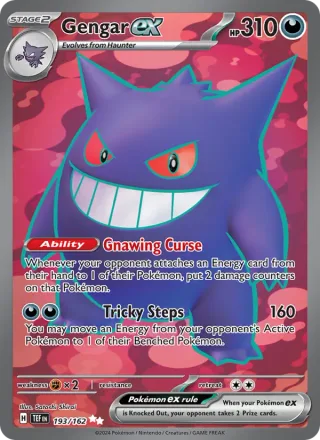
Gengar ex 193/162
$47.85
$49.00
+2.4%
26 sales, $45.00 to $58.54
Six examples from the 139, not a typical cross-section: five sit outside the middle half of gaps, and the median gap was 2.8 percent below. Bulbasaur's gap, the widest of the 139, reflects the one-day jump in its evaluated price described above, not a typical spread. Gap is the lowest ask against the evaluated price. Cardboard Alpha evaluated prices (raw, Near Mint, five or more clean same-day sales each) and TCGplayer lowest delivered asks, last read on October 9, 2026 (UTC). Sales are TCGplayer prints at delivered price, September 26 through October 9, 2026.
Evaluated price $321.17 on October 9, 2026; lowest delivered ask $300.99 at the last read of the day.
What the gap means for a listing
Cardboard Alpha also set the same asks beside the 14 days of TCGplayer sales through October 9. The lowest ask was at or below each card's median sale for 132 of the 139 cards, at or below its 25th percentile for 116, and at or below its lowest sale in the window for 15.
At the evaluated price: a listing would sit 1 to 6 percent above the cheapest ask, for the middle half of cards.
At the lowest ask: a listing would sit about 3 percent under the day's sale-based price and, for 116 of the 139 cards, in the lower quarter of the 14 days of sales.
Below the lowest ask: the listing becomes the new floor, and for 15 cards the floor already sat at or under the lowest sale in the window.
TCGplayer says listings nearer the top of its price-plus-shipping order are seen by more customers and are more likely to sell faster. Lowering shipping moves a listing up that order too. Nothing in this analysis measures how long listings take to sell at each price, so the speed claim is TCGplayer's, not a result here.
What a cut costs after fees
Fees scale with the sale price, so a cut gives back only a sliver of itself. Each dollar cut saves about 13 cents in fees, before sales tax.
As of September 22, 2026, a TCGplayer Level 1 to 4 seller pays a 10.75 percent commission plus a 2.5 percent transaction fee and $0.30. As of October 5, 2026, eBay's rate for Collectible Card Games, for sellers without a Store, was 13.25 percent plus a $0.40 order fee above $10.
On Charizard ex 199/165, listing at the $300.99 lowest ask instead of the $321.17 evaluated price gives up $20.18. On TCGplayer, treating the delivered price as the sale price and ignoring postage, proceeds fall by $17.50, from $278.31 to $260.81. What each marketplace takes from a sale shows the formulas.
As of August 25, 2026, eBay's Product research filtered sold data by listing format and counted the accepted price of a Best Offer, so its sold ranges hold negotiated closes. Its completed-listings search covered only the previous 90 days, against three years for Product research.
As of September 18, 2026, eBay's Best Offer settings turn one price into three numbers:
Buy It Now price: what a buyer pays without negotiating, and the number the auto-accept amount must stay below.
Auto-accept amount: an offer at or above it is accepted.
Minimum offer: an offer below it is declined. Buyers cannot see either limit, and in most categories they can make up to three offers per item.
Offers between the two limits wait for the seller, who has 24 hours to respond, and a counteroffer should sit between the offer and the Buy It Now price. For Meowth ex 121/88, those numbers would sit against an evaluated price of $89.91 and 82 sales that ran from $71.48 to $118.32.
When undercutting stops paying
The next cut leaves the sold range. For 15 of the 139 cards the lowest ask already sat at or under the lowest sale since September 26, as with Pikachu ex 179/131 at $43.55 against $44.49.
The floor moves. The lowest ask changed during October 9 for 121 of the 139 cards, and for 41 the day's high read ran more than 5 percent above its low read.
Repricing tools carry a floor. TCGplayer's MassPrice lets Pro Sellers reprice from Market Price or the low price, set a minimum price, and skip updates that cut a price by more than a set percentage.
Charizard ex 199/165 shows the moving floor. Its lowest ask read $291.00 at 00:02 UTC on October 9, a $291.00 delivered sale printed at 01:44, and the 04:02 read was $310.00, then $300.99 by 16:38.
Gengar ex 193/162 moved too. Its lowest ask read $46.30 until 16:33 UTC and $49.00 at 20:47, after five sales priced $46.30 to $51.78 printed within a second at 20:30.
Drift: the October 9 evaluated prices sat a median 3.9 percent below the 14-day median sale, which pushes asks below older sales.
None of this says whether to sell a particular card. Cardboard Alpha's screener shows live asks and depth across the covered catalog, and a price alert on a card notifies you when its price moves.
Frequently asked questions
Should I price a Pokemon card at the lowest listing?
The lowest delivered ask is the bottom of what is on offer, not a measure of what a card is worth. On October 9, 2026 it sat a median 2.8 percent below Cardboard Alpha's sale-based price across 139 heavily traded Near Mint cards, and at or below the 25th percentile of the previous 14 days of sales for 116 of them. Fees return only about 13 cents of each dollar cut, so the seller carries most of any discount.
What is the difference between a sold price and the lowest listing on TCGplayer?
TCGplayer defines Market Price as the average price of recent sales for a specific product in a specific condition. Its Lowest Listing is the live listing with the lowest combined price plus shipping. One looks back at completed sales and the other at what is listed.
How do Best Offer limits work on eBay?
A seller can set a minimum offer and an auto-accept amount on a fixed-price listing. Offers at or above the auto-accept amount are accepted, offers below the minimum are declined, and anything in between waits for the seller, who has 24 hours to respond. Buyers cannot see either limit, and the auto-accept amount must sit below the Buy It Now price.
Does TCGplayer rank listings by item price or by total price?
By total price. TCGplayer's seller guidance says the listings for a product are displayed in order by price plus shipping, and that listings nearer the top are seen by more customers and are more likely to sell faster. Lowering a shipping charge therefore moves a listing up the order the same way a lower item price does.
How much of a price cut do marketplace fees absorb?
About 13 cents of each dollar. As of September 22, 2026, a TCGplayer Level 1 to 4 seller pays a 10.75 percent commission plus a 2.5 percent transaction fee and $0.30, and as of October 5, 2026, eBay's Collectible Card Games rate for sellers without a Store was 13.25 percent plus a $0.40 order fee above $10. On Charizard ex 199/165, a $20.18 lower price meant $17.50 less in proceeds on TCGplayer.
How many sales make a price reliable?
Cardboard Alpha's cleanest evaluated price needs five or more clean sales on the day. With two to four it blends in a 30-day median and the best ask, and guide values are not sales. Even five can disagree with the next day: Bulbasaur 166/165 went from $54.99 on October 8, 2026 to $78.83 on October 9, so a count, a date range and a spread make a better comp than one number.
Sources
Best Practices for Pricing Your Items, TCGplayer Official / primary source · accessed October 24, 2026
Update Your Pricing with MassPrice, TCGplayer Official / primary source · accessed October 24, 2026
TCGplayer Fees, TCGplayer Official / primary source · accessed October 24, 2026
Product research, eBay Official / primary source · accessed October 24, 2026
Jay Montalbo writes about grading and selling for Cardboard Alpha. His background is in information technology, with nearly six years as an IT systems administrator and later work as an IT support analyst, and he brings the same troubleshooting habit to cards: break the problem into steps, check each one, and trust the answer only when every step holds. His articles work through when a grading submission pays for itself, how condition and grading-company standards move a card's value, and what a sale actually nets after marketplace fees and shipping, using published population reports, fee schedules, and completed-sale data. Every source is cited inline, and each piece is fact-checked against those sources before it is published.
Jay Montalbo's articles describe grading and selling mechanics using published population, fee, and pricing data. They are informational and are not personalized investment advice.