Loading author…

author
Brandon Valdez
Contributing Writer
Brandon Valdez writes market analysis and sealed-product coverage for Cardboard Alpha, and comes to the Pokémon TCG market from a decade in financial planning and analysis. Brandon spent those years building budgets, forecasts, and financial models for Las Vegas hospitality and nightlife groups, rising from senior financial analyst to FP&A manager before moving into premium and VIP services leadership, and reads the card market the same way: what actually sold, what it cost delivered, and whether a sealed product's expected value survives the math. Market narrative stays separate from the numbers behind it, every source is cited inline, and each piece is fact-checked against those sources before it is published.
Credentials
- Contributing Writer, Cardboard Alpha
- A decade in financial planning and analysis: budgeting, forecasting, and financial modeling
- Bachelor's degree in Marketing, University of Nevada, Las Vegas
- Focus areas: market analysis, sealed product
Brandon Valdez is a finance professional, not a licensed financial advisor. Articles under this byline describe market history and mechanics using published pricing and population data; they are informational and are not personalized investment advice.
Articles by Brandon Valdez

Market Analysis
Bear Markets in Pokemon Cards: What History Shows
Dated records from Hasbro's annual report, Fortune and TCGplayer show Pokemon card downturns following supply surges in 2000, 2021 and 2026. Cardboard Alpha's composites show how long the 2021 falls lasted, and its POKE baskets and July 1 slate show how uneven the 2026 fall was as of October 19 and 20, 2026.
8 min read
Market Analysis
Why Pokemon Card Prices Spike: The Mechanics of a Rally
Pokemon card prices spike when buyers outrun thin listings. TCGplayer's 2026 reports show how set reveals, rotation and bulk buying start rallies and how reprints unwind them, and Cardboard Alpha data shows where the value sat on October 18, 2026 and how the average card and the most traded cards moved apart after July 1.
7 min read
Market Analysis
Speculating on New Sets: Why Chase-Card Hype Rarely Holds
TCGplayer's price history shows 49 of 55 chase cards from 11 English sets, released from January 2025 to July 2026, below their first-weeks price on October 16, 2026, with the exceptions clustered in Black Bolt and White Flare. Elite Trainer Boxes fell into release in 10 of 11 sets, yet eight of 11 ended above their first-weeks price. This is a record of past prices and sourced supply mechanics, not a forecast.
8 min read
Market Analysis
How to Check the Value of a Pokemon Card: 5 Steps
A five-step method for checking a Pokemon card's value: identify the printing, judge the condition, compare completed sales with asking prices, count shipping and sale format, and match raw to raw and graded to graded. It works through four Charizard ex cards from Obsidian Flames, whose evaluated Near Mint prices on October 14, 2026 ran from $5.71 to $96.47, and shows how a lowest ask, a median sale, TCGplayer's Market Price and Cardboard Alpha's evaluated price compare.
7 min read
Sealed & Investing
Pull Rates Explained: How Pokemon TCG Odds Actually Work
Pull rates are measured, not published: TCGplayer studies of 1,200 to 8,500 packs report per-pack odds with confidence intervals. How to read them, why 1 in X is not a guarantee, how god packs skew them, and the 1 − (1 − p)^n math for one chase card, priced as of October 5, 2026.
7 min read
Sealed & Investing
Elite Trainer Box vs Booster Box: Which Has Better EV
Booster box vs Elite Trainer Box, priced pack by pack for Pitch Black, Chaos Rising, Phantasmal Flames and Destined Rivals: list and market price per pack, what the promo is worth, and expected card value per dollar from TCGplayer's pull rates and Cardboard Alpha's live ledger, September 30, 2026.
7 min read
Market Analysis
Tax Implications of Buying and Selling Pokemon Cards
Federal tax on Pokemon cards turns on cost basis, how long a card was held, and whether the IRS treats it as a collectible, while the IRS says Form 1099-K shows gross sales rather than profit. A worked example prices Charizard ex 199/165 at Cardboard Alpha's $332.79 evaluated price on September 30, 2026 against hypothetical costs. This is general information, not tax advice.
8 min read
Market Analysis
How Floor Price Is Calculated and Why It Moves
Floor price is not a sales average or an auction result: it is the delivered price, item plus required shipping, of the cheapest live fixed-price listing for a card. This guide walks the calculation step by step and names the four market events, a sale, a delisting, a reprice, or new cheaper supply, that move it.
6 min read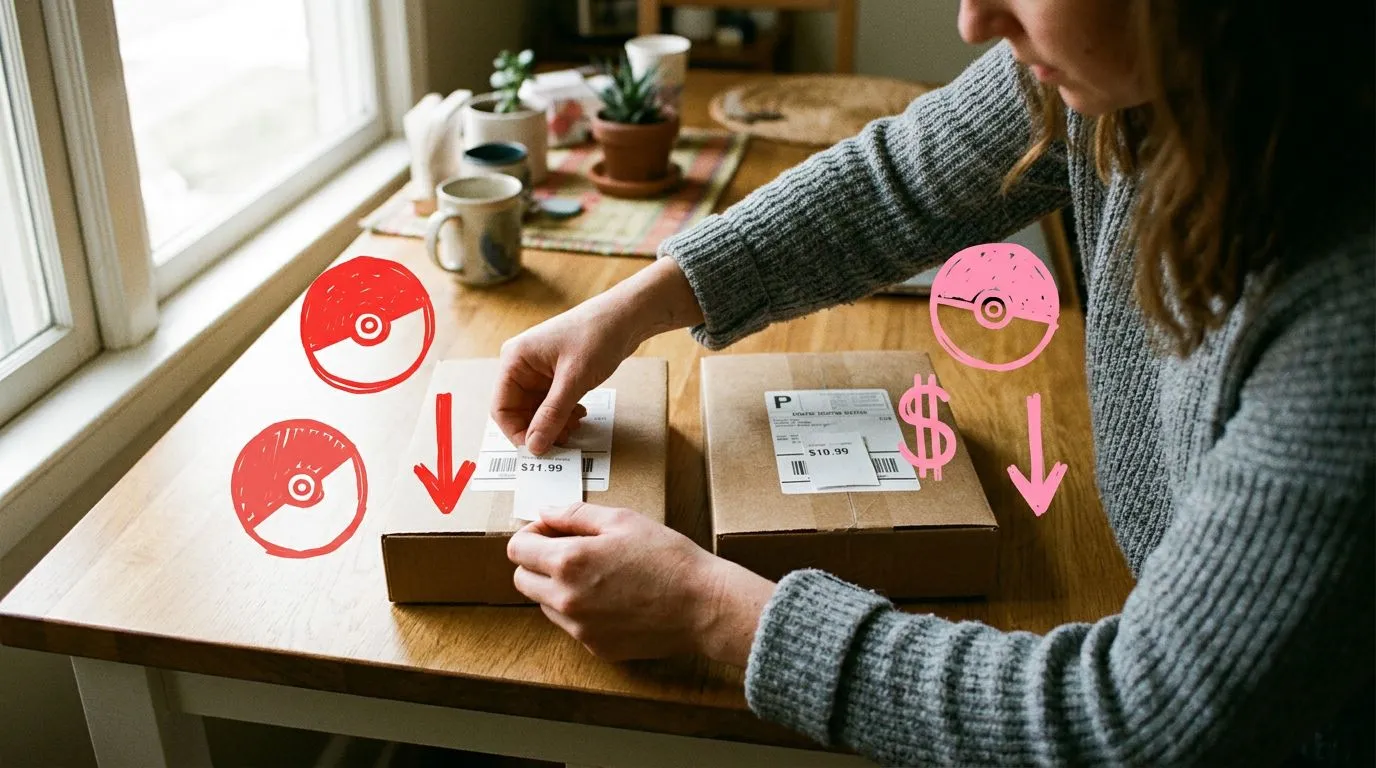
Market Analysis
Delivered Price Explained: Why Shipping Cost Changes the Real Floor
Delivered price is item price plus required shipping, and Cardboard Alpha ranks every fixed-price listing on that basis before calling anything a floor. Live TCGplayer and eBay listings read September 26 and 27, 2026 for two Charizard ex printings from SV: Scarlet & Violet 151 show sticker-price rankings reordering once shipping is added, most sharply on a $7 card where shipping, when charged, runs about 12 to 19 percent of the total.
6 min read
Market Analysis
Absorption and Depth: What Happens When You Sell Into a Thin Market
Depth measures how many listings sit near a card's best price, and absorption measures how much of that depth a specific trade actually uses. Delivered price, item plus shipping, decides which listing is really cheapest, and an auction result should never be read as a fixed-price floor.
6 min read