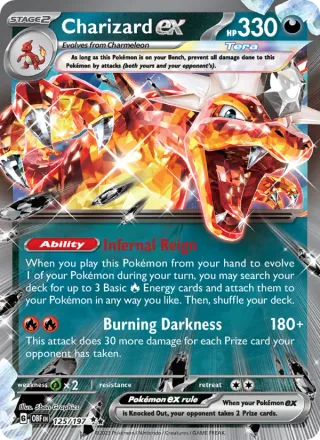
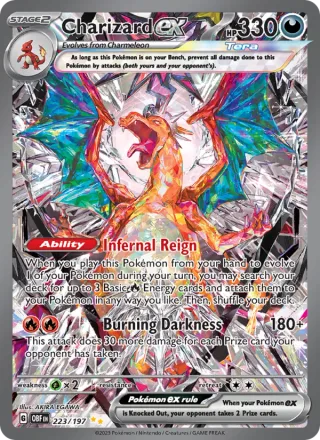
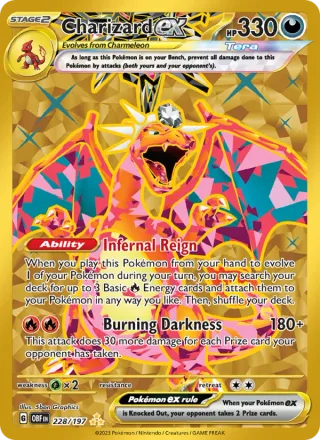
Identify the printing, judge the condition, then check what that version sold for, delivered, before looking at asking prices. On October 14, 2026, four Obsidian Flames Charizard ex cards priced from $5.71 to $96.47 in Cardboard Alpha's evaluated Near Mint prices.
To check what a Pokemon card is worth, identify the exact printing from its collector number, rarity symbol and finish, judge its condition, then compare what that version has sold for, delivered (item plus shipping), with what sellers are asking. Work in that order, because a price found for the wrong printing or condition is the wrong price.
Start with the printing. On October 14, 2026, Cardboard Alpha's evaluated Near Mint (NM) prices, a once-a-day figure built mainly from completed sales and asking prices, put four Charizard ex cards from one set, Obsidian Flames, at $5.71, $22.05, $32.87 and $96.47, a spread of about 17 times among cards with the same name and card text.
Step 1: Identify the printing
Read these off the card before searching, then search TCGplayer or eBay for the name plus the full number, such as Charizard ex 223/197, and confirm the set name on the result.
Collector number: printed on the card as 223/197, the card's number over the set's advertised size. A number above that size, like 215, 223 and 228 here, puts a card outside the advertised count, and TCGplayer notes that many sets print a lower-rarity version with identical gameplay under a different number.
Rarity symbol: on the bottom right or left of the card, a black circle is Common, a diamond Uncommon and a star Rare. The rarity symbols guide covers the extra stars and colors on newer cards.
Finish: a Rare Holo has a foil illustration, while a Reverse Holo is foil on every part of the card except the illustration. The two price separately: on October 14, 2026, Cardboard Alpha's evaluated Near Mint price for Gengar 094/165 in the 151 set was $2.88 as a holofoil and $8.63 as a reverse holofoil, about three times as much.
Edition: English Base Set came in four print runs: a stamped 1st Edition and an unstamped Shadowless, both without the drop shadow around the art, then Unlimited with it, then a later Unlimited with a 1999-2000 copyright line, per Bulbapedia. The 1st Edition versus Unlimited guide covers the price gap.
Language: check it too. Cardboard Alpha's catalog tracks language, finish, edition, stamp and size as separate attributes of each variant and prices each variant separately.
The four Obsidian Flames cards show why the number comes first.
Card
Rarity
Evaluated NM price
Same-day sales
Confidence
Charizard ex 125/197
Double Rare
$5.71
7
0.93
Charizard ex 215/197
Ultra Rare
$22.05
2
0.70
Charizard ex 223/197
Special Illustration Rare
$96.47
3
0.79
Charizard ex 228/197
Hyper Rare
$32.87
4
0.86
Cardboard Alpha evaluated prices, raw Near Mint, English standard-size holofoil prints, October 14, 2026. Jumbo and stamped versions are excluded, and same-day sales are those recorded by the end of the day. Confidence runs from 0 to 1 and is explained at the end of this guide.
TCGplayer lists all four with the same HP, attack and ability text. The Hyper Rare priced below the Special Illustration Rare, so a tier name alone does not set the price.
Special Illustration Rare. Evaluated raw Near Mint price $96.47, October 14, 2026.
Step 2: Judge the condition
TCGplayer lets sellers list a card as Near Mint, Lightly Played, Moderately Played, Heavily Played or Damaged, and it does not sell Mint or Gem Mint cards. The Near Mint versus Lightly Played guide shows how the top two are told apart.
Condition then moves the price. For the Special Illustration Rare, the evaluated ladder ran from $96.47 at Near Mint to $48.13 at Damaged on October 14, 2026.
Condition
Evaluated price
Share of NM
What it rests on
Confidence
Near Mint
$96.47
100%
3 same-day sales, 30 days of sales and the lowest ask
0.79
Lightly Played
$73.99
76.7%
1 same-day sale, the lowest ask and the prior price
0.67
Moderately Played
$63.56
65.9%
No sale: the lowest ask and the prior price
0.56
Heavily Played
$60.96
63.2%
No sale: the lowest ask and the prior price
0.60
Damaged
$48.13
49.9%
No sale: the lowest ask and the prior price
0.47
Charizard ex 223/197, Cardboard Alpha evaluated prices, October 14, 2026.
Lightly Played priced 23 percent under Near Mint and Damaged about half. Sales thin out as condition drops, so the three lowest rows lean on asking prices and the prior price, and their confidence is lower.
Step 3: Compare sales with asking prices
An asking price is what one seller wants and a sale is what a buyer paid. TCGplayer says its Market Price is compiled from recent sales completed on its marketplace, and that its Listed Median, a median of listed prices only, can vary significantly from what people pay. It adds that a product page's price points follow the printing and condition filters selected, so set both before reading one.
eBay's Price Guide, offered to US users, is built from completed eBay sales matched to the same card and, when available, the same grade. You reach it from My eBay or through See insights on a trading card listing. It uses accepted Best Offer prices rather than listed prices, refreshes every 24 hours, and notes that actual prices may still vary with condition, timing and demand.
Number
What it measures
October 14, 2026
Lowest ask
Lowest delivered Near Mint ask on TCGplayer, three reads
$86.95 to $89.99
Median sale
24 TCGplayer sales in Cardboard Alpha's sales ledger, October 8 to 14, delivered
$95.44
Market Price
TCGplayer's figure, compiled from completed sales
$93.83
Evaluated price
Cardboard Alpha's one number for the day
$96.47
Charizard ex 223/197, Near Mint. The TCGplayer reads were taken at 06:48, 14:12 and 21:24 UTC, and the Market Price is the 06:48 UTC read.
The lowest ask sat 7 to 10 percent under the evaluated price; a floor is one seller's listing, not a typical price. The 24 sales ran from $73.63 to $112.74 delivered, so one sale is not a price either.
Across all four Charizard ex cards, the lowest ask, median sale, Market Price and evaluated price each landed within 14 percent of the others. On liquid cards like these, a wider gap is a cue to recheck the printing and condition first. How a floor price is calculated explains why the lowest ask moves.
Hyper Rare. Evaluated raw Near Mint price $32.87, October 14, 2026.
Step 4: Count shipping and sale format
Compare delivered prices, meaning the item price plus required shipping. Five TCGplayer sales of the Special Illustration Rare in Cardboard Alpha's sales ledger are dated October 14, with item prices from $90.00 to $108.75 and free shipping on three, $3.99 on one and $8.49 on one. Three of them had been recorded by the end of that day, so the first table counts three same-day sales.
The sale with the lowest item price, $90.00, delivered at $98.49, which made it the second-lowest delivered price behind a $94.27 sale that shipped free. Delivered price explained covers why Cardboard Alpha ranks listings that way.
Then keep formats apart. An eBay result can be an auction, a fixed price or an accepted Best Offer, and Cardboard Alpha keeps auction results out of fixed-price floors. Auction versus Buy It Now covers the mechanics.
Step 5: Match raw to raw, graded to graded
A graded price belongs to one grader and one grade. On October 14, 2026, Cardboard Alpha's 90-day median for PSA 10 copies of the same card was $710.00, 7.4 times the raw Near Mint price, and $125.00 for PSA 9, 1.3 times.
Those are medians of the item prices, before shipping, of 163 PSA 10 sales dated August 15 to October 14 and 190 PSA 9 sales dated August 24 to October 14. They blend auction, fixed-price and Best Offer sales on eBay and Fanatics Collect, so they show where copies changed hands, not a floor, and they move more slowly than a daily raw price. The grading scale guide lines up what each grade means.
Charizard ex 223/197 evaluated price by condition and grade
Damaged$48.13
Heavily Played$60.96
Moderately Played$63.56
Lightly Played$73.99
Near Mint$96.47
PSA 9$125
PSA 10$710
Cardboard Alpha evaluated prices, October 14, 2026. Raw rows are daily prices; PSA rows are 90-day medians of recorded sale prices before shipping.
A raw copy is priced from the raw ladder in Step 2, never from a slab.
What an evaluated price rests on
Cardboard Alpha computes one evaluated price per card, condition and day under a versioned policy, builds it on delivered prices where shipping is known, and states the evidence behind it. A confidence score from 0 to 1 travels with every price.
Evidence on the day
How the price is formed
Confidence ceiling
Five or more sales
The middle of those sales, with extremes limited
1.00
Two to four sales
Blended with 30 days of sales and the lowest ask
0.90
One sale
Blended with the lowest ask, the prior price and comparables
0.80
TCGplayer's daily sold range
The midpoint of the day's low and high sale
0.75
No sale
The lowest ask averaged with the prior price
0.60
A published guide price
No sale behind it
0.45
An earlier price
Carried forward, with confidence decaying daily
Decays
Within a rung, confidence rises with more same-day sales, more sales in the last 30 days, more distinct sellers and closer agreement between sources. A missing input lowers it instead of being filled with a neutral value. Compare Charizard ex 125/197, at 0.93 on seven same-day sales, with the Damaged copy of 223/197, at 0.47 with none.
When nothing supports a price, it is left empty. A day's price is written as provisional and made final three days later, and every evaluated price here is final.
Rechecking on a card page
A Cardboard Alpha card page carries prices by condition and grade, the Live Listings panel with delivered prices where shipping is known and, on wide screens, the Sales Tape of completed sales. Together they cover the condition, ask, sale, shipping and grade checks in Steps 2 to 5. The evaluated prices quoted here are a separate once-a-day series and can differ from a card page's live figures.
Every figure in this guide is a dated read of past prices, not a forecast. To compare price, liquidity and supply across many cards at once, open the Cardboard Alpha screener.
Frequently asked questions
How do I find out what my Pokemon card is worth?
Identify the exact printing from the collector number, rarity symbol and finish, judge its condition, then look at completed sales for that printing and condition, delivered. The printing comes first: on October 14, 2026, Cardboard Alpha's evaluated Near Mint prices for four Charizard ex cards from one set ran from $5.71 to $96.47. Keep asking prices and graded prices out of the comparison.
Is TCGplayer's Market Price what I would get for my card?
Not exactly. TCGplayer says Market Price is compiled from completed sales on its marketplace and that its price points follow the printing and condition filters selected, so it is a benchmark for a printing and condition rather than a quote for one copy. At 06:48 UTC on October 14, 2026, it read $93.83 for Near Mint Charizard ex 223/197, against a $95.44 delivered median of 24 TCGplayer sales dated October 8 to 14.
Do asking prices show what a Pokemon card is worth?
Not on their own. TCGplayer says its Listed Median, a median of listed prices, can vary significantly from what people pay, and eBay builds its Price Guide from completed sales instead. On October 14, 2026, TCGplayer's lowest delivered Near Mint ask for Charizard ex 223/197 read $86.95 to $89.99 across three reads, against a $96.47 evaluated price.
Does a PSA 10 price tell me what my raw card is worth?
No. A graded price belongs to one grader and one grade, and for Charizard ex 223/197 Cardboard Alpha's 90-day median of PSA 10 sale prices, before shipping, was $710.00 on October 14, 2026, against $96.47 for a raw Near Mint copy. Even PSA 9, at $125.00, sat above the raw price, so a raw copy is priced from the raw condition ladder.
What does the confidence number on an evaluated price mean?
It is a score from 0 to 1 that rises with the evidence behind a price. Each method has a ceiling, such as 1.00 for five or more same-day sales and 0.60 for a price built from the lowest ask and the prior price, and a missing input lowers the score. A higher number means the price rests more on completed sales; it does not predict where the price goes next.
Why do two sites show different prices for the same card?
They can measure different things, such as a lowest ask, a median of completed sales or a blend, for a given printing, condition and moment. TCGplayer updates Market Price as transactions complete, while eBay says its Price Guide data refreshes every 24 hours. On October 14, 2026, four measures of one Near Mint card ran from $86.95 to $96.47.
Sources
What are the rarities of Pokémon TCG cards?, TCGplayer Official / primary source · accessed October 23, 2026
What do the different price points on TCGplayer.com mean?, TCGplayer Official / primary source · accessed October 23, 2026
Card Conditioning Overview, TCGplayer Official / primary source · accessed October 23, 2026
Brandon Valdez writes market analysis and sealed-product coverage for Cardboard Alpha, and comes to the Pokémon TCG market from a decade in financial planning and analysis. Brandon spent those years building budgets, forecasts, and financial models for Las Vegas hospitality and nightlife groups, rising from senior financial analyst to FP&A manager before moving into premium and VIP services leadership, and reads the card market the same way: what actually sold, what it cost delivered, and whether a sealed product's expected value survives the math. Market narrative stays separate from the numbers behind it, every source is cited inline, and each piece is fact-checked against those sources before it is published.
Brandon Valdez is a finance professional, not a licensed financial advisor. Articles under this byline describe market history and mechanics using published pricing and population data; they are informational and are not personalized investment advice.