Five equal-weighted baskets of sealed product — Vintage, Classic, Mid, Modern and everything still in print — chain-linked week by week and rebased to 100, so changing members never move a line on their own. Which vintage of sealed is actually being repriced, and is new supply still arriving while it happens?
Leading era, 30 days+5.9%
In print leads sealed over the last four weeks.
In print vs out of print+10.1 pts
New product on shelves is outrunning what is already out of print.
Supply read5385 lots
Distributor shelves read normal; retail counts sit beside each era below.
Current ranks
- 1Modern8 products · 55 weeks150.4-4.2%
- 2Vintage18 products · 3 weeks101.7—
- 3Classic20 products · 3 weeks101.6—
- 4
In print vs out of print
Supply today
- Vintageno four-week comparison yet
- 84 lots · 0 in stock
- Classicno four-week comparison yet
- 15 lots · 0 in stock
- Midno four-week comparison yet
- 1412 lots · 0 in stock
- Modernno four-week comparison yet
- 2443 lots · 0 in stock
- In printno four-week comparison yet
- 1431 lots · 0 in stock
Distributor lots listed and retail SKUs reading in stock — counts, never prices. A shelf we have not read is an em dash, not a zero.
Multiple of MSRP
Top 100 sealed
The 100 most valuable sealed products this platform prices, by last week’s median, with their basket, set, four-week move and multiple of MSRP.
| Image | Product | Era | Set | Kind · MSRP | |||
|---|---|---|---|---|---|---|---|
| 1 |  XY Evolutions Booster Box Case — vendor product photo XY Evolutions Booster Box Case — vendor product photo | XY Evolutions Booster Box Case | $15,444.44 | Mid | Evolutions | Booster case | — |
| 2 | 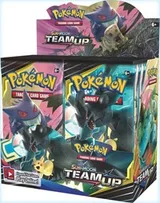 Team Up Booster Box — vendor product photo Team Up Booster Box — vendor product photo | Team Up Booster Box | $11,725.00 | Mid | Team Up | Booster box | — |
| 3 |  Paldean Fates Booster Bundle Display Case — vendor product photo Paldean Fates Booster Bundle Display Case — vendor product photo | Paldean Fates Booster Bundle Display Case | $8,999.99 | Modern | Paldean Fates | Display | — |
| 4 | 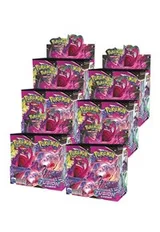 Fusion Strike Booster Box Case — vendor product photo Fusion Strike Booster Box Case — vendor product photo | Fusion Strike Booster Box Case | $6,538.79 | Modern | Fusion Strike | Booster case | — |
| 5 |  TAG TEAM Tin Case — vendor product photo TAG TEAM Tin Case — vendor product photo | TAG TEAM Tin Case | $6,449.95 | Mid | Team Up | Tin | — |
| 6 | 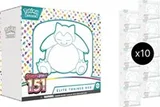 151 Elite Trainer Box Case — vendor product photo 151 Elite Trainer Box Case — vendor product photo | 151 Elite Trainer Box Case | $6,183.33 | Modern | 151 | Elite Trainer Box | — |
| 7 | 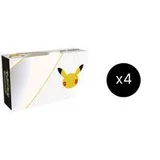 Celebrations Ultra-Premium Collection Case — vendor product photo Celebrations Ultra-Premium Collection Case — vendor product photo | Celebrations Ultra-Premium Collection Case | $5,888.88 | Modern | Celebrations | Ultra Premium Collection | — |
| 8 | 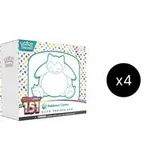 151 Pokemon Center Elite Trainer Box (Exclusive) Case — vendor product photo 151 Pokemon Center Elite Trainer Box (Exclusive) Case — vendor product photo | 151 Pokemon Center Elite Trainer Box (Exclusive) Case | $5,800.00 | Modern | 151 | Elite Trainer Box | — |
| 9 | 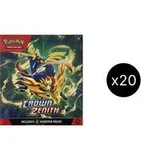 Crown Zenith Booster Bundle Case — vendor product photo Crown Zenith Booster Bundle Case — vendor product photo | Crown Zenith Booster Bundle Case | $5,549.00 | Modern | Crown Zenith | Booster bundle | — |
| 10 |  Furious Fists Booster Box — vendor product photo Furious Fists Booster Box — vendor product photo | Furious Fists Booster Box | $4,717.50 | Mid | Furious Fists | Booster box | — |
Method & caveats
Built by a weekly pipeline step, Sunday night (last run 2026-09-27), never read live: a sealed product's price lives in the same candle table this platform's other daily reads run against, and every aggregation here runs in Postgres so the request-time read stays a single small select.
A week needs 8 members priced in both weeks before it produces a move; below that the level carries and then the line breaks. A break is the honest answer — never a flat stretch invented out of missing evidence. The full method below.
Questions
What is the Sealed Index?
Five baskets of sealed product — Vintage, Classic, Mid, Modern and still-in-print — each holding that era's 20 most valuable sealed products, equal-weighted and rebased to 100. It measures how sealed prices move, not how much sealed costs.
Why group by era rather than by product type?
A 1999 booster box and a box printed last month are different assets with different supply. Era separates them; product type does not. The second chart mode compares booster boxes, ETBs and packs for readers who want that cut instead.
Why chain-linked, and not just an average price?
An average of whatever was priced today moves when the basket changes, not when the market does. Each week's move is the equal-weighted mean of its members' returns, measured only on products priced in BOTH weeks — so a product joining or leaving cannot move the level.
What counts as "in print"?
A product whose set was released within the last 548 days — the outer edge of the 12-to-18-month print run this platform's set-lifecycle work documents. A set with no release date on file is never called in print.
How is supply measured?
Two counts, never a price: distributor lots listed on the public wholesale catalogues we read, and retail SKUs reading in stock. Both are proxies for availability, attributed by matched set or product — never by parsing a listing title.
How much evidence stands behind a line?
1167 priced products across 15 kinds and 113 sets, 2025-09-08 through 2026-09-27. A week needs 8 members priced in both weeks to produce a move; below that the level carries for at most 4 weeks and then breaks. Rebuilt weekly (Sunday night); this build ran 2026-09-27.
Method
What this measures
Five baskets of sealed product. Four are era groups — Vintage (WOTC), Classic (EX, DP, HGSS), Mid (BW, XY, SM) and Modern (SWSH, SV, MEGA). The fifth, “In print”, holds every product whose set was released within the last 548 days and is taken OUT of its era group, so the five partition the catalogue rather than counting the newest product twice. Each basket holds that era's 20 most valuable sealed products, chosen once a month and equal-weighted.
How the level is built, and why it is not an average
Each product gets one price a week: the median of its candle days in that week. The week's basket move is the equal-weighted geometric mean of its members' log returns, measured only over products that carried a price in BOTH weeks. Levels are that chain of weekly moves, rebased to 100 at each basket's own first measurable week.
Two properties follow, and both matter. A product joining or leaving the basket cannot move the level, because it has no return to contribute in the week it arrives. And a writer that prices different products on alternate days cannot make the line saw, because both days land in the same weekly bucket. The previous construction had neither property — it published the mean price of whatever was priced that day — and both defects were visible on the published chart before this rebuild.
Floors, carries and gaps
A week with fewer than 8 members priced in both weeks produces no move at all. The level carries forward for at most 4 weeks and then publishes nothing — the line breaks. One member's weekly log return is clamped to ±0.5 (about +65% / −39%) before it is averaged, so one mis-scraped price cannot carry a twenty-member basket. The product-kind chart only draws kinds with at least 8 members.
The Top 100 board
Ranked by last complete week's median price alone — not by the price × activity weight the baskets are selected with. The two answer different questions, and a board headed "Top 100 sealed" that dropped a $15,000 Evolutions case because nobody recorded a sale that week would be a board about our sales coverage rather than about the market.
Prices
Every price is the candle's own market guide — TCGplayer first, then the guide relay, then a sold low/high midpoint, then the sold-median bridge. Never a delivered price, never a modelled one. Only English products this platform has classified into a product kind are included; a provider label we could not classify is excluded honestly rather than filed under a guess.