live delivered asks
Basil Hawkins stands in a long pale coat against a murky green backdrop, with tarot cards floating around him, a fitting look for the Straw Hat rival
Insufficient data
No priced bars on file for this instrument yet.
as of — · UTC
Basil Hawkins (CS 2023 Top Players Pack) — ST02-010-cs-2023-top-players-pack · 1DC——plotting daily medianitem price
Vol — sold·— prints·— obs
Insufficient data
No fair-value component could be computed for the trailing 30d window (no confirmed prints, no ask ladder, no trend anchor, no completed auctions). No point estimate is offered.
Nothing is listed for sale, so there is no book for one buyer to move.
VenuesTCGplayer
The absorption ladder walks the visible delivered-price ask book cheapest-first: what each slice of the book costs, the ask it leaves marginal, and how far that sits from the last price the card actually traded at. Manipulation risk is the worse of two reads — how many days of this card’s own turnover it would take to absorb the cost of control, and whether the whole buyable book fits inside a single ordinary order.
0 units listed — no 30-day sales pace to measure them against.
A set needs at least three cards carrying a price, a graded population and a pull rate at once before its print scale means anything. this set does not reach that, so there is nothing to rank this card against.
Graded population is print run × how often anyone bothers grading it, and the second factor moves with VALUE — so population is divided by price^0.606, the elasticity fitted across 3,826 cards that carry a population, a price and a pull rate at once. That normalised count is turned into a SET pack scale using the card’s pull rate (every card in a set is an independent read on how many packs exist, pooled by median), then brought back down to this card by its own pull rate. The band is a tertile of the result across every card that clears the gates.
Nobody has ever published a Pokémon print run, and this does not recover one — it is an ORDER, not a count. It reads surviving graded supply across PSA, CGC and ACE, so ungraded and sealed stock are invisible to it. What it is checked against: the model puts Black & White at the bottom of the catalog and modern Scarlet & Violet at the top, which is where the smallest and largest print runs actually are.
125 of this set’s 151 sealed products carry a price; none carries a recorded MSRP to measure appreciation against.
| EvidenceEvidenceWhat kind of fact this row is. A completed sale, a live ask and a calculated guide price are three different weights of evidence about the same number, and this column is the difference between them. | ObservedObservedThe day the fact was read — not the day the underlying event happened, and not today. An old date is an old reading. | AgeAgeHow long ago this row was read, as of the moment the page was computed. | ConfidenceConfidenceHow much weight this row carries where it feeds a model, from the resolver that matched it. Lower means a looser match or a thinner source, and a low-confidence row is reweighted rather than dropped. | ModelledModelledYes = a CALCULATED value (a guide price, an estimate); No = something actually observed (a sale, a listing, a census count). A modelled row is evidence about a model, not about the market. |
|---|
No signal reported, so there is nothing to add up yet. That is under half the model, so no call is made on it.
Not reading yet: value vs fair, price trend, money flow, book pressure, liquidity, relative strength, grading upside, manipulation risk, seller concentration, reprint risk, scarcity.
The bottom line is a weighted mean of the signals that reported, renormalised so their weights sum to 1. Nothing defaults to a neutral 50: an input with no evidence is reweighted away and its absence is charged as a confidence penalty. Risk rows (manipulation, concentration, reprint) enter inverted. Data quality carries no weight at all — it decides whether the verdict may be spoken, because knowing a lot about a card is not a reason to buy it. Competitive meta sits OUTSIDE the weighted mean as a capped bonus added after it: a card nobody plays is never marked down for that, and a card the meta is built on can be marked up for it.

Appreciation vs MSRP
ProductPriceMSRPvs MSRPEvery sealed product the catalog holds for this set, ordered by how standard a unit each is for tracking a set’s sealed price. PRICE is the product’s last stored day — a sale where one was recorded, the provider’s daily guide value where none was, and the row’s hover says which. MSRP is blank wherever no source is recorded against one, because an MSRP with nobody behind it is not a fact. VS MSRP is the price against that MSRP, as a percentage up to a doubling and as a multiple past it.Sealed product from One Piece Promotion Cards — the set this card was printed in. We track which set a product belongs to, not which cards are inside it. Appreciation is each product’s last stored price against its own recorded MSRP, in percent. The card’s call is the MEDIAN of those percentages across the products that have an MSRP — a median rather than a mean, so one outlier SKU cannot carry a whole set — and a product with no MSRP on file is left out of that aggregate rather than counted as zero; it still lists below with its price. MSRP is somebody’s assertion rather than a published dataset, so it is shown only where a source is recorded against it, and that source is on the row’s hover. The bands are a legend for the percentage the card prints beside them: within ±5% is at MSRP, which is this repo’s own fair-value tolerance; up to +25% is a slight premium; up to +100% a significant one; at or above +100% the price has at least doubled and the figure is stated as a multiple, because a four-digit percentage is not a number anybody reads. Each price line takes a day’s observed low/high sale range and plots its midpoint; on a day with no recorded sale it carries the provider’s own daily guide value instead — a quoted price, not a transaction — and those days are drawn dashed, never described as trades. Every line is indexed to its own first stored day = 100, so the chart compares appreciation between products rather than price levels: a booster pack and a booster box cannot honestly share a dollar axis.
151 sealed products in this set, and no retailer has ever been read for any of them — which is not the same as sold out.
Each row is one tracked retailer's most recent reading of one of the set's sealed products, at that retailer's own SKU. A restock is an observed OUT_OF_STOCK → IN_STOCK transition in that SKU's reading history, never a change we inferred from a price or a gap. Shelf prices are pre-tax and exclude shipping, so they are not delivered prices and are never fed into a floor.
1 reading of this book so far, one per 1 day. The direction reads once there are enough of them to tell a drawdown from noise.
Each reading counts the cheapest asks on offer at that instant: how many copies they hold, across how many asks, from how many sellers. It is the cheap end of the book, not the book — the venue lists more, and those asks are not counted here. Sold units are confirmed prints from the live tape over the same span, and are shown only when the tape reaches back past the first reading.
No accumulation or distribution verdict is offered. A rise or fall in a fixed-size window onto the cheapest asks is a fact about the window: the copies inside it grow when multi-copy sellers price into the cheap end, whether the book behind it is growing, shrinking or flat. The verdict returns when a reading carries the venue’s own total for the book rather than the size of our sample.
95.6% of card lines in these decklists matched a card in our catalog; an unmatched line is never counted. Online events only, not Regionals or Worlds. Tournament results →
| CatalogCard identity: set, number, rarity, finish, release date. It dates from the printing itself, so an old reading here is expected and is not staleness. | Sep 30, 2022 | 4.1y | 98% | No |
| Live askA copy offered for sale right now. An ask is what a seller wants, not what anyone paid — it bounds the price from above until it clears. | Oct 25, 2026 | 6d | 90% | No |
| Price statisticAn observed figure computed over several rows rather than one print — a delivered floor, a published median over a window. | Oct 25, 2026 | 6d | 90% | No |
| Inventory countHow many copies and listings stand on the book. What depth, supply and absorption are measured against. | Oct 25, 2026 | 6d | 70% | No |
| # | Card | Trend 30DTrend 30DThe last 30 days of price, drawn from a zero-independent scale. The shape is the reading — the level is the Price column beside it. | PricePriceThe card’s current market price as the wall quotes it (an item price, before shipping). | 30d vol30d volume30d volumeDollars traded over the last 30 days — units sold each day times that day’s price, summed. The same figure the wall sorts by, and the order this list is in. |
|---|---|---|---|---|
| 1 | LokiOP17-119The World's Strongest WarriorsOP17-119 · SEC | $16.00The card’s current market price as the wall quotes it (an item price, before shipping). Source: sales median · item.-36.0% | $40.3k$40,314.84 traded in the last 30 days. |

Ranked by dollars traded over 30 days · refreshed hourly
The whole wall →| 2 | Rocks.D.XebecOP17-118The World's Strongest WarriorsOP17-118 · SEC | $13.75The card’s current market price as the wall quotes it (an item price, before shipping). Source: sales median · item.-33.1% | $34.2k$34,155.92 traded in the last 30 days. |
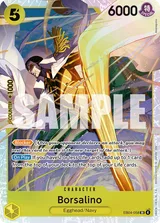
| 3 | BorsalinoEB04-058Adventure on Kami's IslandEB04-058 · SR | $32.00guideThe card’s current market price as the wall quotes it (an item price, before shipping). Source: guide · item.+12.1% | $32.0k$31,973.35 traded in the last 30 days. |
| 4 | MamaraganOP15-078Adventure on Kami's IslandOP15-078 · SR | $25.47guideThe card’s current market price as the wall quotes it (an item price, before shipping). Source: guide · item.-2.0% | $31.3k$31,293.54 traded in the last 30 days. |
| 5 | Marshall.D.TeachOP16-119The Time of BattleOP16-119 · SEC | $23.37guideThe card’s current market price as the wall quotes it (an item price, before shipping). Source: guide · item.-6.0% | $27.9k$27,875.44 traded in the last 30 days. |
| 6 | NamiEB02-017Extra Booster: Anime 25th CollectionEB02-017 · R | $17.00The card’s current market price as the wall quotes it (an item price, before shipping). Source: sales median · item.-15.0% | $20.1k$20,075.79 traded in the last 30 days. |
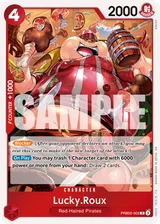
| 7 | Lucky.RouxPRB02-003Premium Booster -The Best- Vol. 2PRB02-003 · R | $20.92guideThe card’s current market price as the wall quotes it (an item price, before shipping). Source: guide · item.+169% | $19.4k$19,394.85 traded in the last 30 days. |
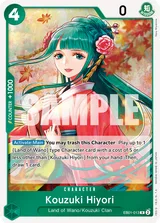
| 8 | Kouzuki HiyoriEB01-013Extra Booster: Memorial CollectionEB01-013 · R | $17.75guideThe card’s current market price as the wall quotes it (an item price, before shipping). Source: guide · item.+344% | $19.2k$19,245.52 traded in the last 30 days. |
| 9 | Monkey.D.Luffy (Super Leader Alternate Art)OP17-079-super-leader-alternate-artThe World's Strongest WarriorsOP17-079-super-leader-alternate-art · L | $1,383.43guideThe card’s current market price as the wall quotes it (an item price, before shipping). Source: guide · item.-20.3% | $18.0k$17,989.64 traded in the last 30 days. |
| 10 | Roronoa Zoro (SP)EB04-007-spThe World's Strongest WarriorsEB04-007-sp · SR | $372.20guideThe card’s current market price as the wall quotes it (an item price, before shipping). Source: guide · item.-2.8% | $17.3k$17,267.61 traded in the last 30 days. |
| 11 | Monkey.D.Luffy (SP)ST31-004-spThe World's Strongest WarriorsST31-004-sp · SR | $544.62guideThe card’s current market price as the wall quotes it (an item price, before shipping). Source: guide · item.-30.6% | $17.2k$17,219.64 traded in the last 30 days. |
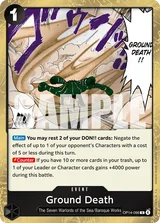
| 12 | Ground DeathOP14-096The Azure Sea's SevenOP14-096 · R | $11.72guideThe card’s current market price as the wall quotes it (an item price, before shipping). Source: guide · item.+22.1% | $16.9k$16,886.75 traded in the last 30 days. |